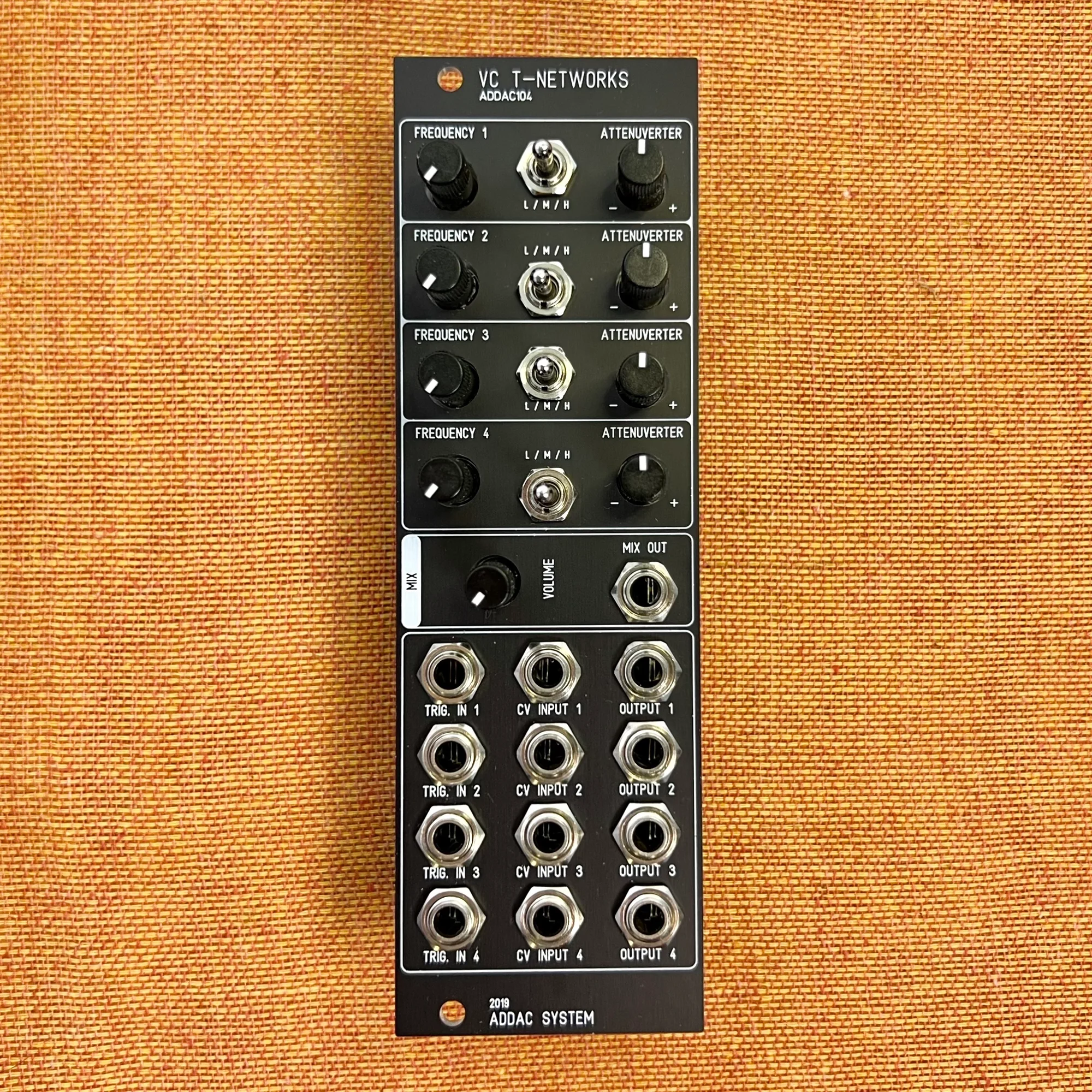
This is an introduction to the ADDAC104 VC T-Networks by ADDAC System, available at Takazudo Modular.
The ADDAC104 VC T-Networks is a module that generates four voices of percussion sounds described as click/blip sounds. The frequency of each voice can be controlled via knobs and CV input.
This product is available as an assembled unit built by ADDAC System, as well as a DIY kit.
This product is available for purchase below.
Takazudo Modularではマニュアル等の日本語訳付きを作成し、公開しています。以下よりご参照下さい。
- Product Photos: Assembled
- Product Photos: DIY Kit
- What is the ADDAC104 VC T-Networks?
- Basic Operation and Three Sound Types
- Use Cases for the ADDAC104
- Reference Video
- Manual
- Technical Specifications
- Included Accessories
- DIY Guide
Product Photos: Assembled
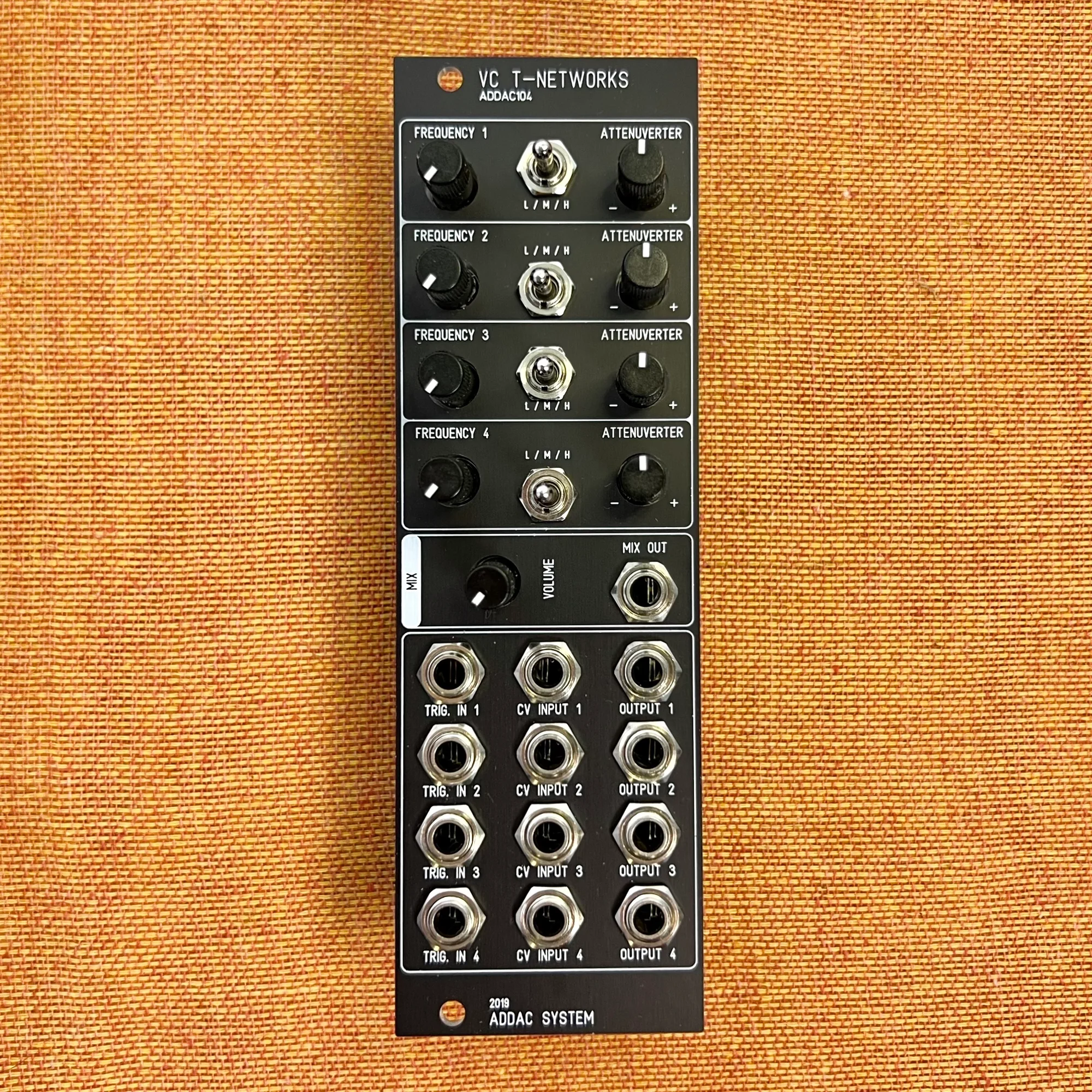
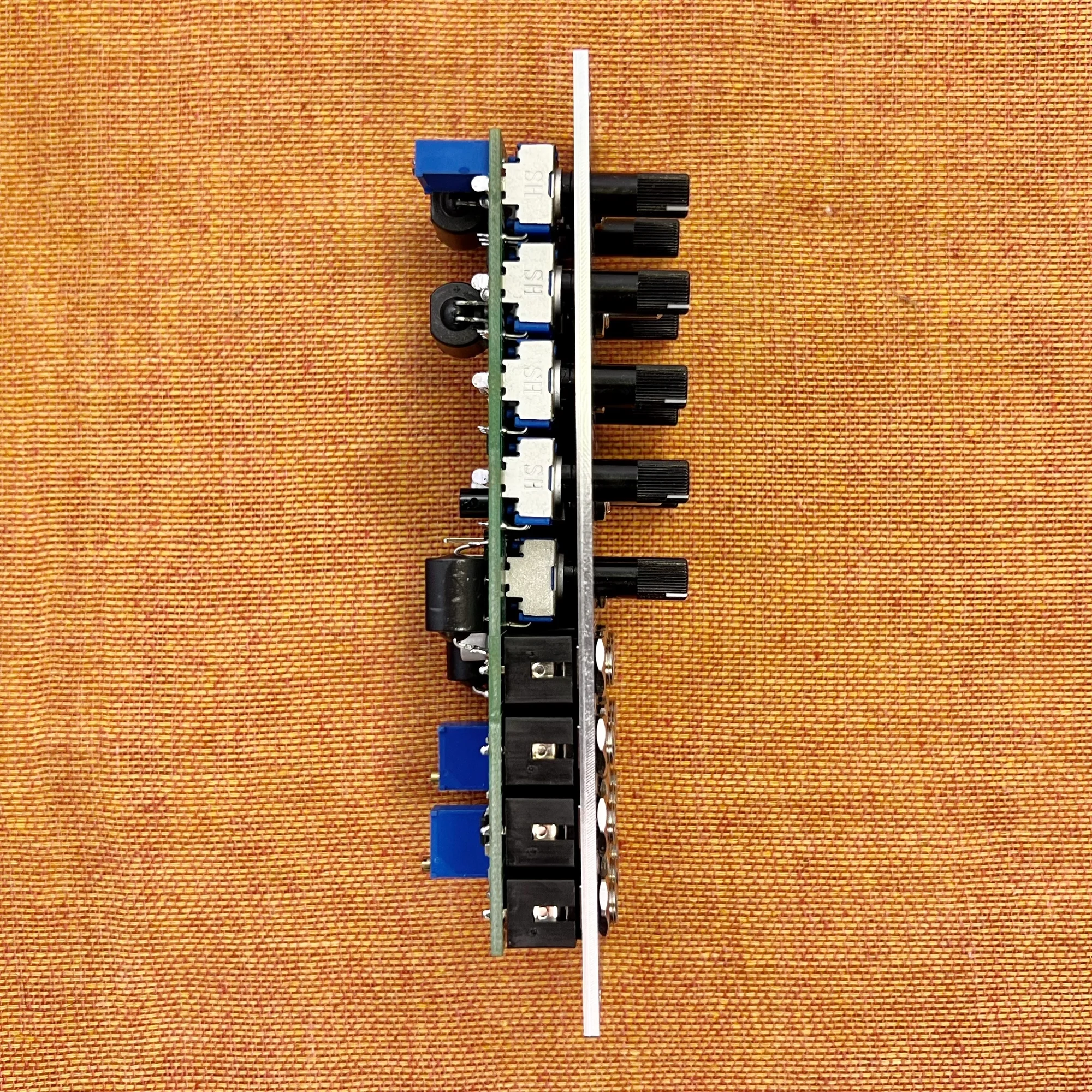
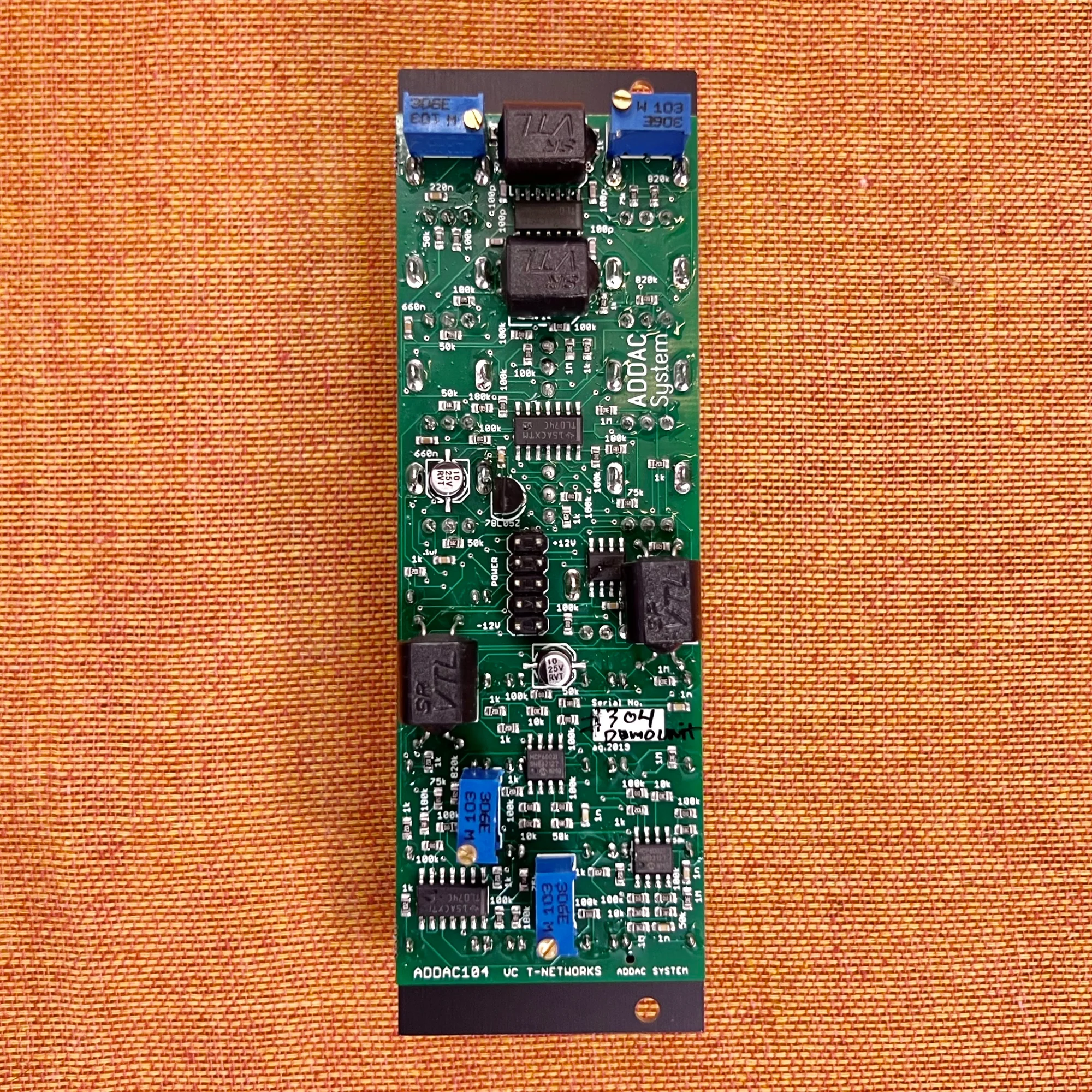
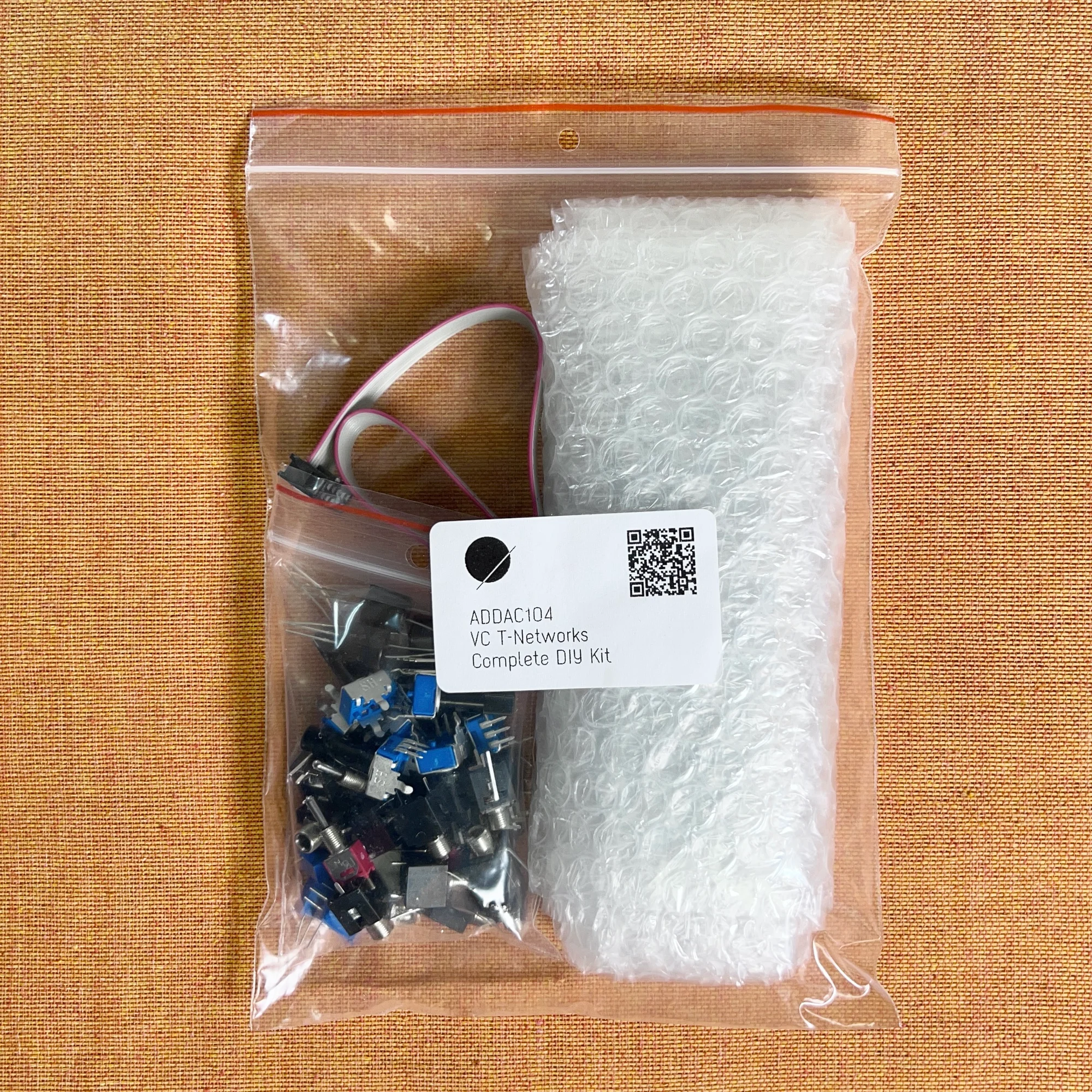
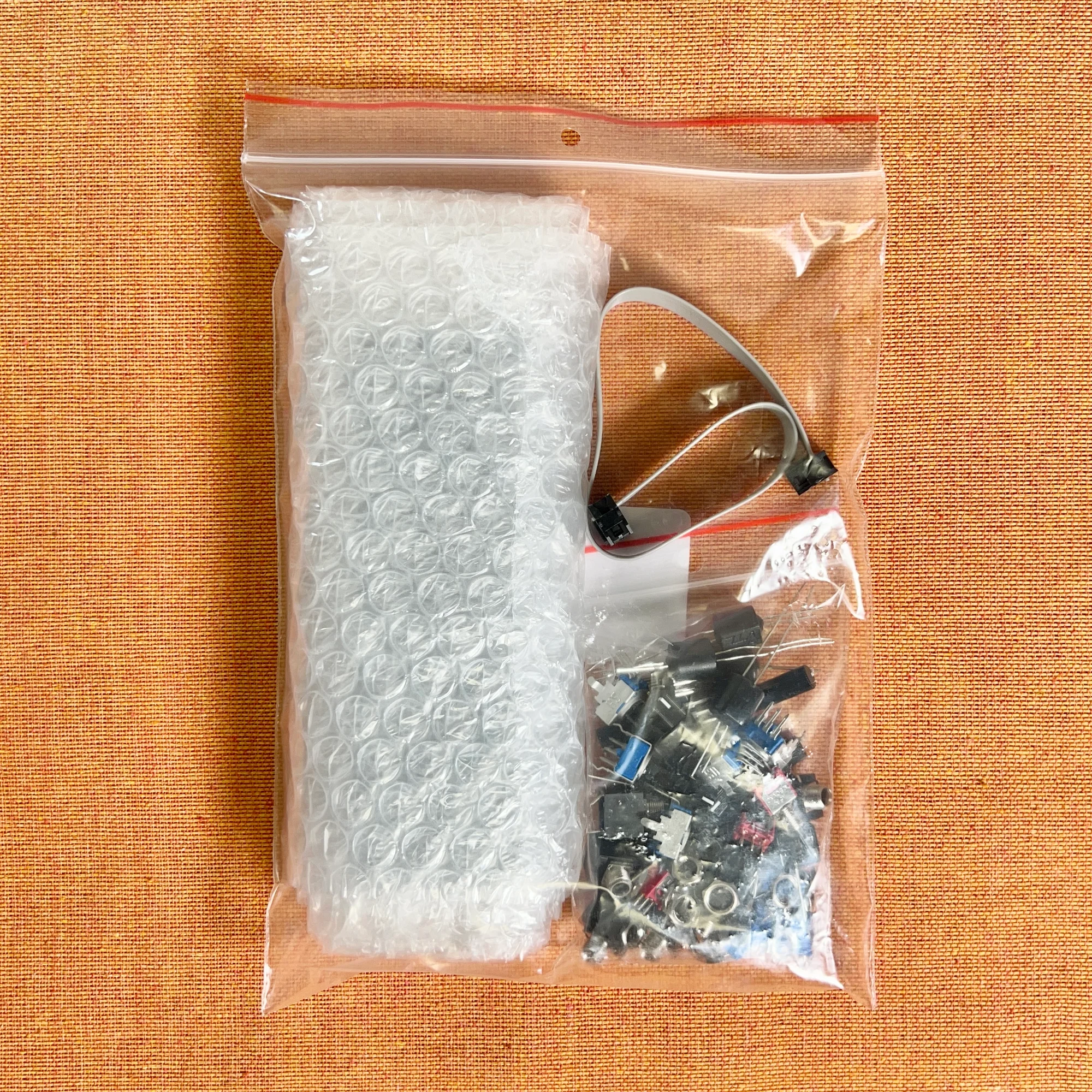
Product Photos: DIY Kit
What is the ADDAC104 VC T-Networks?
When you hear “four click sounds,” it might be hard to picture what that means. The best way to understand the sound is to watch the demo videos below, but to put it in terms that most people can relate to: think of it as four parts of TR-808 kick drum-like percussion sounds, each individually adjustable.
The “T-Networks” in this module’s name refers to T-shaped networks, which are sets of circuits combining resistors and capacitors. What they do is act as notch filters that attenuate specific frequencies. The technique of combining two of these T-shaped networks to create sounds has been widely adopted in classic drum machines. Upon research, the TR-808 turned out to be one of those drum machines.
The ADDAC104 can be understood as an instrument that ADDAC System created by focusing on the sounds produced by T-Networks and packaging them as a 4-voice percussion module.
Basic Operation and Three Sound Types
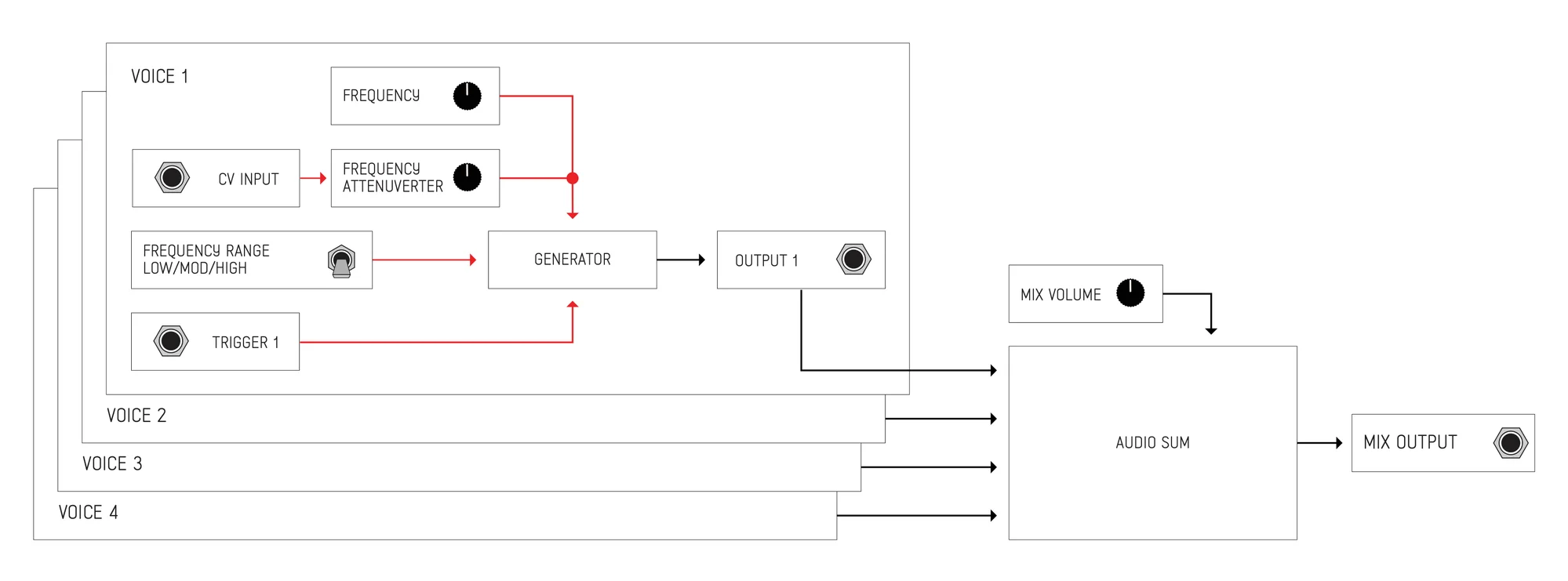
The panel provides identical interfaces for each of the four voices.
When a gate is sent to TRIG, a click sound is output from OUT at a pitch corresponding to the FREQUENCY knob position. The frequency can also be controlled via CV INPUT, with individual attenuverters for each voice.
The three-position switch labeled L/M/H in the center switches the frequency range between three types:
- L (Low): Oscillates at lower frequencies
- M (Modified): Oscillates a voice with stronger accent characteristics
- H (High): Oscillates at higher frequencies
M does not stand for Middle range; rather, it switches to a different character voice with somewhat emphasized resonance.
Use Cases for the ADDAC104
When I first saw this module, my initial reaction was: four click sounds? What does that mean? Is that even useful? But after listening to the demos, I realized that these kinds of sounds actually have real appeal.
It felt like a rediscovery of click sounds that I had previously been glossing over, now recognized as one of the valid sounds an instrument can produce. If you’re into minimal techno, you might even feel that this is the module you’ve been looking for.
Since it oscillates when a gate is sent to TRIG, feeding the output of a fast square wave oscillator into the input causes it to oscillate with each cycle. When patched this way, the output becomes something like a square wave with intense modulation applied. The manual describes this as the module also functioning as a “very destructive filter,” and the sounds obtained this way are quite interesting.
Personally, I feel this module represents a very modular synth-like idea. You wouldn’t arrive at the concept behind this module if you only thought of drums as drums.
If you’re intrigued, we encourage you to try it out for yourself.
Reference Video
Below is a video by DivKid explaining the ADDAC103.
Although we haven’t mentioned it until now, the ADDAC104 is actually an upgraded version of the simpler ADDAC103, with the addition of CV inputs and attenuverters. The sound output itself is identical, so please keep that in mind.
Manual
The manual is available on the official website below.
Technical Specifications
- Width: 8HP
- Depth: 25mm
- Power consumption: 50mA +12V / 50mA -12V
Included Accessories
- Power ribbon cable
- Screws
DIY Guide
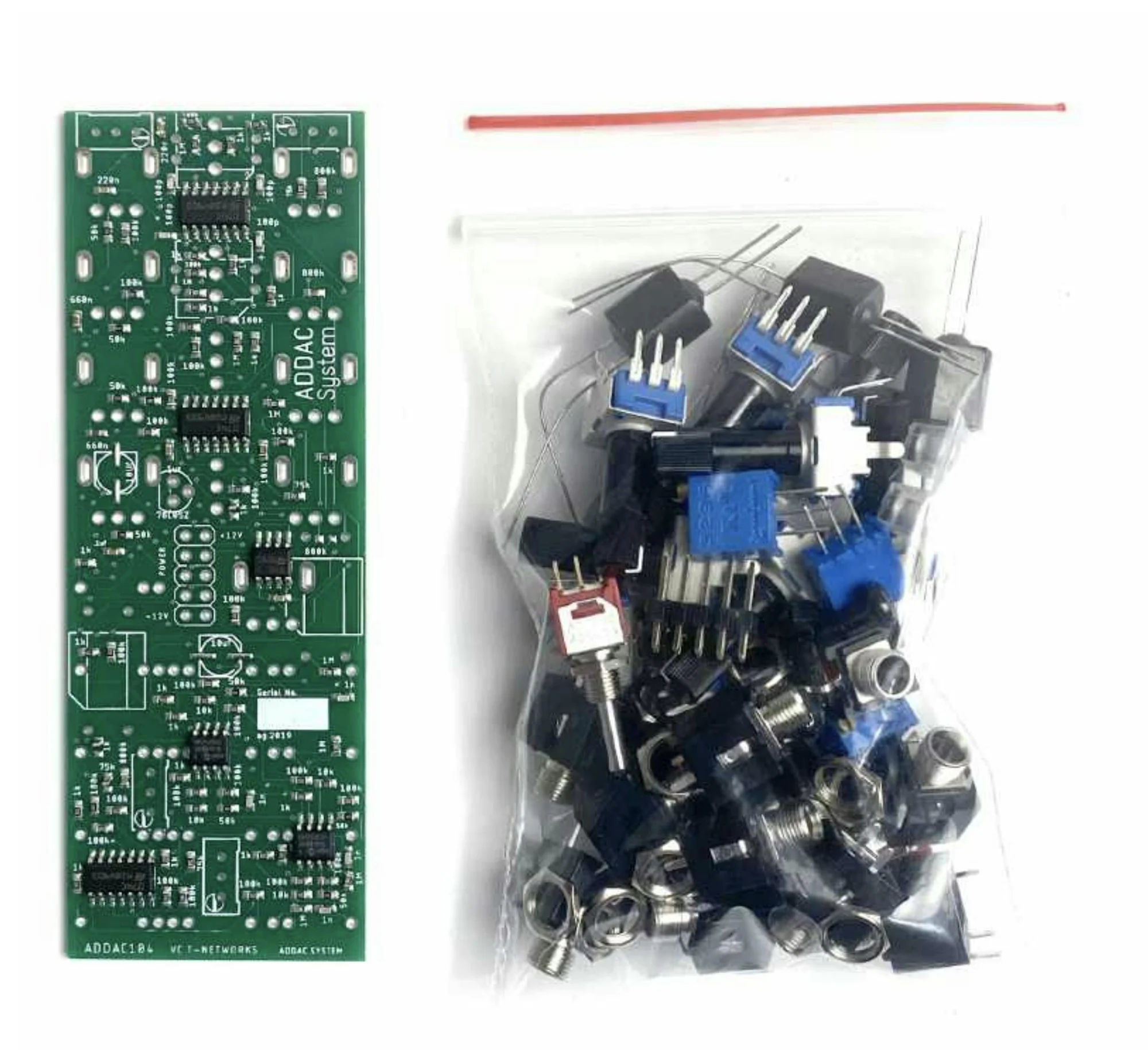
The DIY kit includes the panel, PCB, all components, power ribbon cable, and mounting screws.
ADDAC System provides detailed DIY guides on their website. Please refer to the guide below when assembling your kit.
This module uses many very small parts (SMD parts), but these come pre-soldered to the PCB. The kit is designed so that you only need to solder the relatively larger, easier-to-handle through-hole parts to complete the assembly.
モジュラーシンセのDIYとは?
モジュラーシンセサイザーのDIYについて詳しくご存じない方向けに、以下にDIYの導入的なコラムを用意しました。DIYについてご興味のある方、始めてみようと思う方は、是非ご参照いただければと。
また、組み立てに際して不明点や不安な点がございましたら、以下Takazudo Modularのdiscordチャンネルにてお気軽にご質問等、頂ければと思います。
ADDAC Systemについて
ADDAC Systemはポルトガルのモジュラーシンセメーカーです。
アナログ良さを生かした、ベーシックな機能をしっかり形にしているモジュールラインナップを基本としつつも、CVをMIDIに柔軟にコンバートしたり、高度にコントロール可能なグラニュラープロセッサー等、デジタル技術もうまく調和させた独創的なモジュールも数多くリリースしています。
オマケ: 電氣美術研究會モジュラー小物セット付き

モジュラーシンセをもっと多くの方に触って欲しいという願いの元、電氣美術研究會さまにご協力頂き、モジュラー小物セットを本商品にバンドルさせて販売させていただいております。
パッチケーブルや電源ケーブル、ドレスナットのサンプルセット、モノラルスプリッターなど、内容は時期に応じて変化します。商品に同梱しますので是非お試し下さい!
That concludes the introduction to the ADDAC104 VC T-Networks. We hope you enjoy the click/blip sounds this module creates.
Takazudo Modularではマニュアル等の日本語訳付きを作成し、公開しています。以下よりご参照下さい。
We hope you found this helpful.