This is an introduction to the ADDAC106 T-Noiseworks by ADDAC System, available at Takazudo Modular.
The ADDAC106 T-Noiseworks is a module that generates four voices of noise-based percussion sounds. The texture of the sounds is similar to hi-hat, snare, and kick sounds from classic rhythm machines like the TR-808. However, the sounds this module produces are still far from evoking a physical instrument — they are raw-textured percussion voices at a stage where analog circuitry is shaping and processing noise.
This product is available as an assembled unit built by ADDAC System, as well as a DIY kit.
This product is available for purchase below.
Takazudo Modularではマニュアル等の日本語訳付きを作成し、公開しています。以下よりご参照下さい。
- Product Photos: Assembled
- Product Photos: DIY Kit
- Features of the ADDAC106 T-Noiseworks
- Interface of the ADDAC106 T-Noiseworks
- Use Cases for the ADDAC106 T-Noiseworks
- Reference Videos
- Manual
- Technical Specifications
- Included Accessories
- DIY Guide
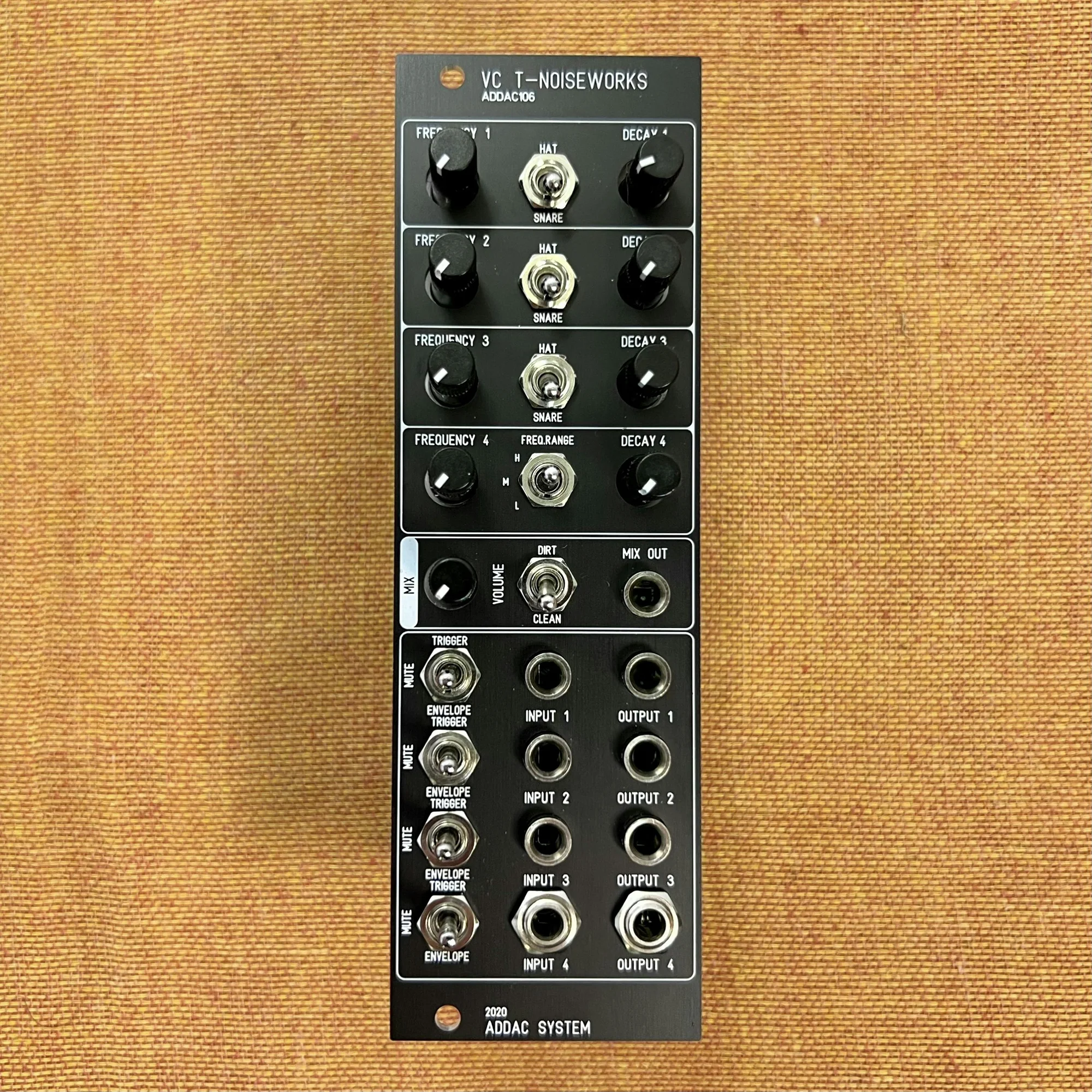
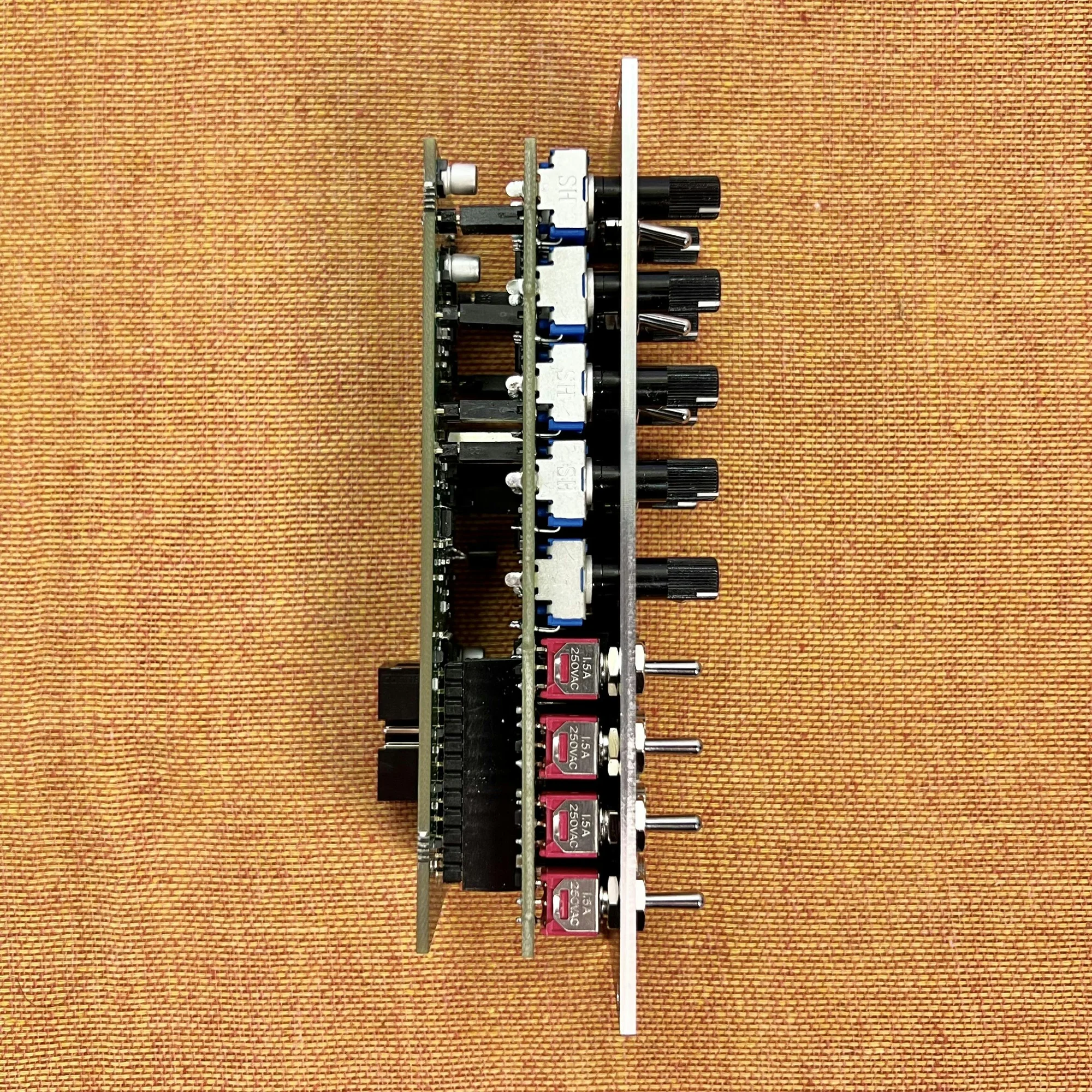
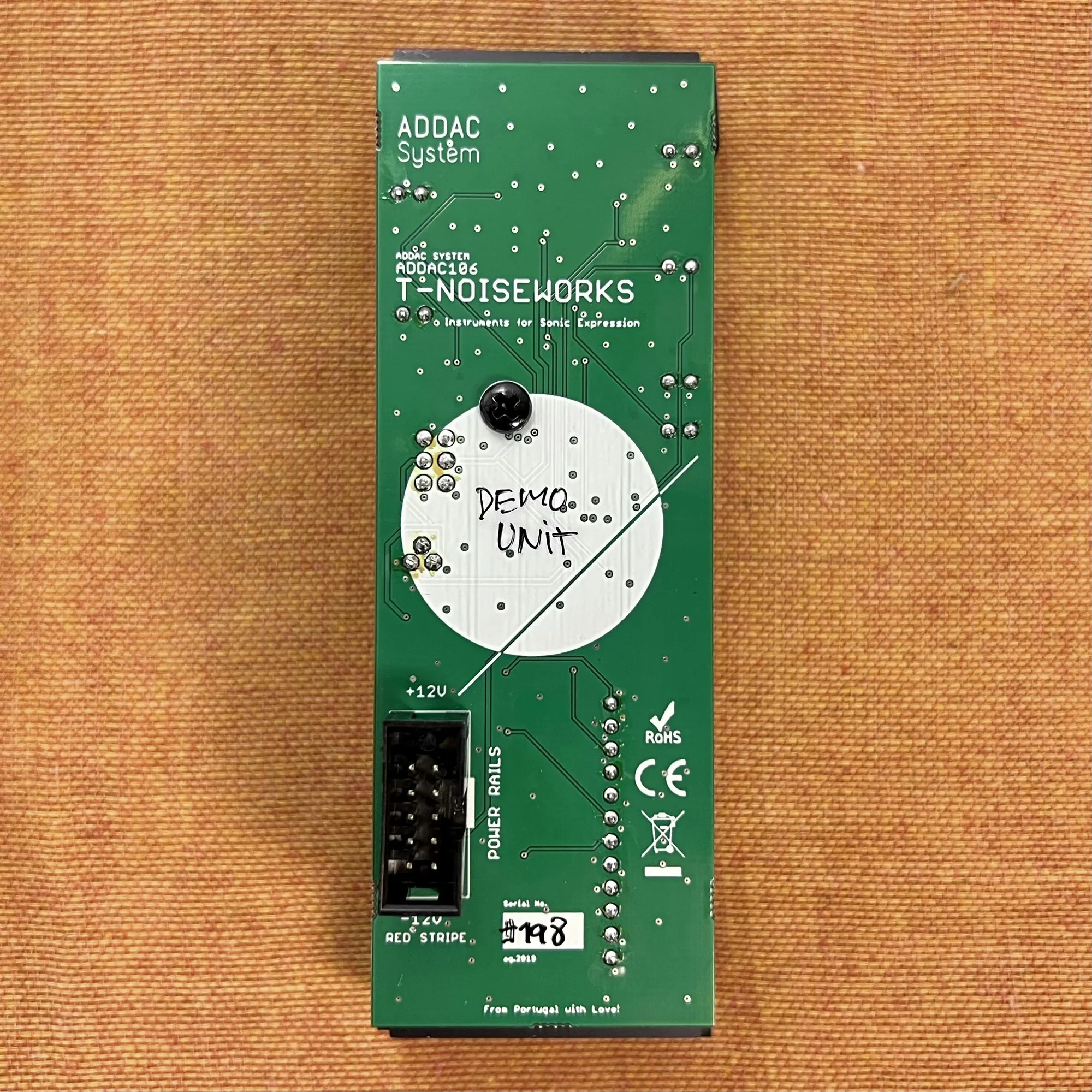
Product Photos: Assembled
Product Photos: DIY Kit
Features of the ADDAC106 T-Noiseworks
The ADDAC106 T-Noiseworks is the final module in ADDAC System’s T-Networks series. T-Networks refers to T-shaped networks, which are sets of circuits combining resistors and capacitors. ADDAC System’s lineup includes multiple voice modules that leverage the characteristics of these T-shaped networks. The ADDAC104 VC T-Networks, also available at our shop, is another module in this T-Networks series.
T-shaped networks act as notch filters that attenuate specific frequencies, and the technique of combining two of them to create sounds has been widely adopted in classic drum machines. In this module, noise is fed into these T-shaped networks to create intriguing sounds.
This module has four voices, and in terms of circuit design, voices 1-3 share the same design while voice 4 differs. The circuit differences are as follows:
- A: Voices 1-3: Noise -> T-shaped Network -> VCA
- B: Voice 4: Noise -> VCA -> T-shaped Network
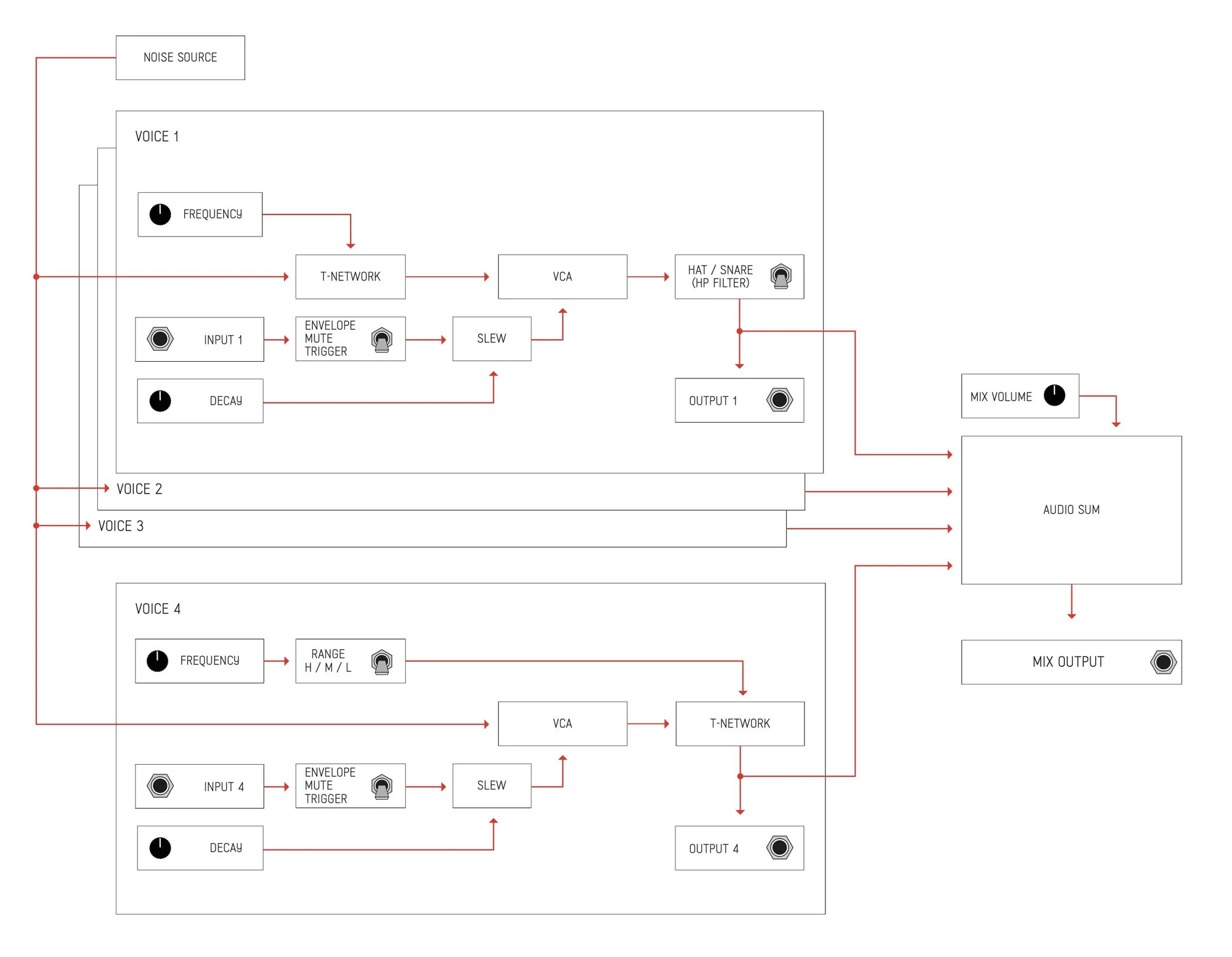
In Pattern A (voices 1-3), noise is fed into the T-shaped network and then the volume is controlled by the VCA. In Pattern B (voice 4), noise is fed into the VCA first, and then into the T-shaped network.
As a result, Pattern A produces sounds with a lot of gritty noise texture remaining, similar to hi-hats and snares, while Pattern B produces sounds where the resonance created by the T-shaped network comes through strongly as a tone, similar to a TR-808 kick.
Interface of the ADDAC106 T-Noiseworks
The following controls are provided for all four voices:
- FREQUENCY knob
- DECAY knob
- INPUT jack
- INPUT type switch (TRIGGER / MUTE / ENVELOPE)
- OUTPUT jack
The FREQUENCY knob controls the frequency affected by the T-shaped network. When the INPUT type switch is set to TRIGGER, a signal input at the INPUT causes the corresponding voice to be output from the OUTPUT jack. At this time, an envelope with near-zero ATTACK and a decay time corresponding to the DECAY knob is created and sent to the VCA, resulting in a percussive sound.
Setting the INPUT type switch to ENVELOPE causes the CV received at the INPUT to be sent directly to the VCA, allowing precise volume control via an external envelope or LFO.
Voices using Pattern A (1-3) have a HAT/SNARE switch, but this doesn’t mean it produces exactly a hi-hat or snare voice — rather, it creates sounds with those characteristics. Internally, it appears to be a switch that toggles a High Pass Filter on or off. When set to HAT, it’s turned on, resulting in a sound with emphasized high frequencies. When off, the sound has a broader frequency range, resulting in a quality closer to a snare.
For the voice using Pattern B (4), instead of the HAT/SNARE switch, there is a FREQ.RANGE switch with L/M/H positions. This is the same as what’s provided on the ADDAC104 VC T-Networks, switching the frequency range between three types:
- L (Low): Oscillates at lower frequencies
- M (Modified): Oscillates a voice with stronger accent characteristics
- H (High): Oscillates at higher frequencies
M does not stand for Middle range; rather, it switches to a different character voice with somewhat emphasized resonance.
Use Cases for the ADDAC106 T-Noiseworks
First, regarding voice 4, it’s essentially one of the circuits used in the ADDAC104 VC T-Networks brought into this module, so please refer to the ADDAC104 description for details. You can enjoy the click/blip sounds produced by this circuit.
As for the noisy voices of 1-3, in my experience with modules I’ve used, they gave me an impression similar to the Noise Plethora released by Befaco. Noise Plethora can create a variety of noise expressions by filtering white noise in various ways. When I first used Noise Plethora, I was struck by the realization that noise can produce beautiful sounds.
The experience of using the ADDAC106 T-Noiseworks gives me a similar feeling. When you think about what makes TR-909 and TR-808 hi-hats and snares sound so good, you might realize it’s the raw texture of the noise component they contain. Most of the sound added when you lengthen a snare’s decay is noise. That rawness is perhaps what sounds so appealing. This ADDAC106 T-Noiseworks has three parts of such noise, each with subtly different textures, and the notch filter-like T-shaped networks let you control those textures.
It’s a module called “Noiseworks” that lets you rediscover the beauty of noise.
Reference Videos
Below is a recording of my session where the drums use AD110 and B2 Kick, and the main noise source is this ADDAC106 run through SF1 with the cutoff controlled by SE1.
In the following video, you can see the ADDAC106 T-Noiseworks being used as percussion.
We hope you find these helpful as a reference.
Manual
The manual is available on the official website below.
Technical Specifications
- Width: 8HP
- Depth: 40mm
- Power consumption: 40mA +12V / 40mA -12V
Included Accessories
- Power ribbon cable
- Screws
DIY Guide
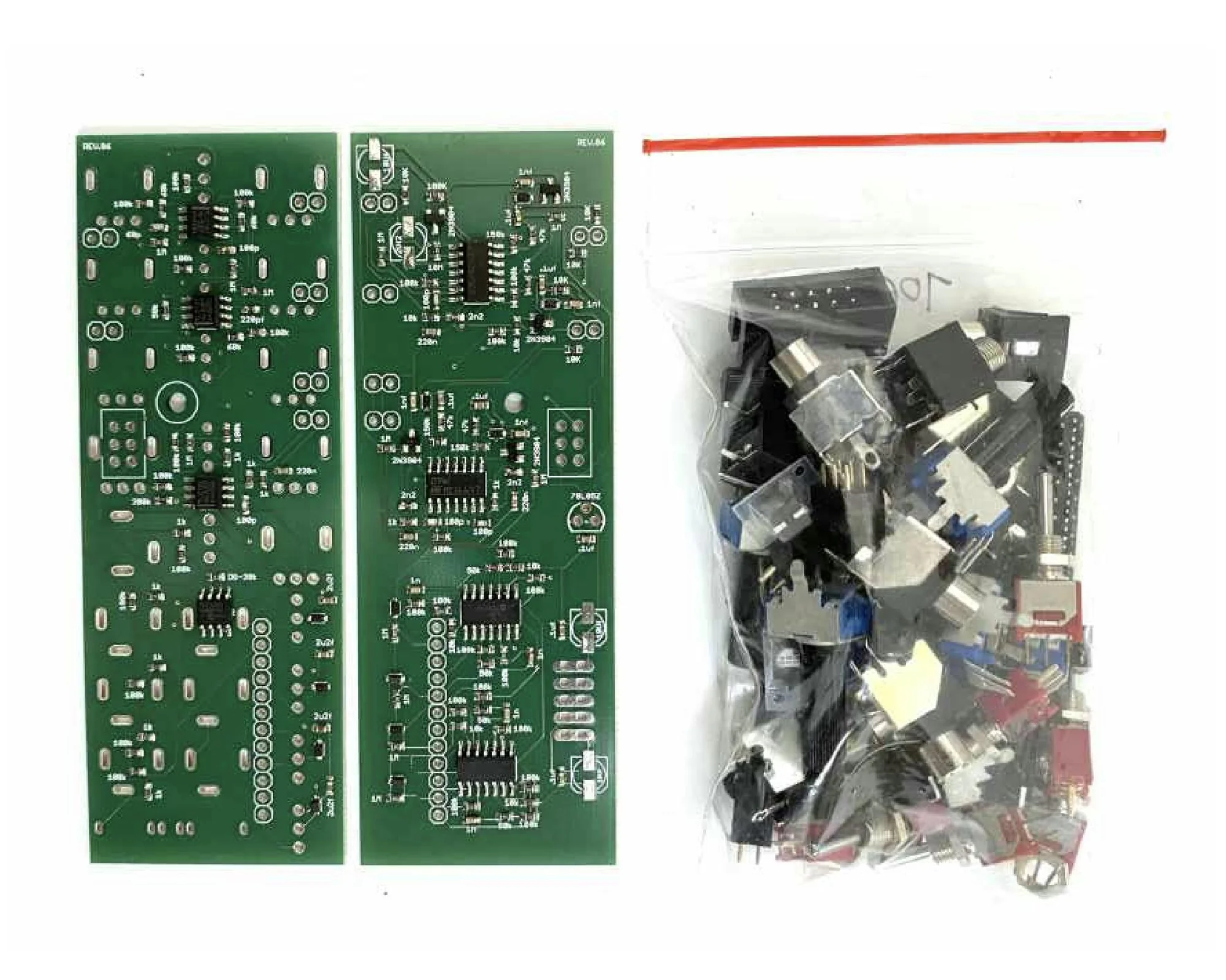
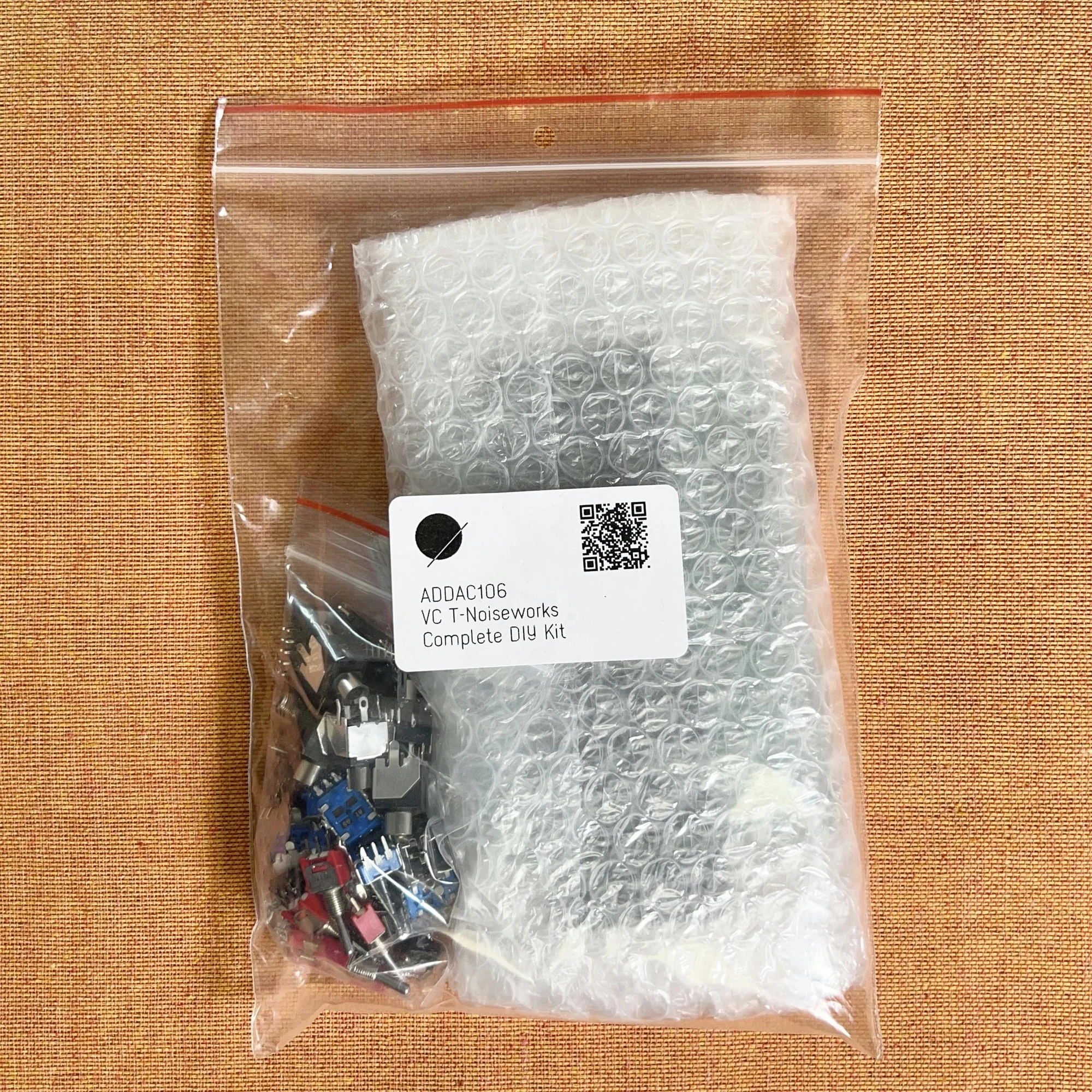
The DIY kit includes the panel, PCB, all components, power ribbon cable, and mounting screws.
ADDAC System provides detailed DIY guides on their website. Please refer to the guide below when assembling your kit.
This module uses many very small parts (SMD parts), but these come pre-soldered to the PCB. The kit is designed so that you only need to solder the relatively larger, easier-to-handle through-hole parts to complete the assembly.
モジュラーシンセのDIYとは?
モジュラーシンセサイザーのDIYについて詳しくご存じない方向けに、以下にDIYの導入的なコラムを用意しました。DIYについてご興味のある方、始めてみようと思う方は、是非ご参照いただければと。
また、組み立てに際して不明点や不安な点がございましたら、以下Takazudo Modularのdiscordチャンネルにてお気軽にご質問等、頂ければと思います。
ADDAC Systemについて
ADDAC Systemはポルトガルのモジュラーシンセメーカーです。
アナログ良さを生かした、ベーシックな機能をしっかり形にしているモジュールラインナップを基本としつつも、CVをMIDIに柔軟にコンバートしたり、高度にコントロール可能なグラニュラープロセッサー等、デジタル技術もうまく調和させた独創的なモジュールも数多くリリースしています。
オマケ: 電氣美術研究會モジュラー小物セット付き

モジュラーシンセをもっと多くの方に触って欲しいという願いの元、電氣美術研究會さまにご協力頂き、モジュラー小物セットを本商品にバンドルさせて販売させていただいております。
パッチケーブルや電源ケーブル、ドレスナットのサンプルセット、モノラルスプリッターなど、内容は時期に応じて変化します。商品に同梱しますので是非お試し下さい!
That concludes the introduction to the ADDAC106 T-Noiseworks. We hope you enjoy the noise textures this module creates.
Takazudo Modularではマニュアル等の日本語訳付きを作成し、公開しています。以下よりご参照下さい。
We hope you found this helpful.