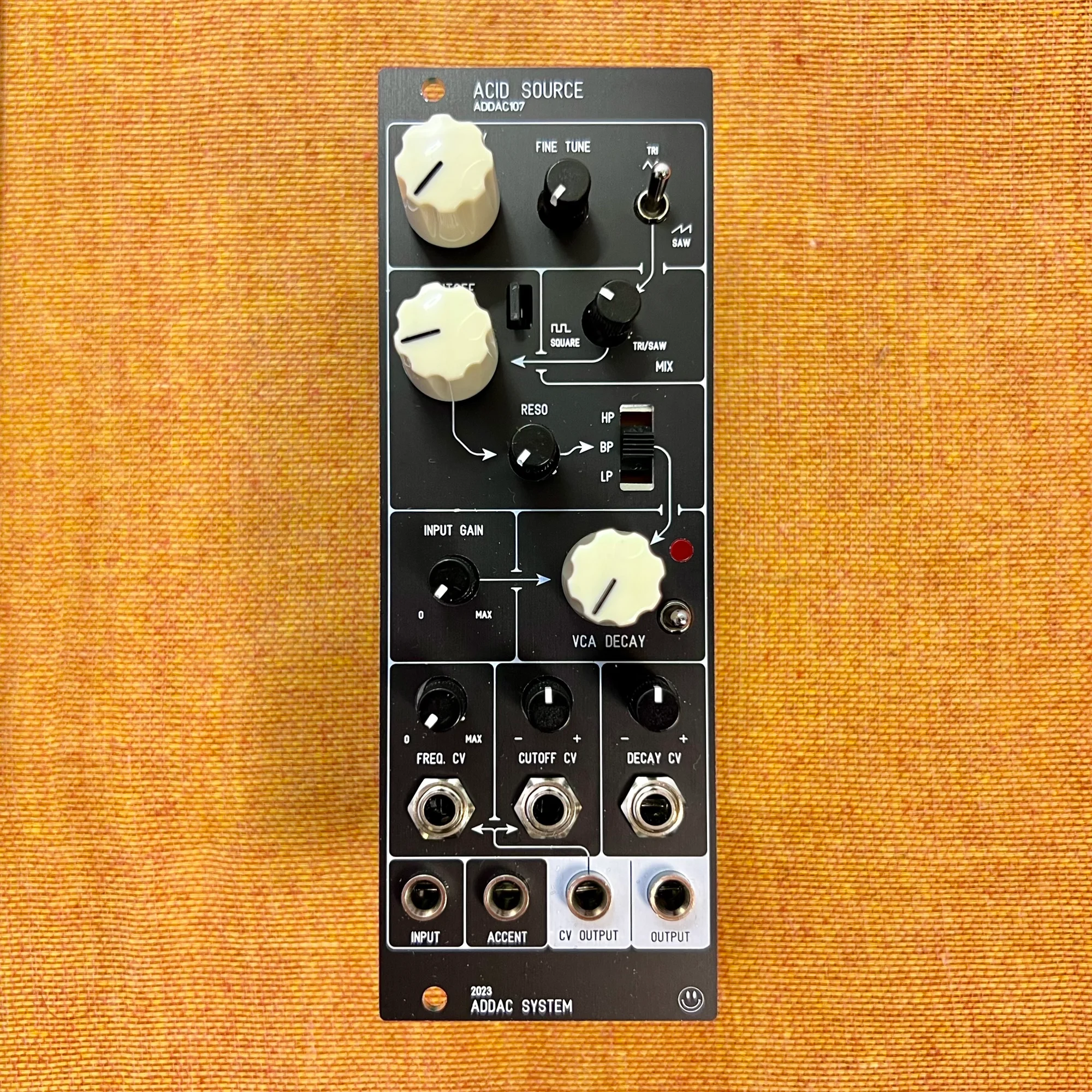
This is an introduction to the ADDAC107 ACID Source by ADDAC System, available at Takazudo Modular.
The ADDAC107 ACID Source is a module that compactly combines all the elements needed to create acid sounds into a single unit. It contains a VCO, VCF, and VCA, and the VCA’s unique clipping design works in harmony with the VCF characteristics to produce acid sounds reminiscent of the TB-303.
This product is available for purchase below.
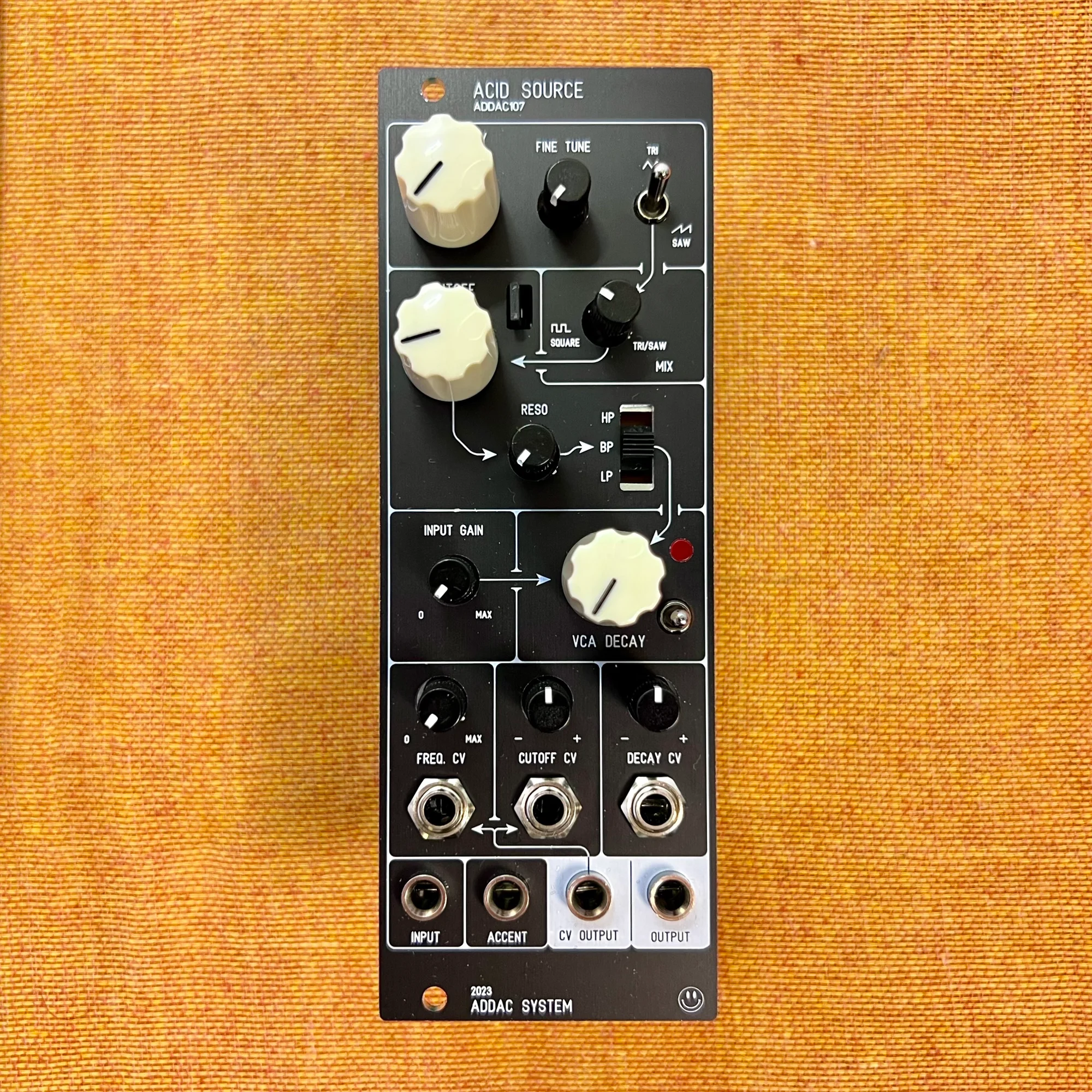
Takazudo Modularではマニュアル等の日本語訳付きを作成し、公開しています。以下よりご参照下さい。
- Background and Features of the ADDAC107 ACID Source
- General Architecture of the ADDAC107 ACID Source
- VCA and Decay Envelope
- INPUT GAIN and Sound Clipping
- External Audio Source Input
- Disconnecting the Built-in VCO
- 1V/Oct Input
- Reference Videos
- Manual
- Technical Specifications
- Included Accessories
Background and Features of the ADDAC107 ACID Source
The ADDAC107 ACID Source was born from an idea that emerged during the process of creating drum voice modules, when it was discovered that the concept produced interesting effects on synth voices, leading to its completion as a standalone module.
Therefore, it was never intended to faithfully reproduce the TB-303 — the components that make up the module are similar to but quite different from the TB-303. As a result, while the sound it produces resembles the TB-303, it’s more accurate to say that it arrived at a similar result through a different approach.
The part that creates the acid sound is this module’s VCA section. Let’s explain what makes it distinctive.
General Architecture of the ADDAC107 ACID Source
To understand this module, the easiest approach is to look at the knobs and jacks from top to bottom on the panel. Let’s first examine the basic architecture, setting aside the finer details and assuming standard usage.

From the top to roughly the center-bottom of the panel, the following controls are compactly arranged:
- VCO (Square / Triangle / Saw Mix)
- VCF (selectable from HPF / BPF / LPF)
- VCA + Decay Envelope
The knobs and jacks in the lower section are:
- VCO Frequency can be CV controlled (also accepts 1V/Oct)
- VCF Cutoff can be CV controlled
- VCA Decay can be CV controlled
The jacks at the very bottom of the panel serve the following roles:
- CV input to INPUT controls the VCA output
- Input to ACCENT increases the VCA Gain
Looking at the flow, it appears to simply be a VCO + VCF + VCA bundled together.
VCA and Decay Envelope
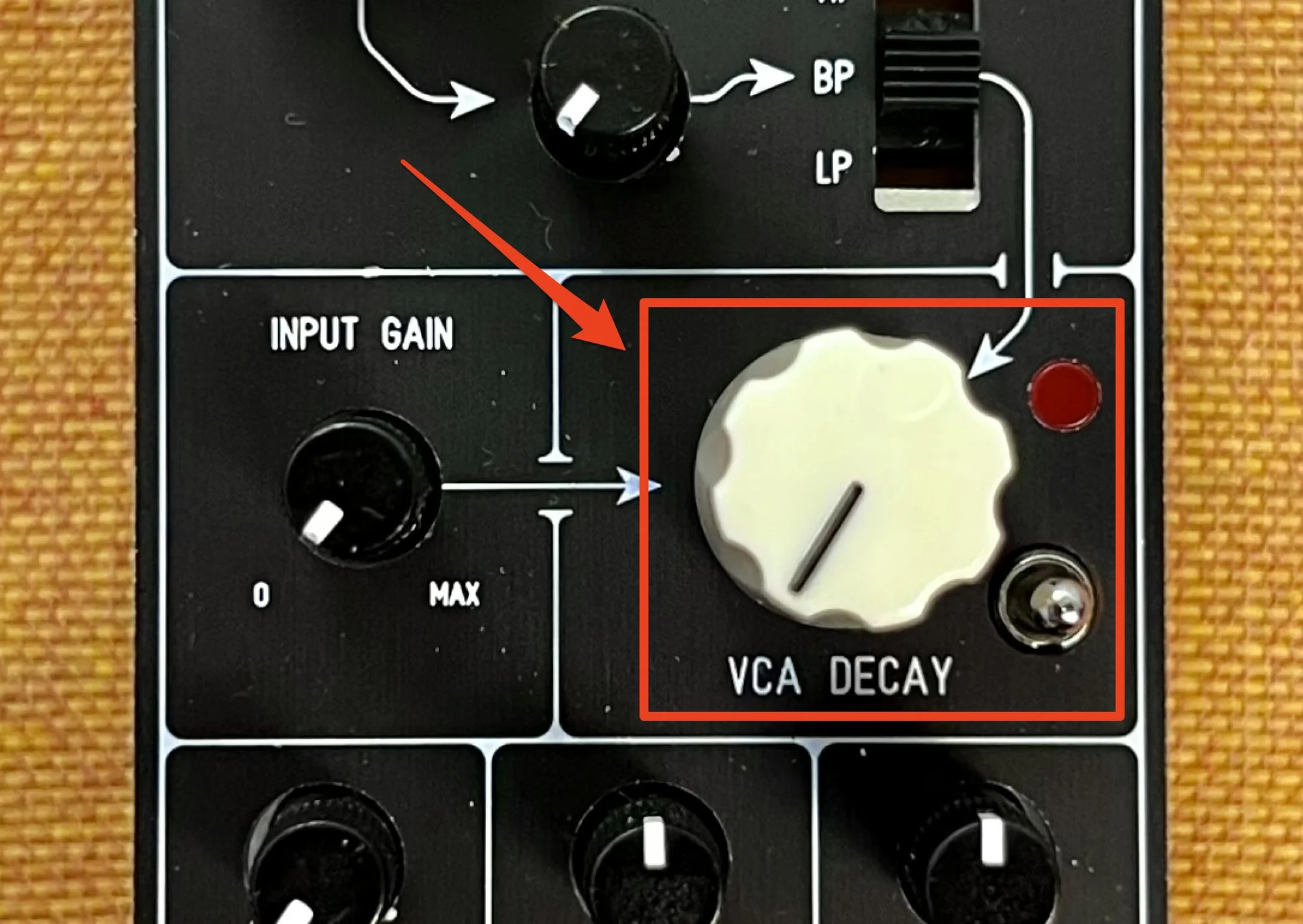
The most distinctive part of this module is the VCA and Decay Envelope section. This is the one part that’s hard to understand just by touching it.
First, the switch to the right of VCA Decay is a three-position switch that adjusts Decay as follows:
- Up: Long decay time
- Center: No adjustment
- Down: Short decay time
Let’s assume this switch is set to center (no adjustment). The CV from this module’s INPUT jack basically controls the VCA output volume. So, for example, if you feed in an envelope with zero attack and a short decay — the kind of envelope you’d use for percussive sounds — the synth sound will be output at a volume following that envelope. This is the basic behavior.
When you set this switch to down (short decay time), a slight amount of decay is added to the input envelope, making the decay time a little longer. Setting the switch to up (long decay time) adds even more decay. In these cases, the length of the added decay is also determined by the VCA DECAY knob value — the further you turn the knob clockwise, the longer the added decay time.
To take advantage of this feature, there are broadly two approaches:
The first is to create an envelope externally and use it directly to control VCA output. In this case, set the switch to center (no adjustment).
The second is to input a very short gate (more like a pulse than a gate, or an envelope with very short decay) to INPUT and control the decay time using the VCA DECAY knob. In this case, set the switch to up or down.
The former is standard VCA behavior in a modular system, while the latter allows you to use the decay parameter built into this module with a feel similar to operating the Decay knob on an original TB-303.
INPUT GAIN and Sound Clipping
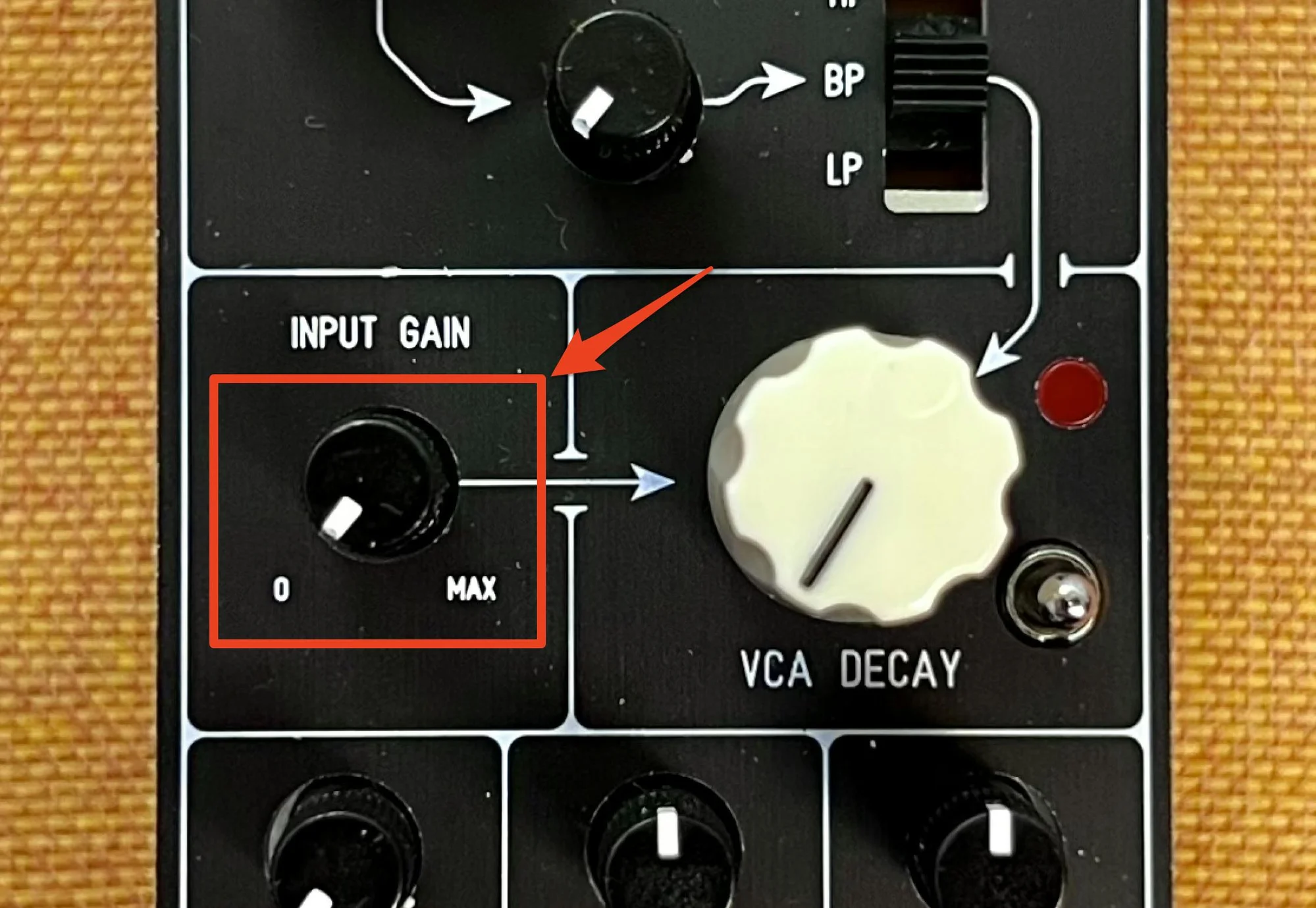
The INPUT GAIN knob located just to the left of the Decay control has a very distinctive characteristic. First, this INPUT GAIN adjusts the CV received from INPUT: fully counter-clockwise is zero, at the center position it passes through unchanged, and fully clockwise it amplifies the CV received from INPUT to 2x.
For example, with the Decay switch described above set to center (no adjustment), if a 5V gate is received and the INPUT GAIN knob is turned fully clockwise, the 5V is amplified to 10V, and that 10V CV is passed to the VCA.
And when the VCA receives input CV exceeding 5V, it clips the sound.
So what does this mean in practice? Simply put, the more you turn the INPUT GAIN knob clockwise, the more the portions of the output sound that are loud get progressively clipped. INPUT GAIN doesn’t just attenuate the input CV — the amplified portion that pushes the volume above 100% causes aggressive clipping of the output.
This may be hard to understand without actually using it, but this deliberate clipping of the sound, combined with the built-in filter’s resonance, produces a sound close to a TB-303 with distortion applied, where the filter resonance is pushed to the extreme.
External Audio Source Input
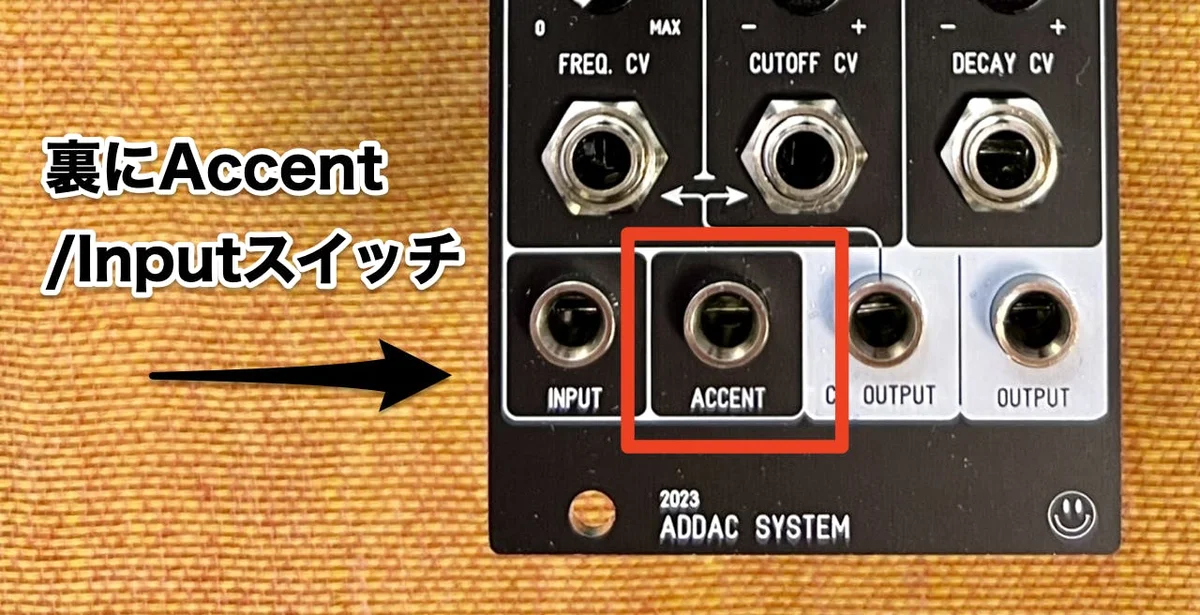
The ADDAC107 ACID Source can use external audio sources in addition to the built-in VCO. However, when using this feature, the ability to boost VCA output by sending a gate to the ACCENT jack becomes unavailable, because the external audio source input uses the ACCENT jack.
To use an external audio source, you need to flip a switch on the back of the module. The specific location is shown below:
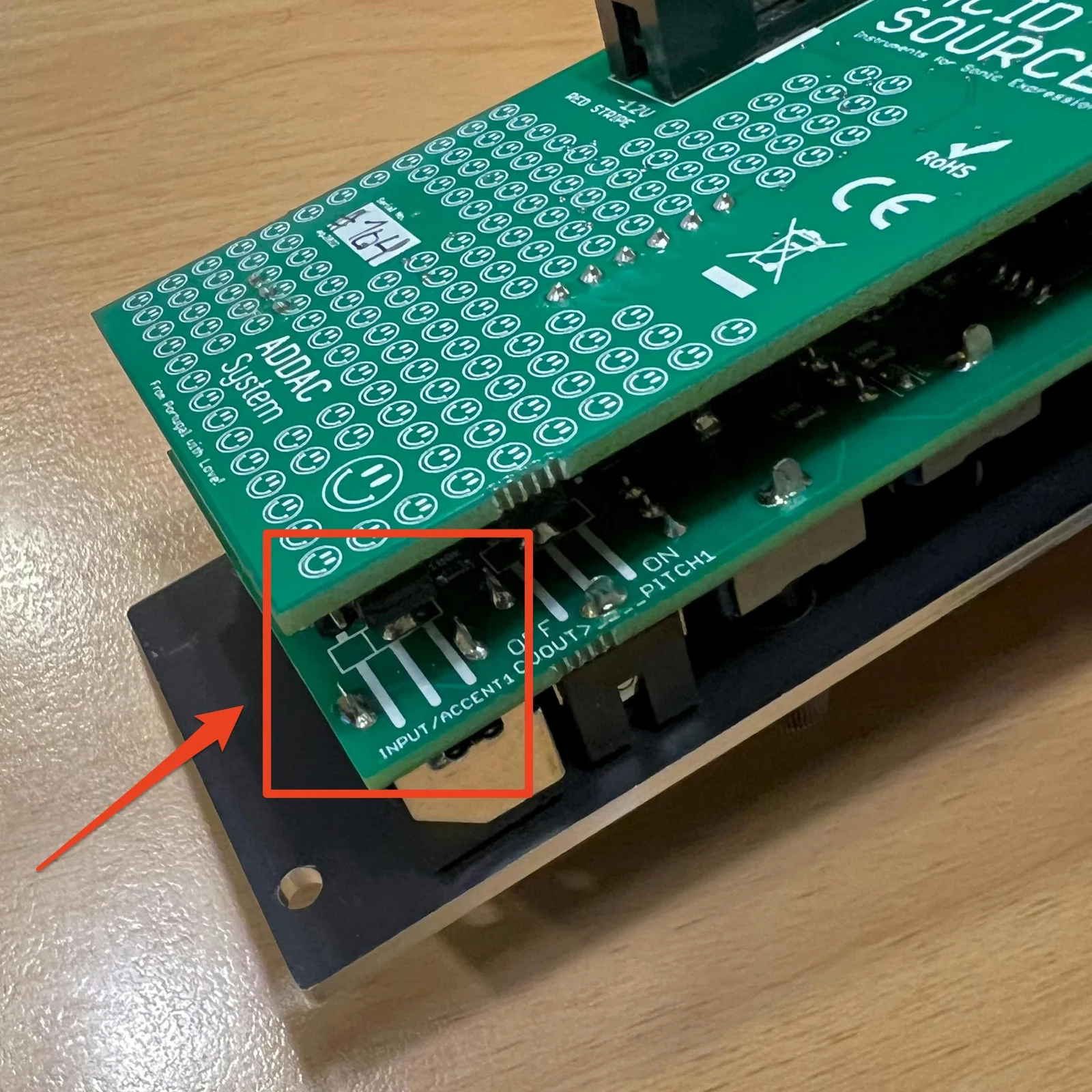
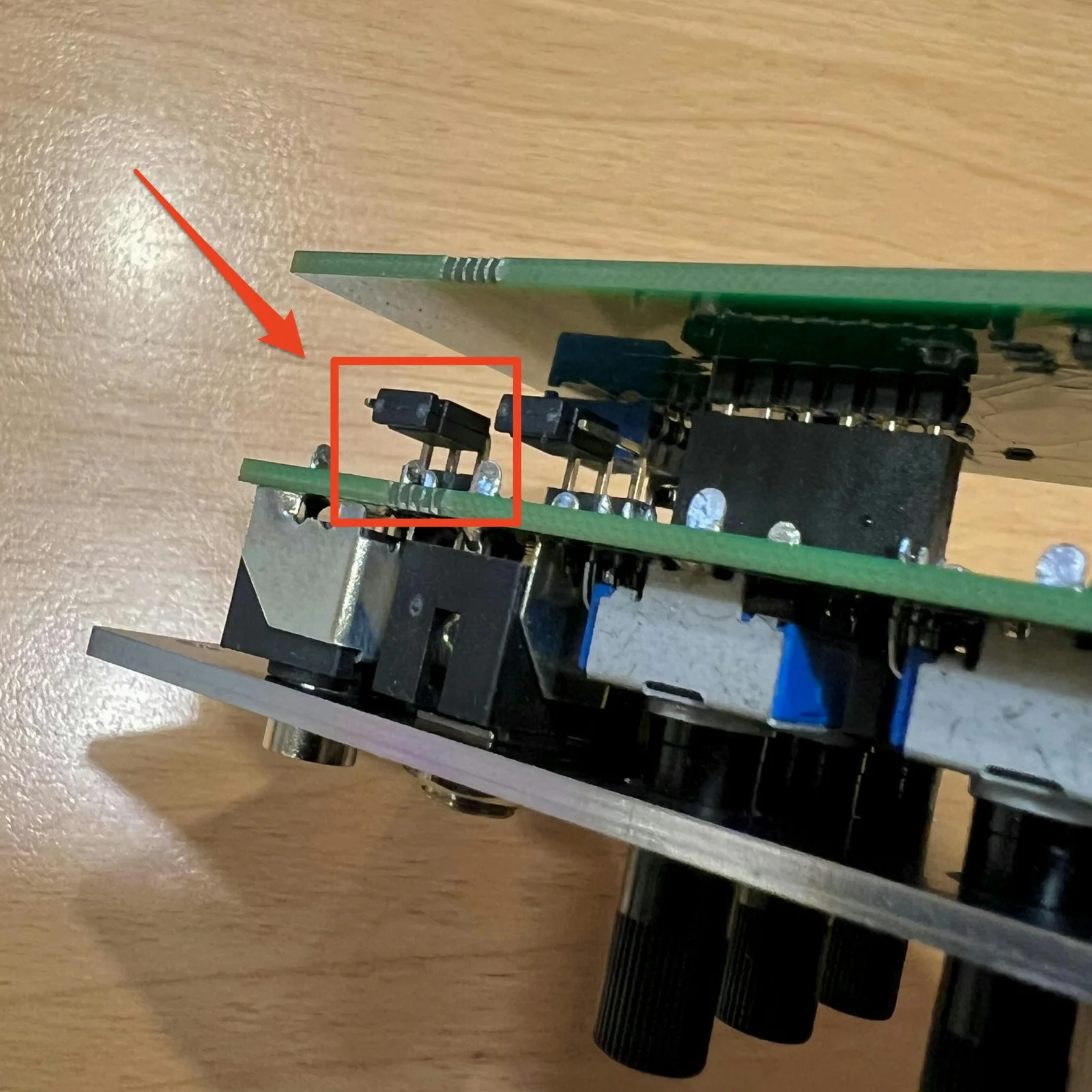
By default, this switch is set to use ACCENT, but flipping it causes the signal input to the ACCENT jack to be mixed with the built-in VCO output before being sent to the VCF. In the circuit diagram from the manual, this corresponds to the following section:
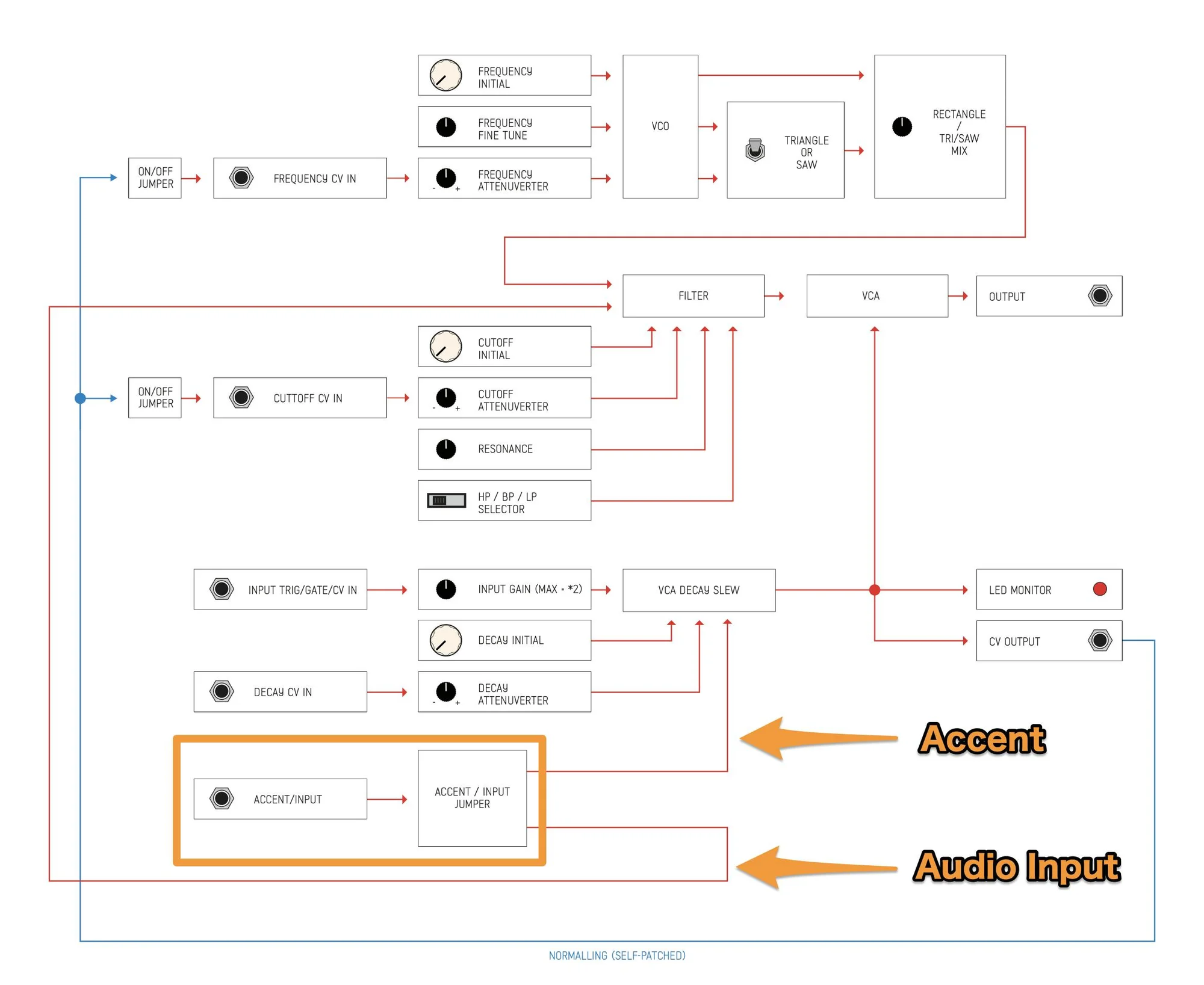
Switching to external audio input allows you to mix in another VCO’s input, noise, and more. This results in richer synth voices and the ability to create percussion-like sounds. This feature significantly expands this module’s expressive capabilities, and we highly recommend trying it out.
Disconnecting the Built-in VCO
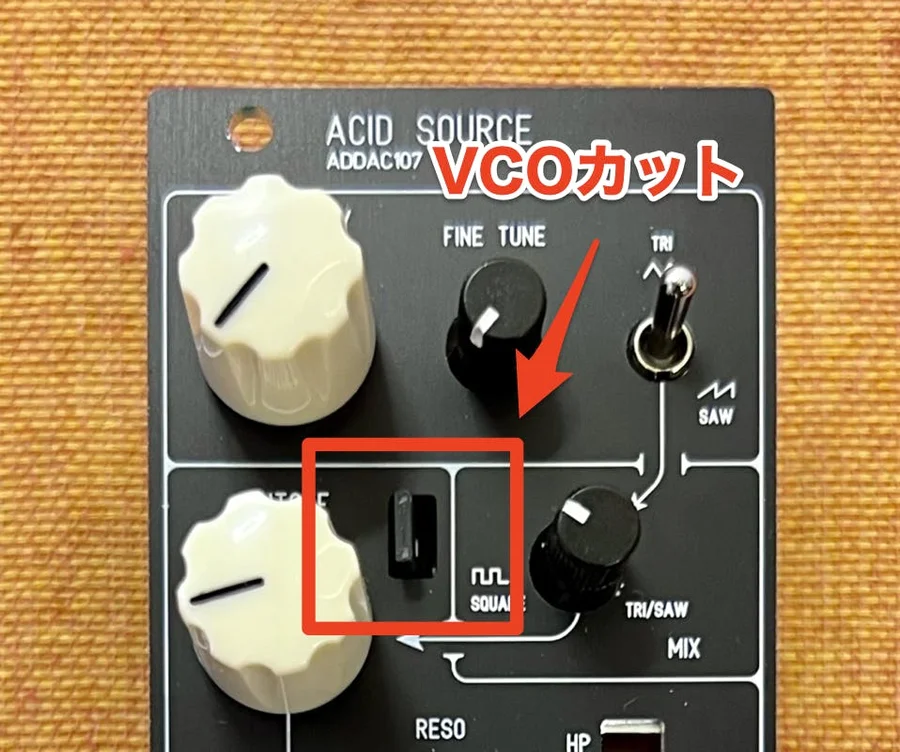
When using an external audio source as described above, you can also disable the built-in VCO. To do this, simply remove the switch located just to the right of the CUTOFF knob.
Removing this switch disconnects the internal VCO from the VCF. As a result, only the external audio source is fed to the VCF, effectively replacing this module’s VCO section entirely with the external audio source.
1V/Oct Input
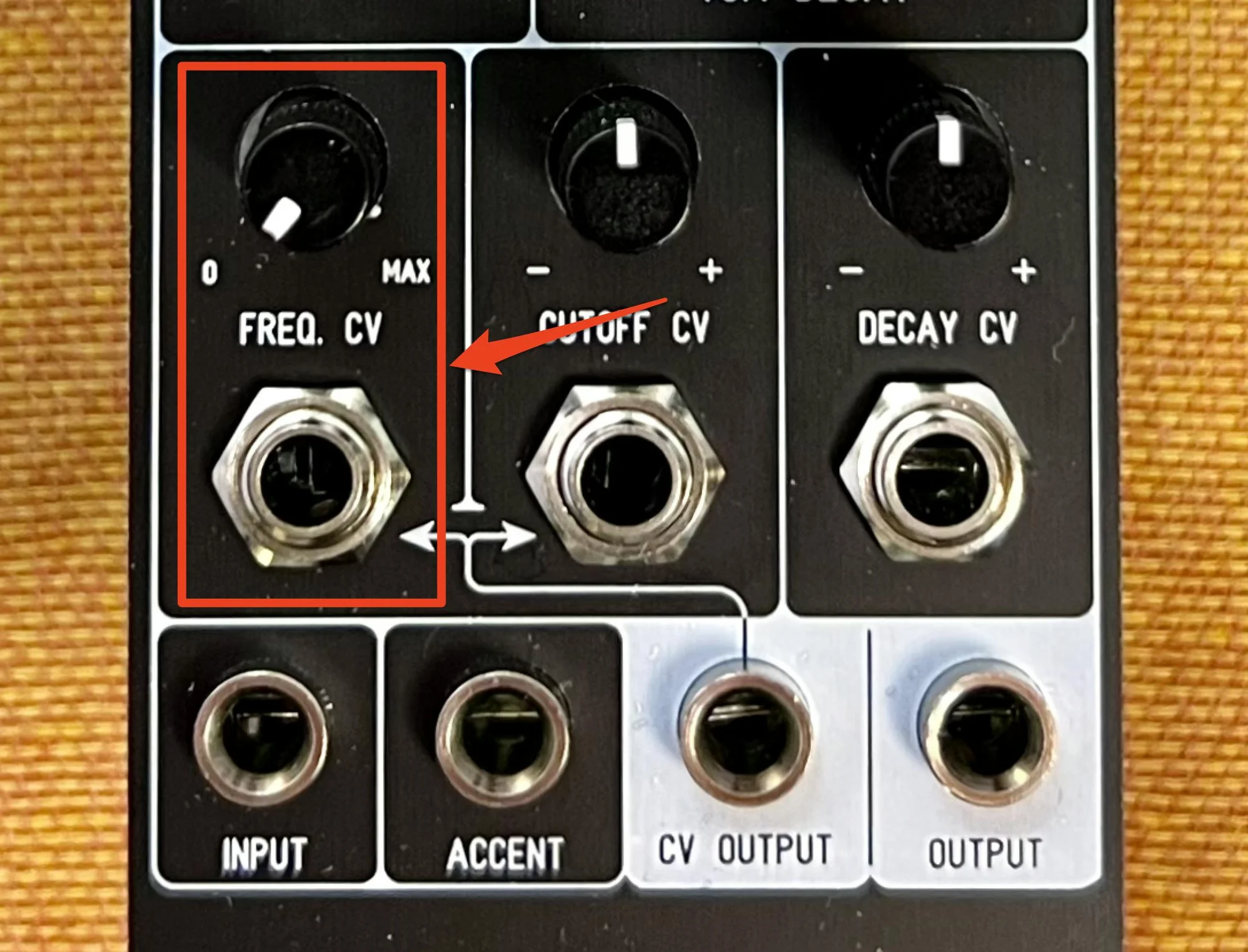
To control the pitch of this module’s VCO, feed CV into the FREQ. CV jack located in the lower part of the panel. The knob just above this jack attenuates the input, and when turned fully clockwise, it’s calibrated to 1V/Oct.
Reference Videos
In the video below, you can hear the acid sounds produced by this ADDAC107 ACID Source. While the impression is admittedly different from a TB-303, you can see how it creates a diverse range of sounds.
Additionally, below is a session video where I used the ADDAC107. Along with the ADDAC107, I also used ADDAC112, ADDAC104, ADDAC106, and OXI ONE, all available at our shop.
Manual
The manual (English only) is available on the official website below.
Technical Specifications
- Width: 9HP
- Depth: 40mm
- Power consumption: 80mA +12V / 80mA -12V
Included Accessories
- Power ribbon cable
- Screws
ADDAC Systemについて
ADDAC Systemはポルトガルのモジュラーシンセメーカーです。
アナログ良さを生かした、ベーシックな機能をしっかり形にしているモジュールラインナップを基本としつつも、CVをMIDIに柔軟にコンバートしたり、高度にコントロール可能なグラニュラープロセッサー等、デジタル技術もうまく調和させた独創的なモジュールも数多くリリースしています。
オマケ: 電氣美術研究會モジュラー小物セット付き

モジュラーシンセをもっと多くの方に触って欲しいという願いの元、電氣美術研究會さまにご協力頂き、モジュラー小物セットを本商品にバンドルさせて販売させていただいております。
パッチケーブルや電源ケーブル、ドレスナットのサンプルセット、モノラルスプリッターなど、内容は時期に応じて変化します。商品に同梱しますので是非お試し下さい!
That concludes the introduction to the ADDAC107 ACID Source.
When I received a batch of ADDAC System modules at once, this ADDAC107 ACID Source was among them. My impression is that this module likely contains the accumulated VCO, VCF, and clipping expertise of ADDAC System. It feels like there’s something deliberately designed to clip the resonance in a pleasing way, rather than just crude clipping.
With that in mind, we hope you enjoy this module as ADDAC System’s take on an acid sound generator.
Takazudo Modularではマニュアル等の日本語訳付きを作成し、公開しています。以下よりご参照下さい。
We hope you found this helpful.