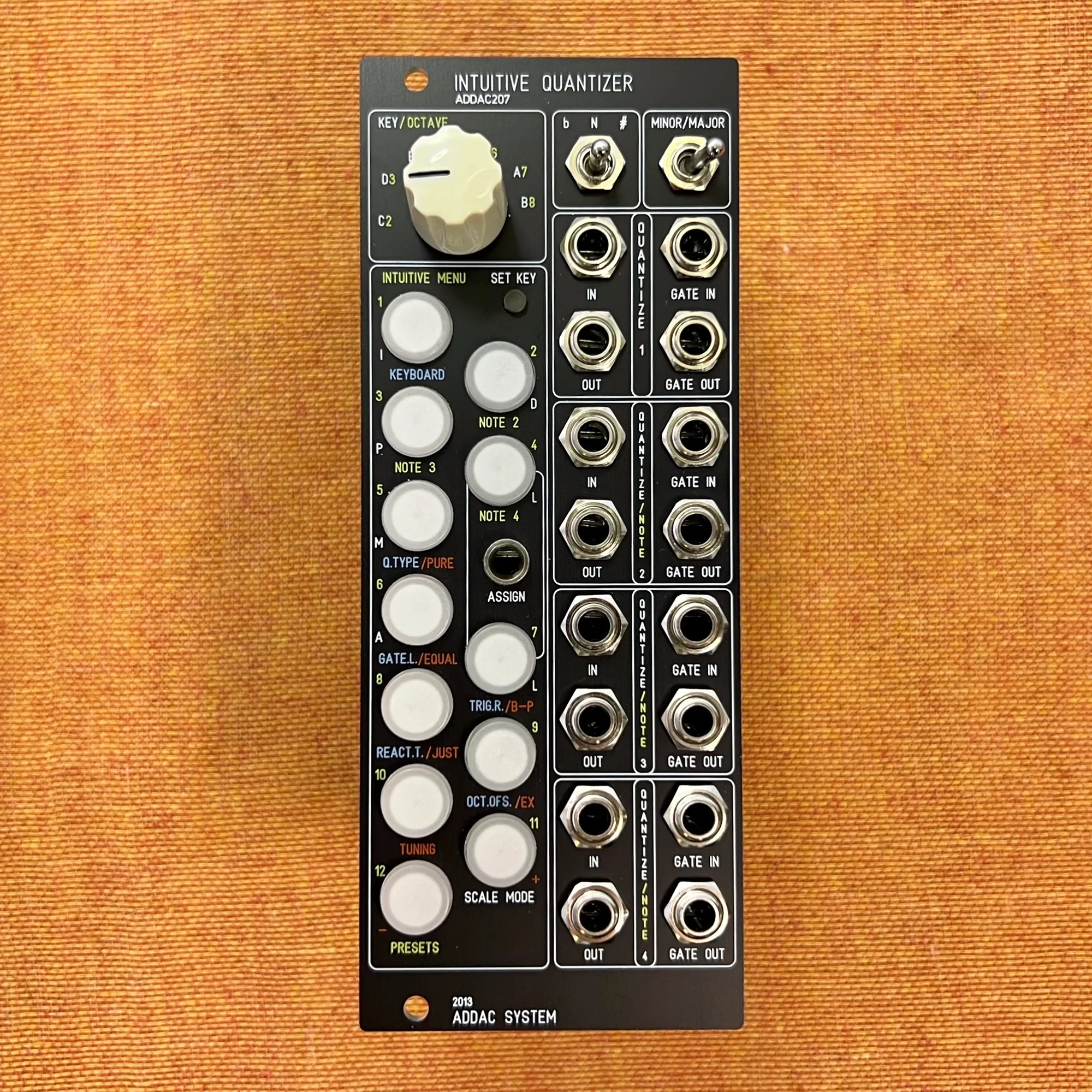
This is an introduction to the ADDAC207 Intuitive Quantizer by ADDAC System, available at Takazudo Modular.
The ADDAC207 Intuitive Quantizer is a 4-voice intuitively operated quantizer.
This product is available for purchase below.
Takazudo Modularではマニュアル等の日本語訳付きを作成し、公開しています。以下よりご参照下さい。
- ADDAC207 Feature Overview
- The Appeal of the ADDAC207
- Reference Video
- Technical Specifications
- Included Accessories
- Manual
ADDAC207 Feature Overview
This quantizer has an extensive set of features. Let me first list the ADDAC207’s features in bullet points, then dive deeper into the key areas.
- 2 modes (Keyboard mode / Quantizer mode)
- Sample & hold function via gate input/output
- Custom scale definition capability
- Definable note interval offsets for chord generation
- 3 quantization type settings (Above, Below, Ignore)
- Configurable gate output length
- Octave offset settings
- Menu settings controllable via CV
- 5 different temperaments selectable including Bohlen-Pierce
- Configurable octave ratio (e.g., changing 1V/Oct to 0.5V/Oct)
- Save scales and settings to 11 user presets
The Appeal of the ADDAC207
Here are three points that I consider the standout qualities of this ADDAC207.
1. 4 Voices
The feature that anyone choosing this quantizer is certainly looking for is the ability to handle multiple voices. The ADDAC207 can handle up to 4 voices.
When you want to play multiple oscillators in a modular system, assuming a straightforward setup, you need to quantize the pitch sent to each oscillator individually. With the ADDAC207, this single module can handle all four of those quantizations. This is the first key convenience.
Among the modules we carry, the RYK Modular: Vector Wave is a multi-timbral oscillator module that receives four 1V/Oct signals and can assign a different oscillator to each of four pitches. While MIDI can also drive these 4 voices, the ADDAC207 pairs perfectly when you want to control 1V/Oct via analog CV input. (The separately sold Vector Wave Expander is required to receive four 1V/Oct inputs.)
Depending on the type of music you play, tonal harmony between notes may not always be critical. But when you do want to harmonize multiple oscillators playing different pitches, a module like the ADDAC207 is especially useful.
2. Performance-Friendly Size
The second point is that, in my personal opinion, this module has an interface sized for performance. Among quantizers, there are many very compact modules as small as 2HP. If you need 4 voices, you could argue that lining up four of those would be the same — and even more compact.
However, if you’re changing quantizer settings as part of a performance, modules that small would be difficult to operate. The ADDAC207’s button layout is sized appropriately for operating the quantizer on the fly during performance.
3. Custom Scales and Chord Generation
The third point is the ease of setting custom scales and pitch interval offsets for chord generation. Many quantizer owners probably just set their favorite scale, feed in some CV or LFO, and leave it at that.
Personally, I believe one of the great appeals of a quantizer with customizable scales is the ability to explore pitch harmonies by operating the quantizer. For example, you might discover that within C major, narrowing to C-E-G-A-B creates your preferred harmonies, or that switching to C-D-E-A creates an interesting variation.
Using a sequencer and quantizer to operate a modular system this way gives me a strong sense of actually performing with a modular system. Points 2 and 3 are crucial for achieving this experience.
I feel this module was designed precisely for this kind of use, and the ADDAC207 lives up to its name — Intuitive.
Combine multiple sequencers with this ADDAC207, send individual 1V/Oct signals to multiple VCOs, and apply separate VCA/Filter+Envelope to each audio out — this will greatly expand your performance possibilities.
Reference Video
Below is a session video where I used this quantizer. CV from OXI ONE is received across 4 channels, and the quantized 1V/Oct output is sent to Vector Wave. The CVs are raised and lowered from the OXI ONE side, and I continuously change the active keys on the quantizer to match.
Technical Specifications
This is a module with considerable depth. Please check your case depth.
- Width: 10HP
- Depth: 52mm
- Power consumption: max +140mA / -70mA
Included Accessories
- Power ribbon cable
- Screws
Manual
The manual is available on the official website below.
ADDAC Systemについて
ADDAC Systemはポルトガルのモジュラーシンセメーカーです。
アナログ良さを生かした、ベーシックな機能をしっかり形にしているモジュールラインナップを基本としつつも、CVをMIDIに柔軟にコンバートしたり、高度にコントロール可能なグラニュラープロセッサー等、デジタル技術もうまく調和させた独創的なモジュールも数多くリリースしています。
オマケ: 電氣美術研究會モジュラー小物セット付き

モジュラーシンセをもっと多くの方に触って欲しいという願いの元、電氣美術研究會さまにご協力頂き、モジュラー小物セットを本商品にバンドルさせて販売させていただいております。
パッチケーブルや電源ケーブル、ドレスナットのサンプルセット、モノラルスプリッターなど、内容は時期に応じて変化します。商品に同梱しますので是非お試し下さい!
That concludes the introduction to the ADDAC207 Intuitive Quantizer.
This module was what first led me to discover ADDAC System. I was searching for exactly this kind of quantizer and found this module, which was precisely what I was looking for. Personally, quantizers are among my favorite category of modules, and the ADDAC207 is one I especially recommend.
Takazudo Modularではマニュアル等の日本語訳付きを作成し、公開しています。以下よりご参照下さい。
We hope you found this helpful.