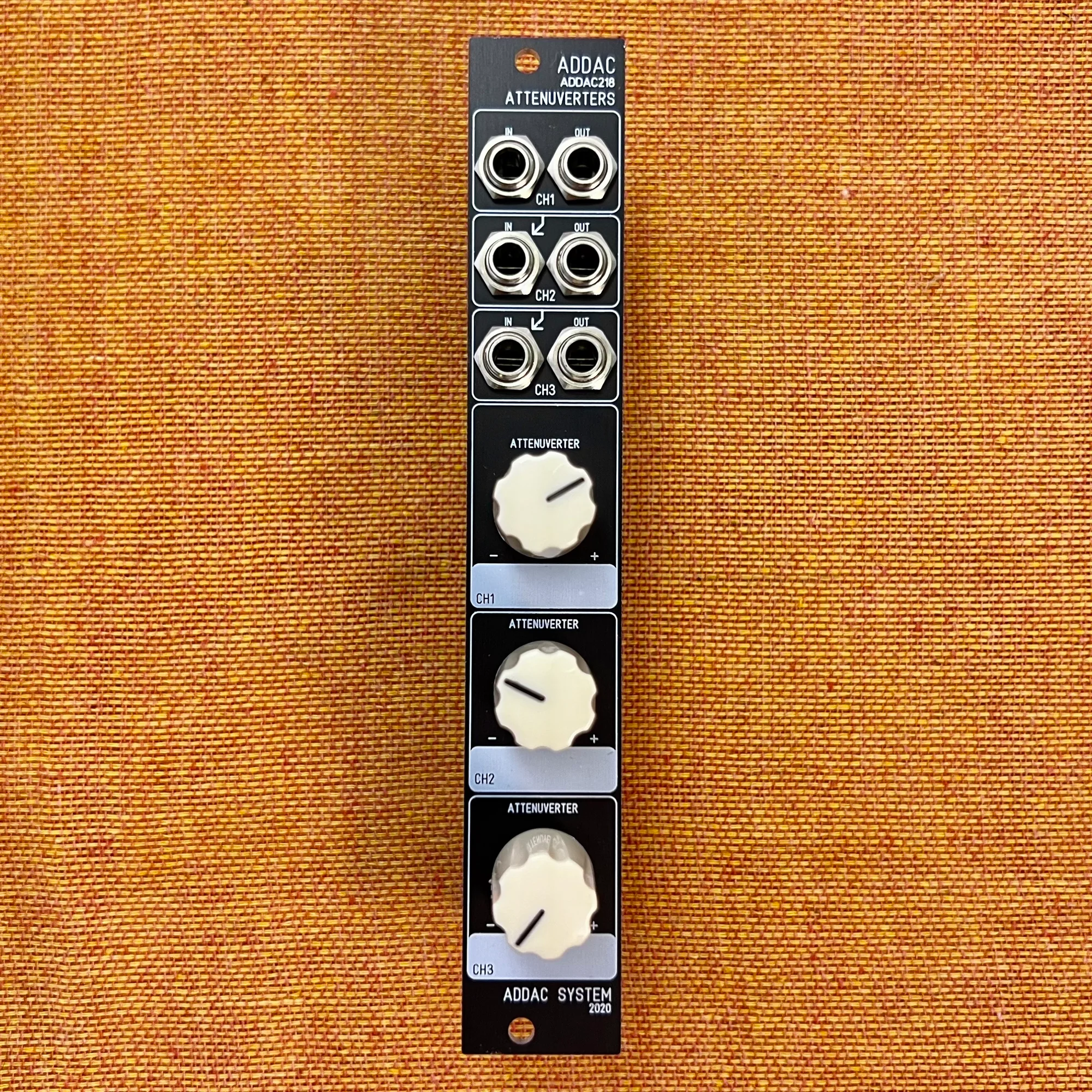
This is an introduction to the ADDAC218 Attenuverters by ADDAC System, available at Takazudo Modular.
The ADDAC218 Attenuverters is a module equipped with 3 channels of Attenuverters. Despite being only 4HP, it features large knobs that make it well-suited for performance use.
The module’s three channels (hereafter Ch) are each independent. However, Ch2 and Ch3 are designed so that when nothing is connected to their IN jacks, they use the input connected to Ch1’s IN (normalled connection).
This product is available for purchase below.
Takazudo Modularではマニュアル等の日本語訳付きを作成し、公開しています。以下よりご参照下さい。
Attenuverter Use Cases
As a modular synth fundamental, an Attenuverter is a module that attenuates and inverts an input signal.
Many modules come with CV inputs alongside knobs for multiple parameters, and those knobs often have Attenuverter functionality built in. For example, on an oscillator, you will commonly see CV input jacks and corresponding Attenuverter knobs for FM Modulation and Pulse Width Modulation.
Below are the built-in Attenuverters on the ADDAC604 Dual Filter and the ADDAC701.REV2 VCO.
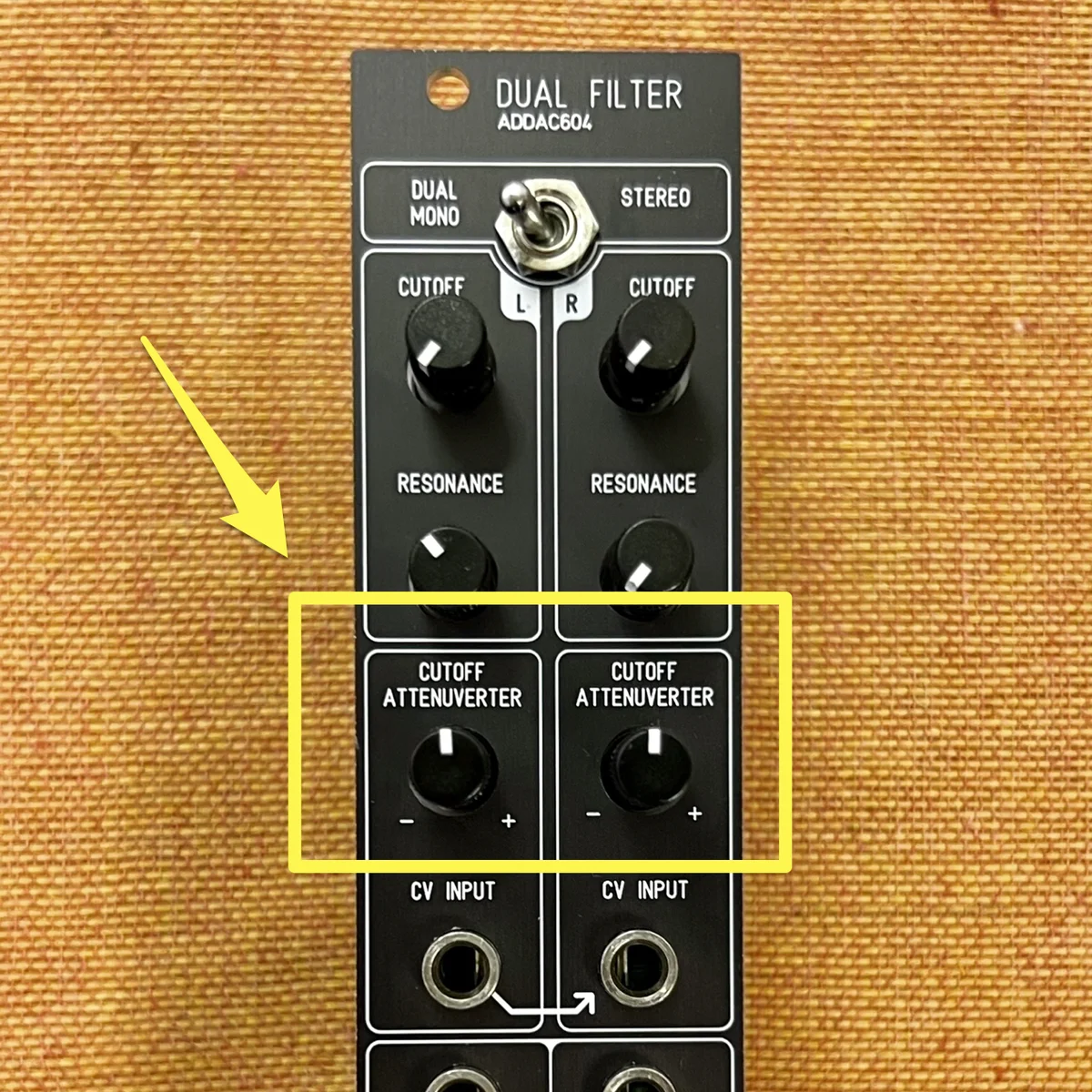
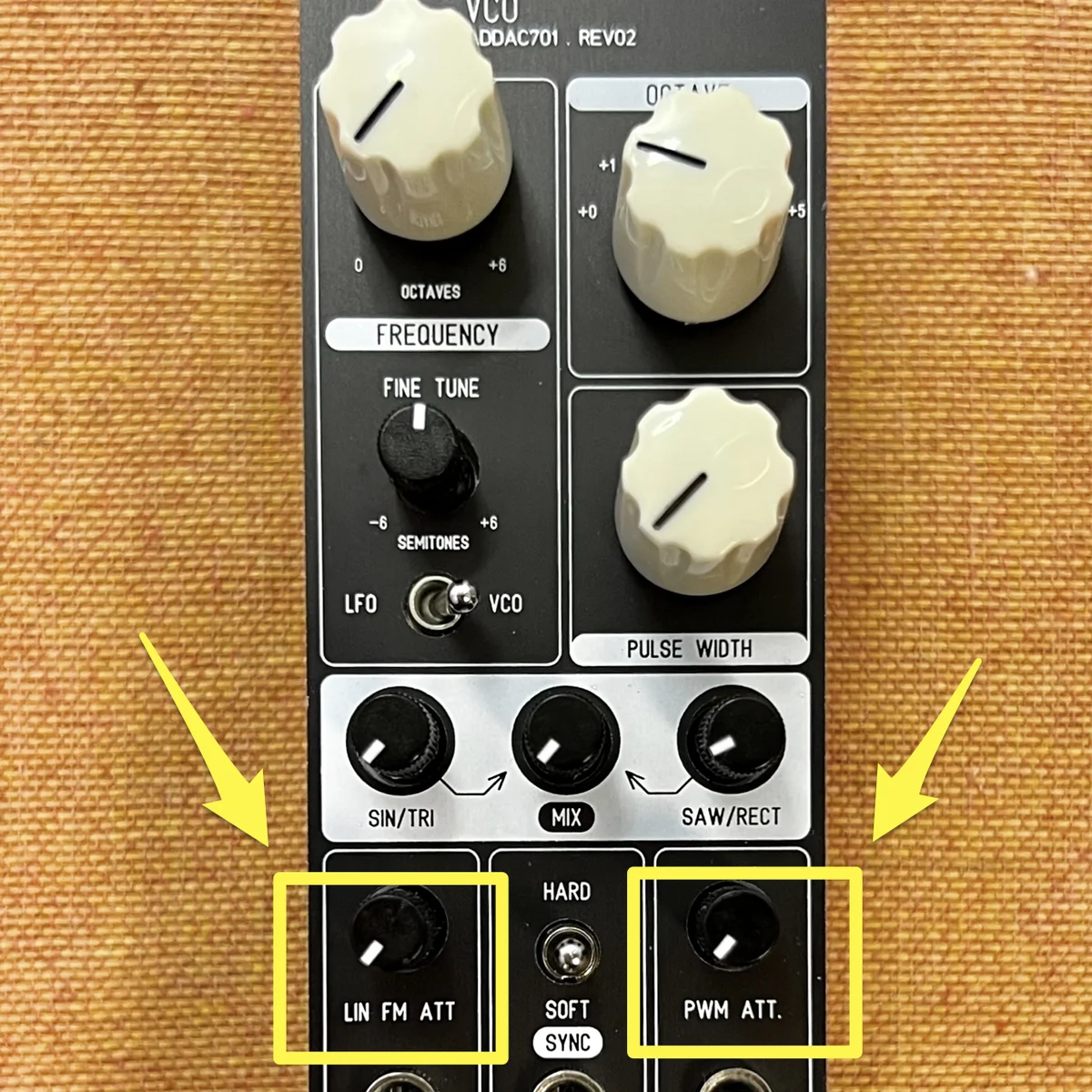
While this module has the advantage of large, easy-to-use knobs, in situations like the above where Attenuverters are already built in, there is no particular need for a separate module.
However, this module shines when leveraging the 3-channel normalled connection configuration, or when you need Attenuverter control for CV inputs that do not have their own built-in Attenuverter. Here are three example use cases.
1. Attenuverting a CV Sequencer’s Output
For example, suppose you are feeding the output of a CV sequencer (such as the OXI ONE CV sequence) into a quantizer (such as the ADDAC207 Intuitive Quantizer) to create 1V/Oct CV for an oscillator.
In this case, the scale-following 1V/Oct CV generated by the quantizer corresponds to the magnitude of the CV produced by the sequencer over time (which goes without saying). If you insert an Attenuverter between them and reduce the CV magnitude to 70%, the range of the CV narrows and the overall voltage drops.

As a result, the melody being played becomes less varied overall and shifts to a lower pitch range.
2. Attenuverting an Envelope
Suppose you connect the output of an Envelope Generator to Ch1’s IN on the ADDAC218. At this point, the Ch1 input is normalled to Ch2 and Ch3 as well. Using this, you can output a single Envelope CV at three different levels.

This is useful, for example, when using a VCA (such as NoisyFruitsLab: Dual VCA) and a VCF (such as ADDAC604 Dual Filter). By sending Ch1’s output to the VCA’s Level CV and Ch2’s output to the VCF’s Cutoff, you can create an effect similar to a Low Pass Gate (such as DPLPG). And you can adjust the Envelope strength independently for Ch1 and Ch2.
Additionally, since many Envelope Generators output CV at fairly high voltage levels, this module is also handy when you simply want to adjust the strength of an Envelope output.
3. Using It for Ducking
This is a somewhat involved process, but Attenuverters can also be used to create an effect known as ducking or sidechain compression. The diagram below illustrates the signal flow.

This diagram shows a kick drum signal being passed through an Envelope Follower, then inverted by the Attenuverter, and fed into a VCA’s CV input. As a result, when the kick volume is high, the VCA level decreases. With this setup, if you feed a hi-hat audio mix into the VCA’s Audio In, the hi-hat volume drops whenever the kick hits, making the kick stand out more prominently.
In a modular system, nearly all communication between modules is CV — changes in voltage. Having an Attenuverter as one of your CV control tools and inserting it between modules to try various ideas is a great approach.
Controlling sound by manipulating CV in this way is, I believe, one of the great pleasures of using a modular synthesizer.
Other Notes
The labels directly below the knobs are provided so you can write in the purpose with a marker when you permanently assign each channel to a specific role in your system. If you find a favorite combination, you can dedicate this module as an Attenuverter for those specific modules and keep it mounted in your rack for easy access.
Manual
The manual is available on the official website below. However, since this module itself is quite simple, no specific usage examples are provided.
Technical Specifications
- Width: 4HP
- Depth: 25mm
- Power consumption: +/-40mA
Included Accessories
- Power ribbon cable
- Screws
ADDAC Systemについて
ADDAC Systemはポルトガルのモジュラーシンセメーカーです。
アナログ良さを生かした、ベーシックな機能をしっかり形にしているモジュールラインナップを基本としつつも、CVをMIDIに柔軟にコンバートしたり、高度にコントロール可能なグラニュラープロセッサー等、デジタル技術もうまく調和させた独創的なモジュールも数多くリリースしています。
オマケ: 電氣美術研究會モジュラー小物セット付き

モジュラーシンセをもっと多くの方に触って欲しいという願いの元、電氣美術研究會さまにご協力頂き、モジュラー小物セットを本商品にバンドルさせて販売させていただいております。
パッチケーブルや電源ケーブル、ドレスナットのサンプルセット、モノラルスプリッターなど、内容は時期に応じて変化します。商品に同梱しますので是非お試し下さい!
That concludes the introduction to the ADDAC218 Attenuverters.
Takazudo Modularではマニュアル等の日本語訳付きを作成し、公開しています。以下よりご参照下さい。
We hope you found this helpful.