This is an introduction to the ADDAC304 Manual Gates by ADDAC System, available at Takazudo Modular.
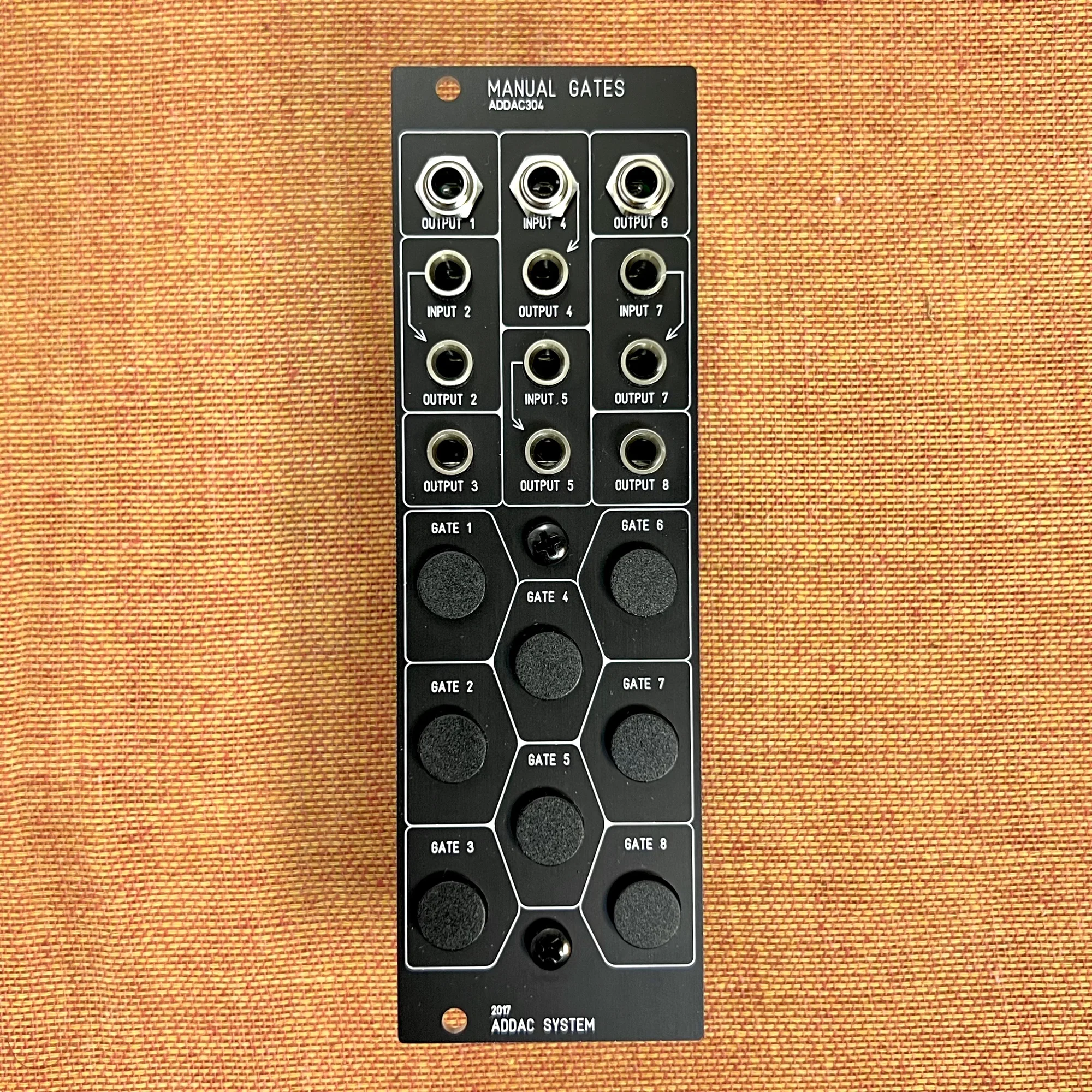
The ADDAC304 is a manual gate output module built around eight momentary switches (switches that are active only while pressed) and their corresponding eight output jacks. Each button outputs a fixed +5V CV from its corresponding jack while it is being pressed.
Additionally, four of the eight channels have separate CV input jacks. When a cable is connected to these input jacks, the corresponding output jack passes through the input CV instead of the fixed +5V.
While extremely simple in function, this module is widely useful for performances using modular systems.
This product is available as an assembled unit built by ADDAC System, as well as a DIY kit.
This product is available for purchase below.
Takazudo Modularではマニュアル等の日本語訳付きを作成し、公開しています。以下よりご参照下さい。
- Product Photos: Assembled
- Product Photos: DIY Kit
- Why Is Sending Gates by Pressing Buttons Useful?
- The Freedom of Modular Synthesizers
- Reference Video
- Technical Specifications
- Included Accessories
- Manual
- DIY Guide
Product Photos: Assembled
Product Photos: DIY Kit


Why Is Sending Gates by Pressing Buttons Useful?
This module is, at its core, simply a module that outputs 5V while a button is pressed.
Some people might feel that since it doesn’t make any interesting sounds on its own, they have no idea what to use it for. However, as the author Takazudo, I find that these kinds of understated CV control modules are actually one of the most enjoyable aspects of building a modular synth system. Let me introduce a few use cases.
As a One-Shot Sound Trigger
When performing with a modular synthesizer, you typically use sequencers to trigger oscillators. With a simple sequencer, you need one sequencer per oscillator. If you want to handle many parts, that means you’d need a huge number of sequencers. Even something like the OXI ONE, which we carry and which can handle multiple tracks at once, has a maximum of eight gate outputs.
And depending on the type of sound, some sounds don’t need to be triggered very often. For example, a sampled voice clip or a flashy crash cymbal or a short loop that you only want to trigger during a big transition in the song. For triggering these one-shot sounds, rather than dedicating an entire sequencer, a module like the ADDAC304 that simply outputs a gate when you press a button might be much more practical.
If you have some kind of sampler module (e.g., 2hp: Play) that plays back a sound upon receiving a gate, then the ADDAC304 can function as eight sample playback trigger buttons.
Syncing Trigger Timing to a Clock with Sample & Hold
However, if you primarily make beat-based music, triggering at arbitrary timing might not be ideal. You might want the trigger to align with a four-on-the-floor kick pattern, for example. In that case, combining the ADDAC304 with a Sample & Hold module (e.g., ADDAC215 S&H+) solves the problem.
The gate produced by the ADDAC304 is output only while the button is held. If you send it directly to a sampler’s trigger as in the previous example, the sound plays immediately. But by inserting a Sample & Hold in between and continuously feeding the clock you want to sync to into the S&H’s Hold input, the gate won’t reach the sampler’s trigger until the next clock pulse.
For example, if you continuously feed a 1/4 note clock gate into the S&H’s Hold input and press the ADDAC304 button slightly before you want the sound to play, the S&H won’t pass the gate through until the next 1/4 note timing, so the sample plays in time with the beat. Alternatively, feeding a 1/16 note clock and doing the same thing lets you casually press buttons while the triggers automatically snap to the clock.
This is admittedly a bit involved, and it does require a dedicated S&H module, but it solves the problem of outputting gates in sync with a clock.
Outputting External CV Instead
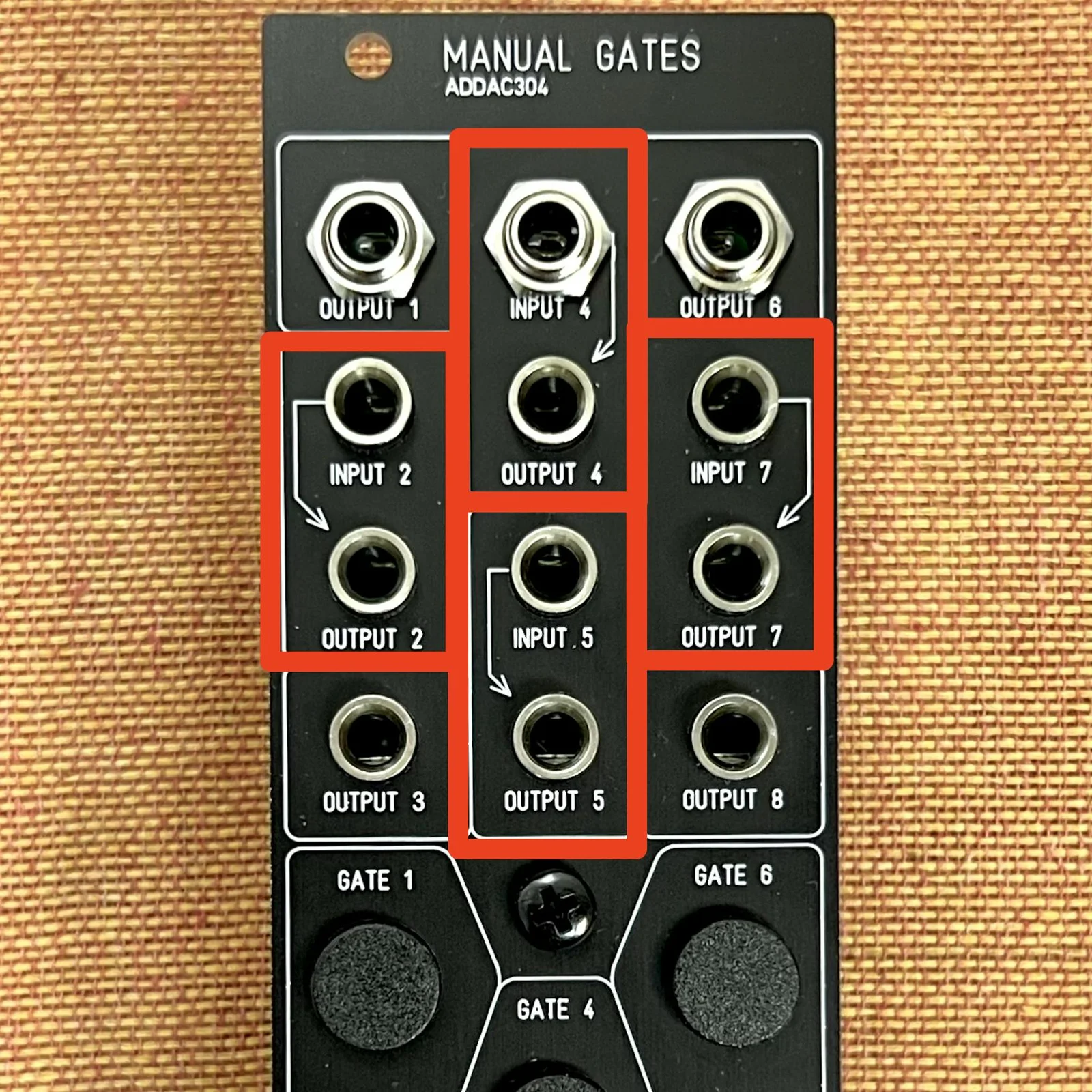
By default, the ADDAC304 outputs 5V CV while a button is pressed, but buttons 2/4/5/7 each have a CV input jack. When a cable is connected to this jack, the CV received at INPUT is passed through to OUTPUT only while the button is held.
This feature can be thought of as a way to unmute a normally muted CV signal by pressing the button, and it offers a very wide range of applications.
For example, you can use this to pass through a gate output from a sequencer only when you want it. If you’re outputting a continuous stream of 1/16 clock gates from a sequencer like the OXI ONE and feeding it to a NoisyFruitsLab: 808 Snare Drum, you’d get a continuous snare roll. But what if you only want to use that during a brief break? In that case, route the OXI ONE’s gate output through the ADDAC304’s channel 2 INPUT, and connect the OUTPUT to the 808 Snare Drum’s TRIG.
In this setup, the gate output from the OXI ONE is normally blocked by the ADDAC304, so the snare stays silent. When you press button 2 on the ADDAC304, the gate from the OXI ONE passes through to the 808 Snare Drum, and the snare starts playing. Release the button, and the gate is blocked again, silencing the snare.
In this way, when you want to temporarily pass CV through, the INPUT jacks on channels 2/4/5/7 of the ADDAC304 are extremely useful.
Beyond this, you could temporarily apply FM modulation to an oscillator like the ADDAC701.REV2 VCO, or temporarily alter effects on a Sproom DSP. What buttons 2/4/5/7 do is simply unmute a muted CV, but precisely because of that simplicity, the possibilities are endless. The ADDAC304 is almost like a puzzle piece of a module.
The Freedom of Modular Synthesizers
When you think about why people use modular synthesizers, which deliberately separate oscillators and filters into individual modules, one major reason is that you want a custom set of gear combined exactly the way you want it.
There’s a joy in combining your favorite sequencer, your favorite sound sources, and your favorite knobs and buttons to build something unique. As one element of that, the primitive mechanism of pressing a button to generate a trigger CV is something that matches the modular synth platform exceptionally well, in my opinion as Takazudo.
A sibling module to this one is the ADDAC305 Manual Latches, which uses latch switches (switches that toggle ON/OFF with each press) instead of momentary switches. We encourage you to explore both and experiment with various ways to use them. Be sure to check it out.
Reference Video
Below is an explanatory video published on ADDAC System’s official YouTube channel, covering both this module, the ADDAC304 Manual Gates, and the ADDAC305 Manual Latches.
In this video, you can see a real-time performance using the ADDAC304 and ADDAC305 to perform the following types of control:
- Toggling gate output from a sequencer ON/OFF
- Resetting the sequencer
- Triggering drum modules
- Triggering delay
- Enabling effects only while a button is held
Technical Specifications
- Width: 8HP
- Depth: 25mm
- CV input voltage: +/-10V
- Gate output voltage: 0/+5V
- Max power consumption: 10mA
Included Accessories
- Power ribbon cable
- Screws
Manual
No dedicated manual is provided for this module. If you have any questions, please feel free to contact us.
DIY Guide
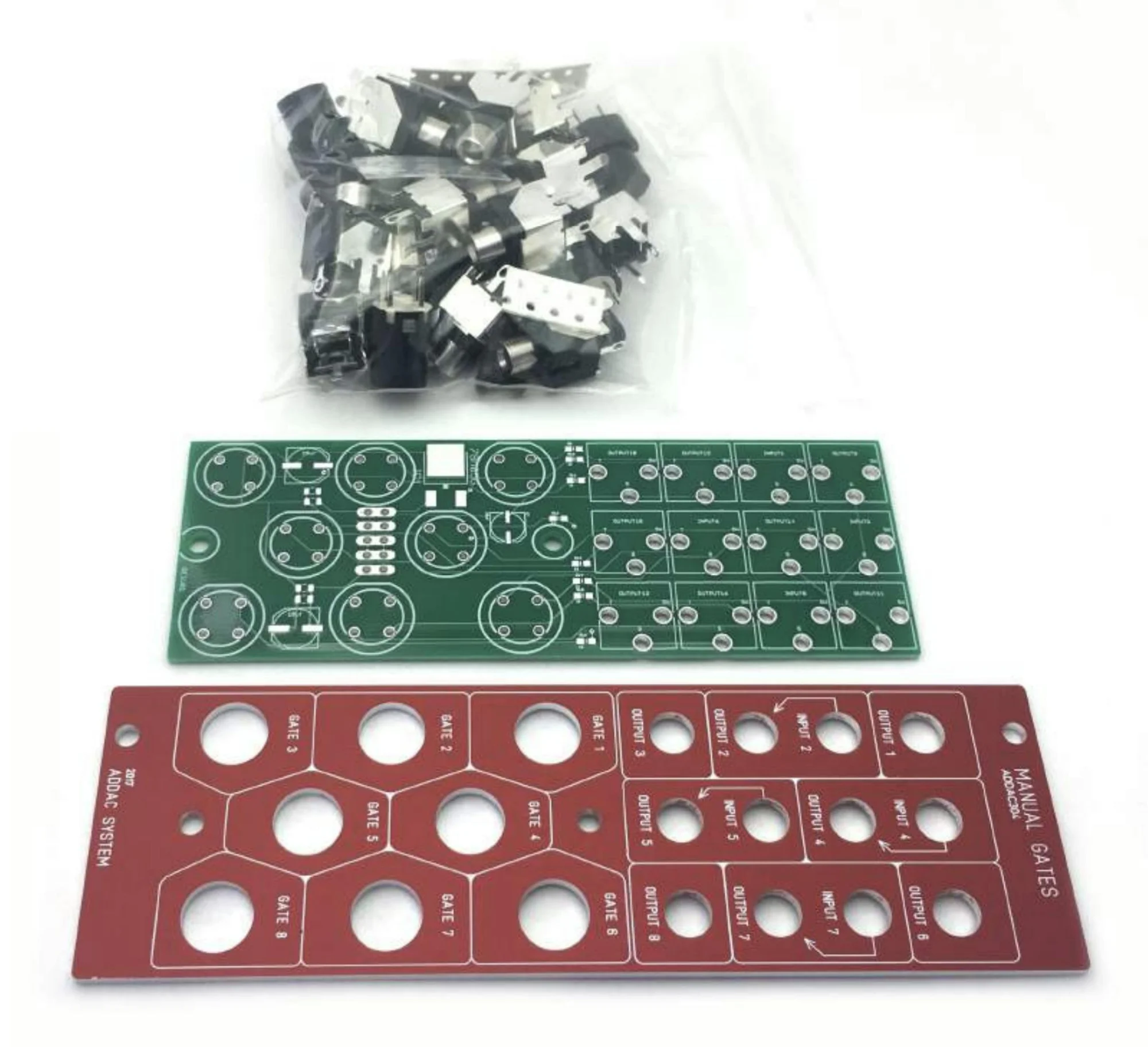
The DIY kit includes the panel, PCB, all components, power ribbon cable, and mounting screws.
ADDAC System provides detailed DIY guides on their website. Please refer to the guide below when assembling your kit.
*Note: The photos in the DIY guide show a red panel, but the actual product panel is black.
While the DIY guide for this module includes instructions for mounting many very small parts (SMD parts), upon inspecting an actual kit, the components are prepared so that assembly can be completed by soldering only the relatively larger, easier-to-handle through-hole parts such as jacks and buttons.
モジュラーシンセのDIYとは?
モジュラーシンセサイザーのDIYについて詳しくご存じない方向けに、以下にDIYの導入的なコラムを用意しました。DIYについてご興味のある方、始めてみようと思う方は、是非ご参照いただければと。
また、組み立てに際して不明点や不安な点がございましたら、以下Takazudo Modularのdiscordチャンネルにてお気軽にご質問等、頂ければと思います。
ADDAC Systemについて
ADDAC Systemはポルトガルのモジュラーシンセメーカーです。
アナログ良さを生かした、ベーシックな機能をしっかり形にしているモジュールラインナップを基本としつつも、CVをMIDIに柔軟にコンバートしたり、高度にコントロール可能なグラニュラープロセッサー等、デジタル技術もうまく調和させた独創的なモジュールも数多くリリースしています。
オマケ: 電氣美術研究會モジュラー小物セット付き

モジュラーシンセをもっと多くの方に触って欲しいという願いの元、電氣美術研究會さまにご協力頂き、モジュラー小物セットを本商品にバンドルさせて販売させていただいております。
パッチケーブルや電源ケーブル、ドレスナットのサンプルセット、モノラルスプリッターなど、内容は時期に応じて変化します。商品に同梱しますので是非お試し下さい!
That concludes the introduction to the ADDAC304 Manual Gates.
Takazudo Modularではマニュアル等の日本語訳付きを作成し、公開しています。以下よりご参照下さい。
We hope you found this helpful.