This is an introduction to the ADDAC305 Manual Latches by ADDAC System, available at Takazudo Modular.
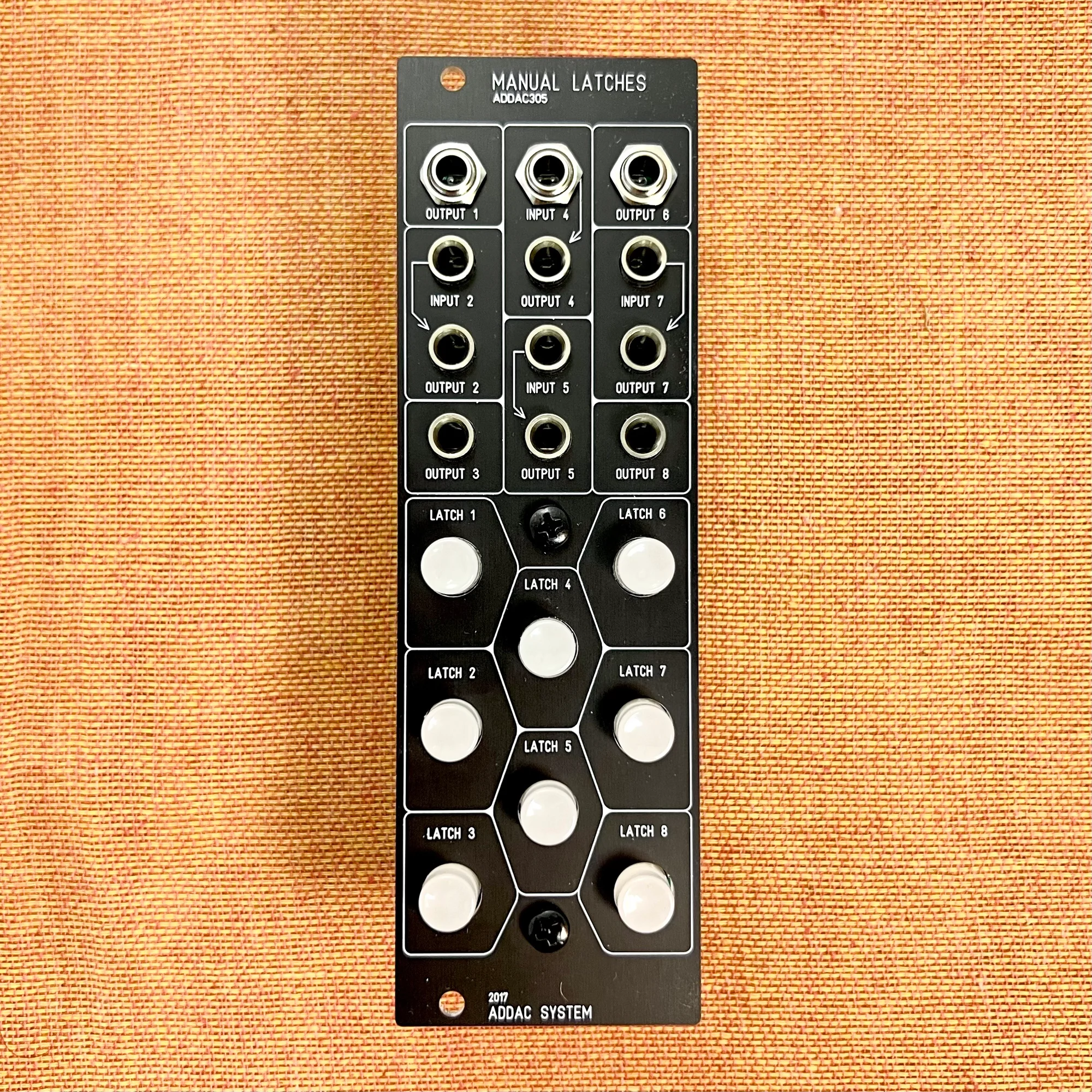
The ADDAC305 is a manual gate output module built around eight latch switches (switches that toggle ON/OFF with each press) and their corresponding eight output jacks. Each button lights up when pressed to indicate it is ON. Pressing it again turns the light off, indicating OFF. While a button is ON, the corresponding jack outputs a fixed +5V CV.
Additionally, four of the eight channels have separate CV input jacks. When a cable is connected to these input jacks, the corresponding output jack passes through the input CV instead of the fixed +5V.
While extremely simple in function, this module is widely useful for performances using modular systems.
This product is available as an assembled unit built by ADDAC System, as well as a DIY kit.
This product is available for purchase below.
Takazudo Modularではマニュアル等の日本語訳付きを作成し、公開しています。以下よりご参照下さい。
- Product Photos: Assembled
- Product Photos: DIY Kit
- ADDAC304 Manual Gates and ADDAC305 Manual Latches
- Use Cases for Latch Switches
- Mute/Unmute
- Reference Video
- Technical Specifications
- Included Accessories
- Manual
- DIY Guide
Product Photos: Assembled
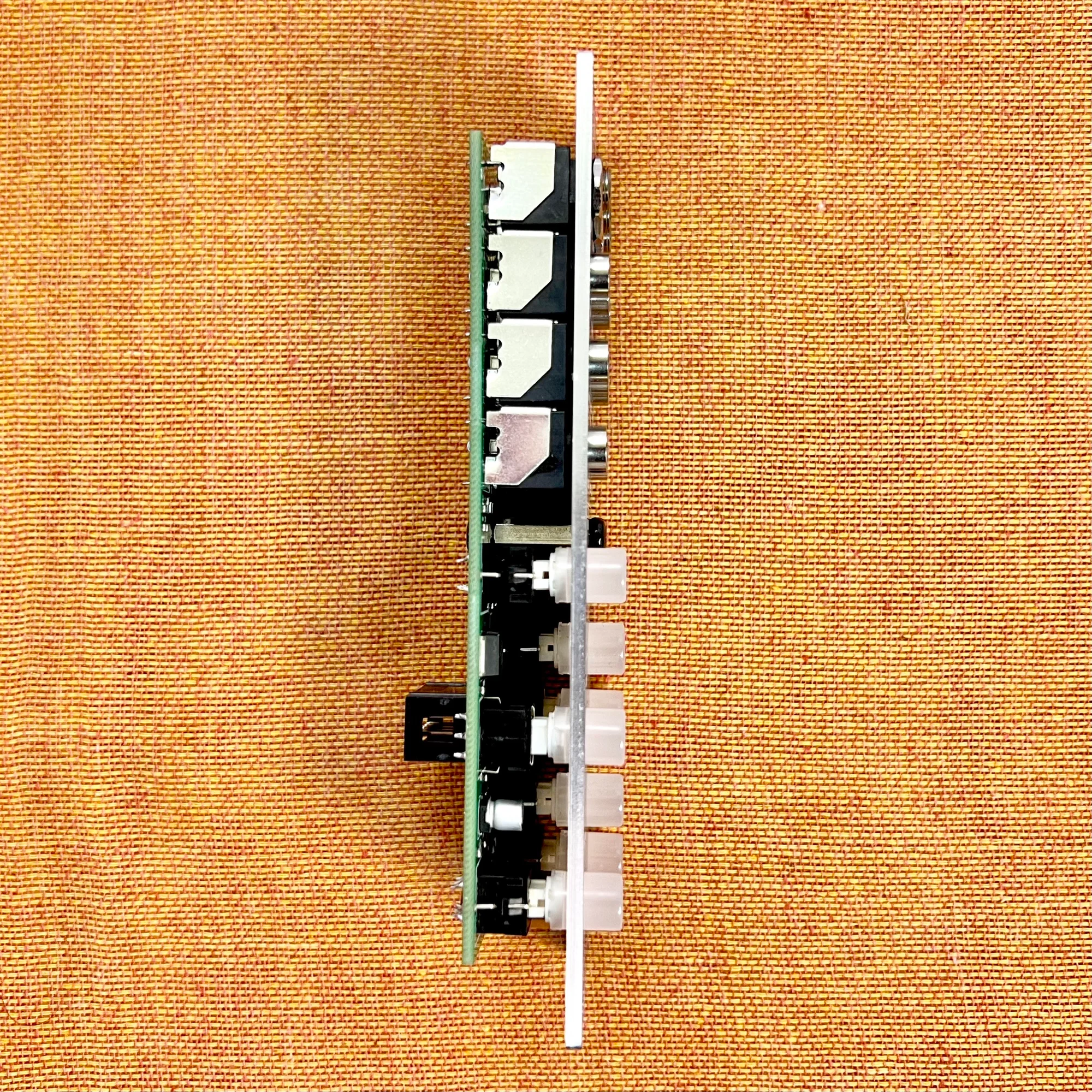
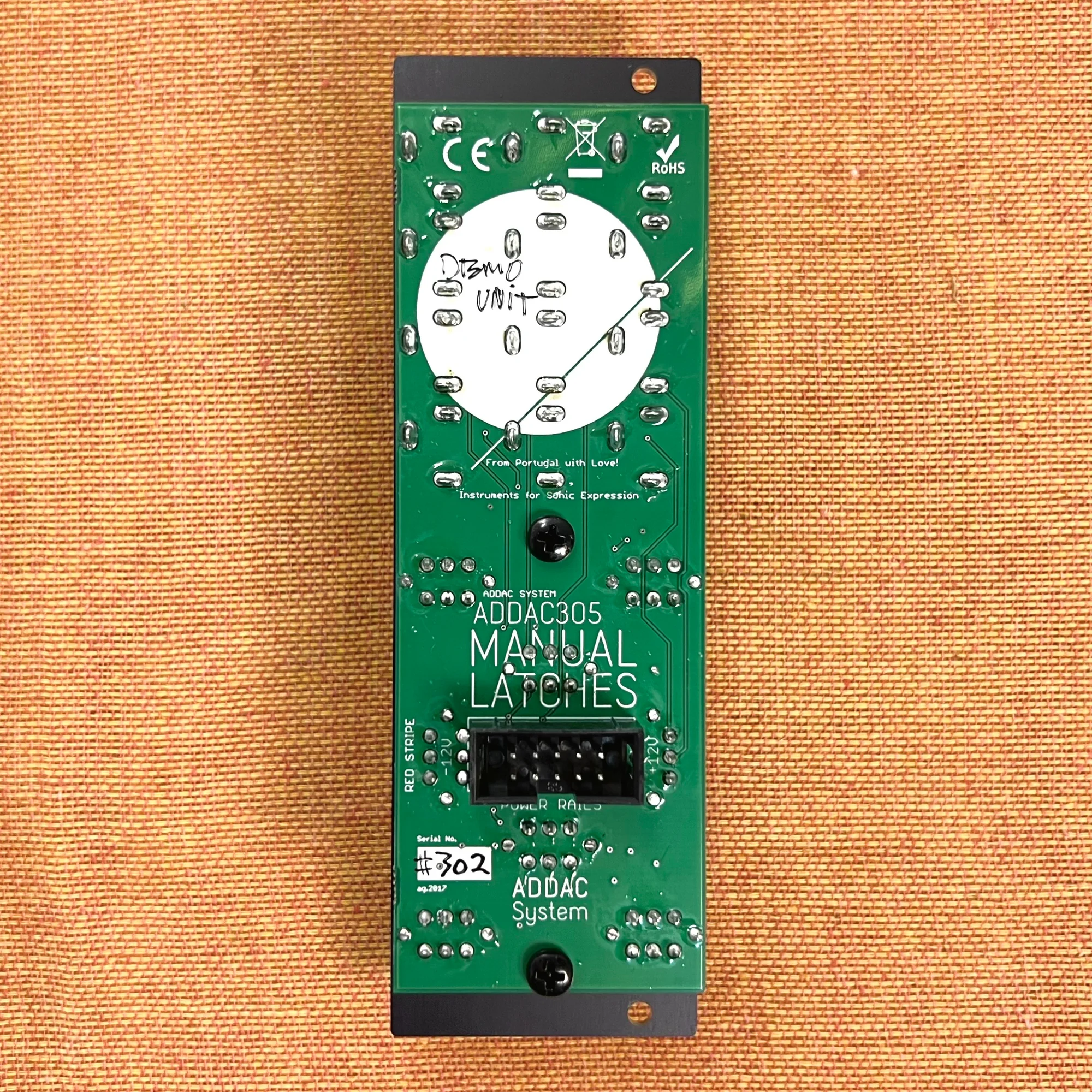

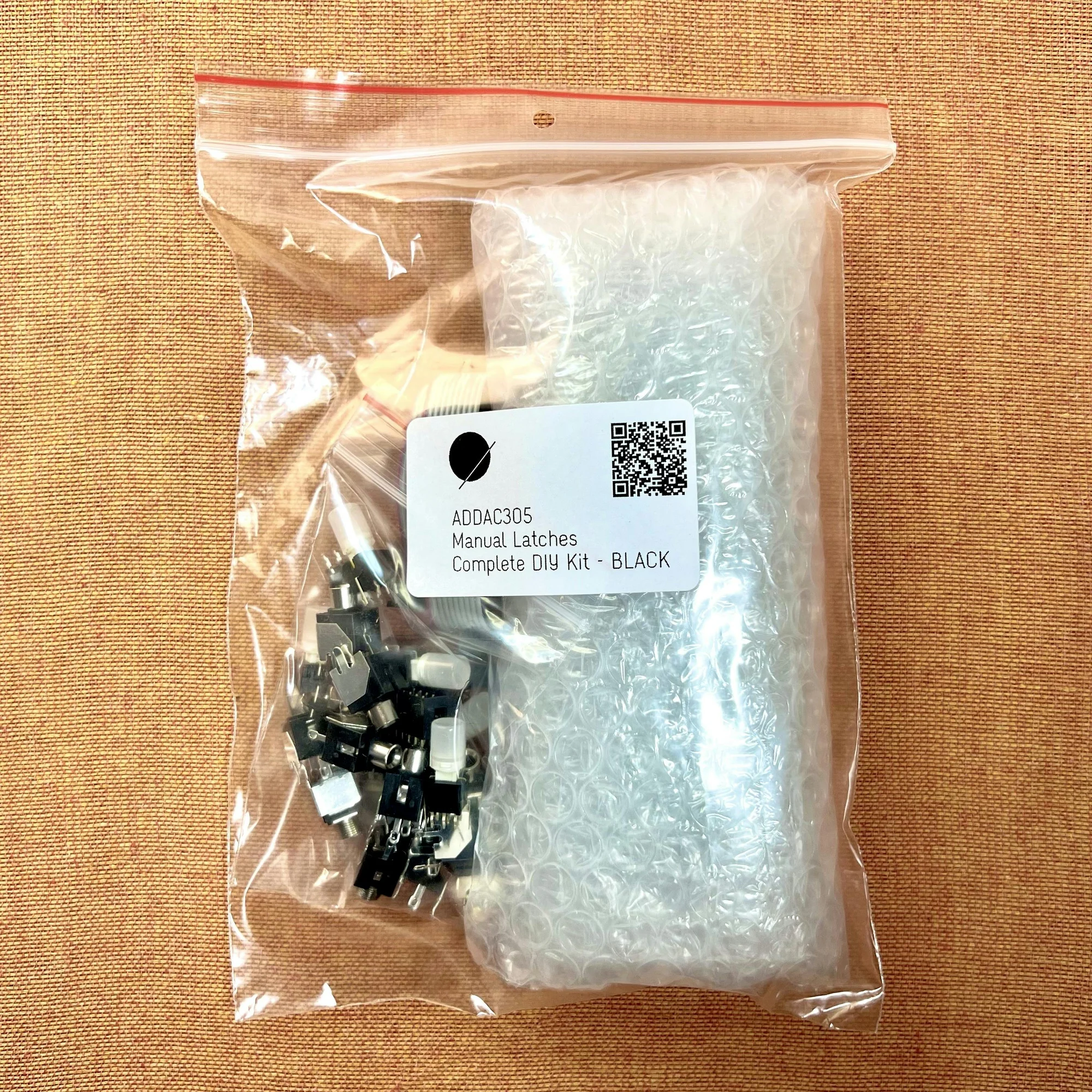
Product Photos: DIY Kit

ADDAC304 Manual Gates and ADDAC305 Manual Latches
First, this module is essentially a sibling module to the ADDAC304 Manual Gates, and shares a great deal of common ground with the ADDAC304 introduction article.
The ADDAC304 is “a module that outputs a gate while the switch is held down”, while this ADDAC305 is “a module that outputs a gate while the switch is ON”. Everything else is completely identical. We recommend first skimming the ADDAC304 introduction above before reading this article.
Use Cases for Latch Switches
The basic use cases for this module are essentially the same as those described in the ADDAC304 Manual Gates article. The ability to use Sample & Hold for beat synchronization and to handle CV output from other modules applies equally.
The key difference is that the ADDAC305 stays ON once activated until the button is pressed again, making it easier to use when you want to change a state persistently. In this article, we’ll introduce three usage examples.
Mute/Unmute
To start with, since this module’s ON/OFF state is indicated by the button’s illumination, it can be conveniently used as a simple persistent mute/unmute control.
For example, output four drum track gate sequences from an OXI ONE:
- Kick
- Snare
- Hi-Hat
- Clap
Connect each to the INPUT of channels 2/4/5/7 on the ADDAC305. Route each OUTPUT to the trigger input of the respective drum module, and the ADDAC305 functions as a mute switch for four tracks.
Simple, but having mute/unmute control consolidated in one place is very convenient.
CV and Effect Toggle
With the momentary-switch ADDAC304, you have to keep holding the button down the entire time you want a filter active. But with the latch-button ADDAC305, once you press it, it stays ON until you press it again.
In the ADDAC304 Manual Gates introduction article, we gave examples of applying FM modulation or altering effects. When you want to sustain these changes for a while, the latch-button ADDAC305 may be better suited. That said, the ADDAC304 introduction covered use cases like triggering one-shot samples or temporarily unmuting, and for those “just briefly ON” scenarios, the latch-switch ADDAC305 would be less convenient.
The choice comes down to how you want to use your modular synth. It’s not about which one is more efficient; rather, the choice of tools itself is part of what makes modular synths fun. We recommend thinking about what you want to do and how, and choosing accordingly.
Shifting Sequence CV Up or Down
Here’s another example that I, Takazudo, use frequently. I often mix a fixed CV into whatever CV is serving as the basis for a melody line, to instantly shift the pitch up or down. Having a latch switch-style CV control like this is convenient for introducing pitch changes at the timing you want.
For example, suppose you’re using an OXI ONE Modulation Lane to loop a CV sequence, feeding it into an ADDAC207 Intuitive Quantizer, and then to an oscillator. While the OXI ONE alone can certainly create any sequence, doing something like temporarily lowering the CV pattern in the Modulation Lane by one octave is difficult. (This is possible in the regular note-by-note mode, but here we’ll assume you’re working with the Modulation Lane CV approach.)
In this situation, you can take a module like the ADDAC203 REV.02 CV Mapping that can output a fixed CV, output -1V for example, feed it into the ADDAC305, and have the -1V CV output only while the latch button is ON. Then mix this with the sequence CV from the OXI ONE before sending it to the quantizer. What happens is that the ADDAC305’s latch button functions as a switch that lowers the melody by one octave.
In this example, we used -1V for one octave down to keep things clear, but in practice, it’s much more intuitive. You just create a CV that sounds roughly right, prepare a few of them, and mix them together as you play.
In the session video below by Takazudo, although the configuration is different, a fixed CV output from the ADDAC305 is connected to Sycamore’s pitch Shift jack, shifting the melody line up or down while the latch switch is ON.
It sounds complicated when explained in writing, but in practice, it’s closer to the feeling of adding and subtracting CV to alter a melody as you play. I find that very instrument-like. We encourage you to try various approaches.
Reference Video
Below is an explanatory video published on ADDAC System’s official YouTube channel, covering both this module, the ADDAC305 Manual Latches, and the ADDAC304 Manual Gates.
In this video, you can see a real-time performance using the ADDAC304 and ADDAC305 to perform the following types of control:
- Toggling gate output from a sequencer ON/OFF
- Resetting the sequencer
- Triggering drum modules
- Triggering delay
- Enabling effects only while a button is held
Technical Specifications
- Width: 8HP
- Depth: 25mm
- CV input voltage: +/-10V
- Gate output voltage: 0/+5V
- Max power consumption: 10mA
Included Accessories
- Power ribbon cable
- Screws
Manual
No dedicated manual is provided for this module. If you have any questions, please feel free to contact us.
DIY Guide
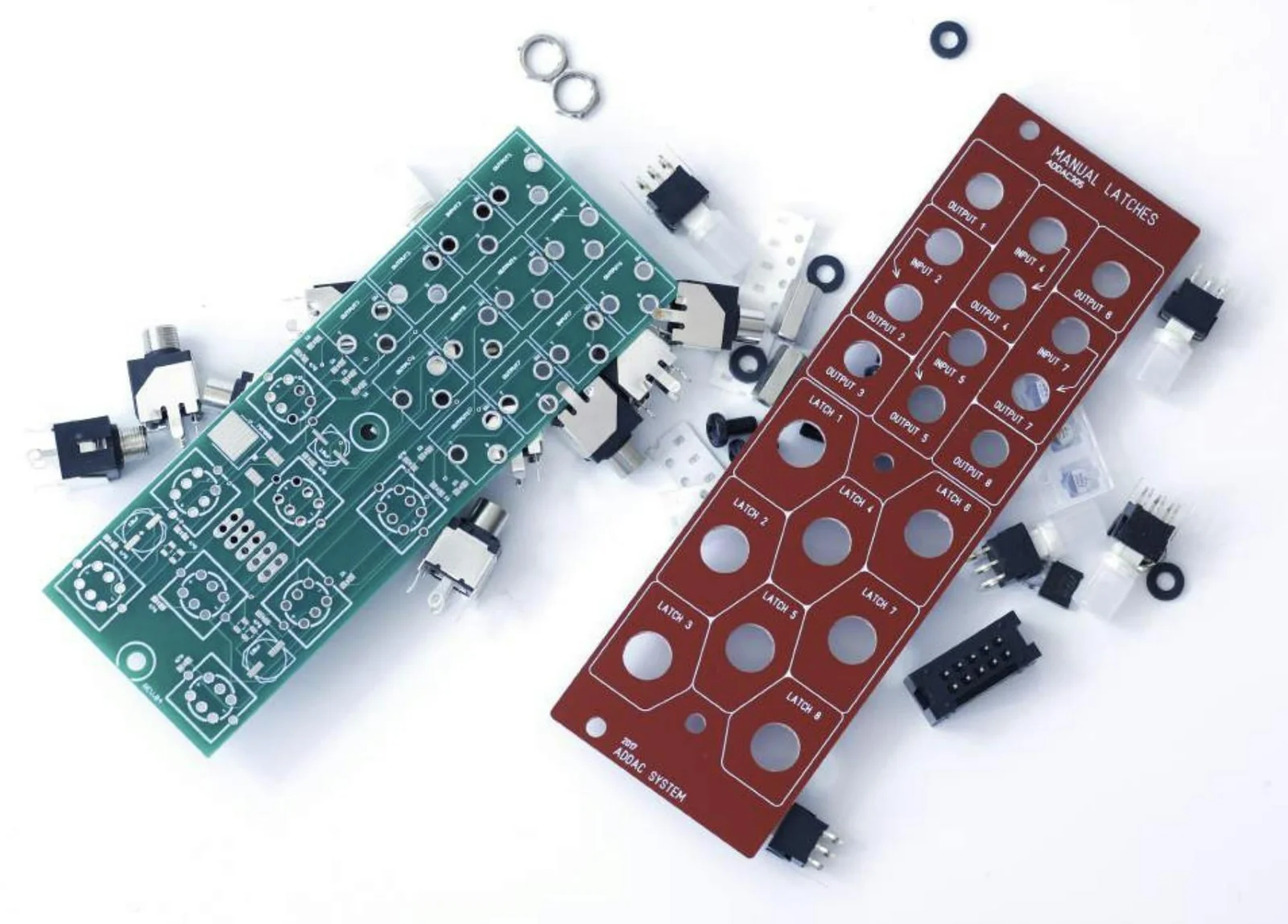
The DIY kit includes the panel, PCB, all components, power ribbon cable, and mounting screws.
ADDAC System provides detailed DIY guides on their website. Please refer to the guide below when assembling your kit.
*Note: The photos in the DIY guide show a red panel, but the actual product panel is black.
While the DIY guide for this module includes instructions for mounting many very small parts (SMD parts), upon inspecting an actual kit, the components are prepared so that assembly can be completed by soldering only the relatively larger, easier-to-handle through-hole parts such as jacks and buttons.
モジュラーシンセのDIYとは?
モジュラーシンセサイザーのDIYについて詳しくご存じない方向けに、以下にDIYの導入的なコラムを用意しました。DIYについてご興味のある方、始めてみようと思う方は、是非ご参照いただければと。
また、組み立てに際して不明点や不安な点がございましたら、以下Takazudo Modularのdiscordチャンネルにてお気軽にご質問等、頂ければと思います。
ADDAC Systemについて
ADDAC Systemはポルトガルのモジュラーシンセメーカーです。
アナログ良さを生かした、ベーシックな機能をしっかり形にしているモジュールラインナップを基本としつつも、CVをMIDIに柔軟にコンバートしたり、高度にコントロール可能なグラニュラープロセッサー等、デジタル技術もうまく調和させた独創的なモジュールも数多くリリースしています。
オマケ: 電氣美術研究會モジュラー小物セット付き

モジュラーシンセをもっと多くの方に触って欲しいという願いの元、電氣美術研究會さまにご協力頂き、モジュラー小物セットを本商品にバンドルさせて販売させていただいております。
パッチケーブルや電源ケーブル、ドレスナットのサンプルセット、モノラルスプリッターなど、内容は時期に応じて変化します。商品に同梱しますので是非お試し下さい!
That concludes the introduction to the ADDAC305 Manual Latches.
Takazudo Modularではマニュアル等の日本語訳付きを作成し、公開しています。以下よりご参照下さい。
We hope you found this helpful.