This is an introduction to the ADDAC701.REV2 VCO by ADDAC System, available at Takazudo Modular.
The ADDAC701.REV2 VCO is a standard VCO from ADDAC System. This module is the new REV2 revision, featuring improved pitch accuracy and additional functions over the original REV1. With a 6-octave rotary switch, flexible waveform mixing, and other well-considered features packed into a basic design, it is a module you’ll always be glad to have in your rack.
This product is available as an assembled unit built by ADDAC System, as well as a DIY kit.
This product is available for purchase below.
- Product Photos: Assembled
- Product Photos: DIY Kit
- Features of the ADDAC701.REV2 VCO
- CEM3340-Based High-Precision Oscillator
- Flexible Pitch Control
- Diverse Waveform Output
- The Appeal of a Basic Analog Oscillator
- Reference Video
- Technical Specifications
- Included Accessories
- Manual
- DIY Guide
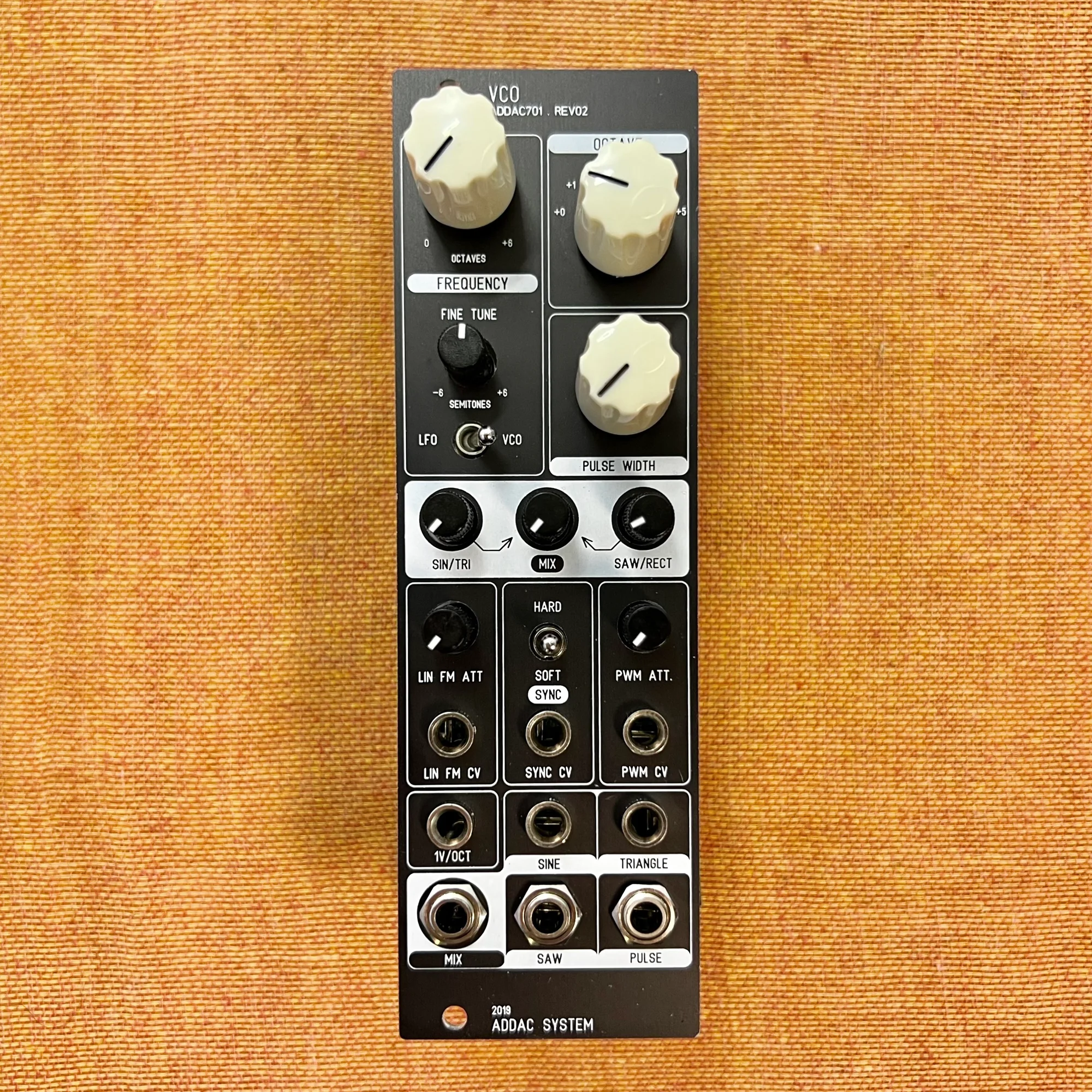
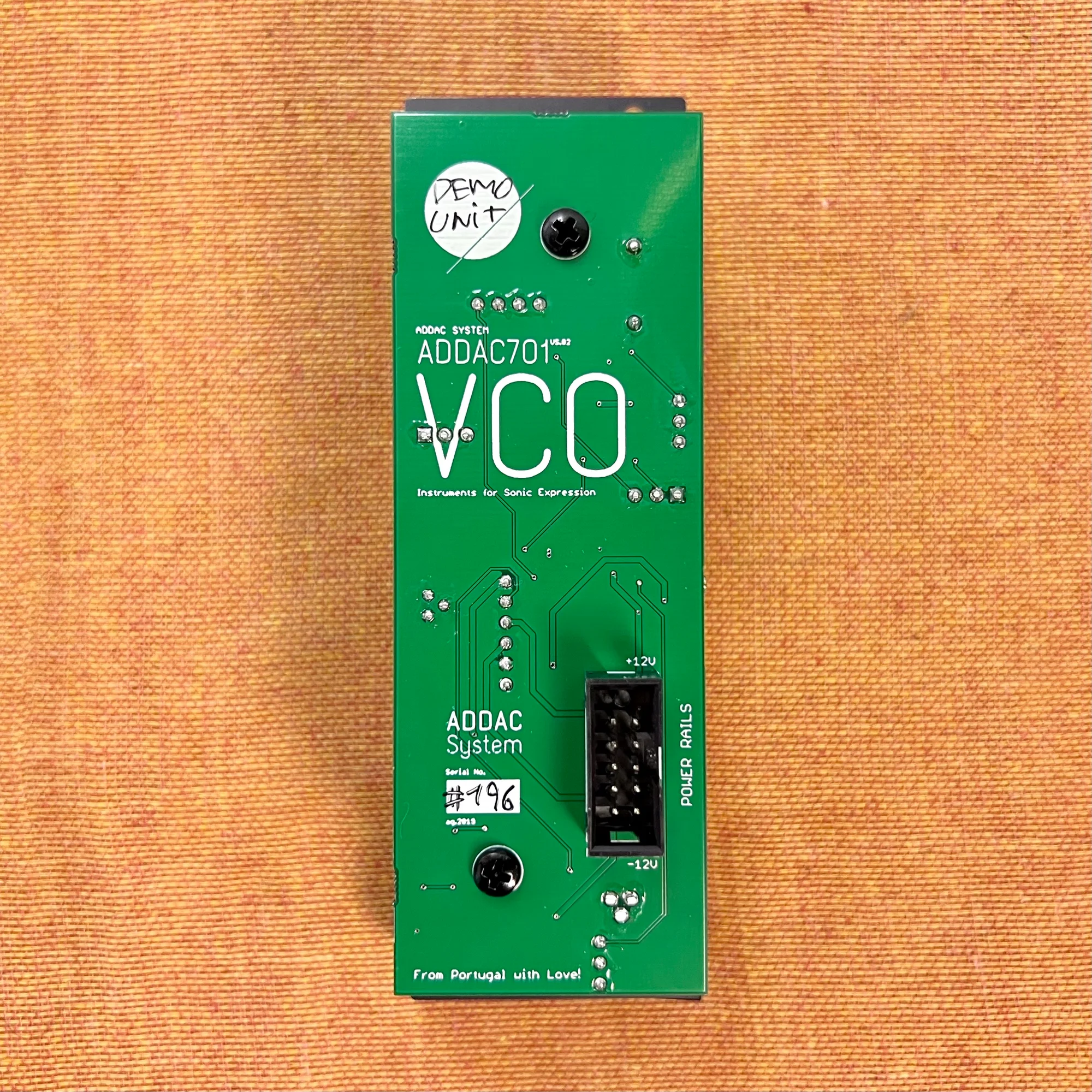
Product Photos: Assembled

Product Photos: DIY Kit
Features of the ADDAC701.REV2 VCO
This module is a basic type of VCO, but its supporting features are well-rounded and thorough. Let’s first list the key features and then explain each one:
- Standard
1V/OCTCV input FREQUENCYknob with a 6-octave rangeFINE TUNEknob with a 12-semitone rangeOCTAVErotary switch with a 6-octave range- Linear
FMCV input with Attenuator LFO/VCOtoggle switch that drastically changes the output waveform frequencySYNCswitch selectable betweenSOFTandHARDPULSE WIDTHknob for pulse width controlPWMCV input with Attenuator- Sine, Triangle, Saw, and Pulse waveform outputs
- Three knobs —
SIN/TRI,MIX, andSAW/RECT— enabling mixed waveform output
CEM3340-Based High-Precision Oscillator
The ADDAC701 uses a modern version of CoolAudio’s CEM3340 IC at its core.
The CEM3340 is a VCO chip for analog synthesizers originally developed in the 1970s. Highly regarded for its precision and tonal versatility, it was used in numerous synthesizers including the Sequential Circuits Prophet-5 and Roland SH-101. Even today, reissue versions and compatible chips based on the original design continue to be manufactured and used in many synthesizers.
ADDAC System improved upon the previous ADDAC71 VCO (REV1), redesigning it as the new REV2 to enhance pitch output accuracy and minimize the pitch detuning issues common to analog VCOs (where pitch accuracy degrades due to environmental factors and aging).
Flexible Pitch Control
The ADDAC701 offers a precise pitch range spanning over 7 octaves.
Pitch can be controlled via the FREQUENCY and FINE TUNE knobs in the upper left of the panel, as well as a 6-position OCTAVE rotary switch. Personally, the feature I appreciate most on a basic VCO like this is the octave selector switch.
Being able to easily switch between octaves makes it possible to introduce dramatic changes during live performances without disrupting the current tone. With its wide pitch range and easy octave switching, it could also be interesting to tune multiple ADDAC701s together for polyphonic use.
Diverse Waveform Output
The ADDAC701 can output Sine, Triangle, Saw, and Pulse waveforms individually. Additionally, the knobs in the center of the panel allow for mixed waveform output from these waveforms.
Furthermore, switching the LFO/VCO toggle switch to LFO mode slows down the oscillation rate, allowing it to function as an LFO. In principle, both LFOs and VCOs are fundamentally the same — devices that oscillate voltage up and down. When the output frequency is low, it’s called an LFO; when it offers precise pitch control via 1V/Oct CV, it’s called a VCO. The LFO/VCO toggle switch enables this single module to flexibly serve both roles.
The Appeal of a Basic Analog Oscillator
Modern synthesizers, having evolved over decades since the instrument was first conceived, often feature oscillators with novel algorithms never implemented before, or offer vast preset libraries to choose tones from — in short, rich-featured oscillators. After decades of technological progress, this is a natural evolution.
While making music with such synthesizers is certainly rewarding, even a simple module like the ADDAC701 that outputs basic waveforms can produce a wide variety of timbres using Frequency Modulation and Hard/Soft Sync.
The act of creating sounds by CV-controlling fundamental oscillator functions is, I believe, what awakens the synthesizer player to the joy of crafting their own sounds.
This is a basic yet high-quality VCO that we would recommend to experts seeking a high-precision oscillator, as well as to those just getting started with modular synthesis.
Reference Video
Below is a session where I used the ADDAC701.REV2. I prepared two ADDAC701 units, using one for modulation and Hard/Soft Sync. The sequence is from OXI ONE, the VCO output goes through a DPLPG, and effects are applied via AUM on iPad.
Technical Specifications
- Width: 8HP
- Depth: 35mm
- Power consumption: 60mA +12V / 60mA -12V
Included Accessories
- Power ribbon cable
- Screws
Manual
The manual is available on the official website below. However, since the module itself is straightforward, the manual only contains a calibration guide.
DIY Guide
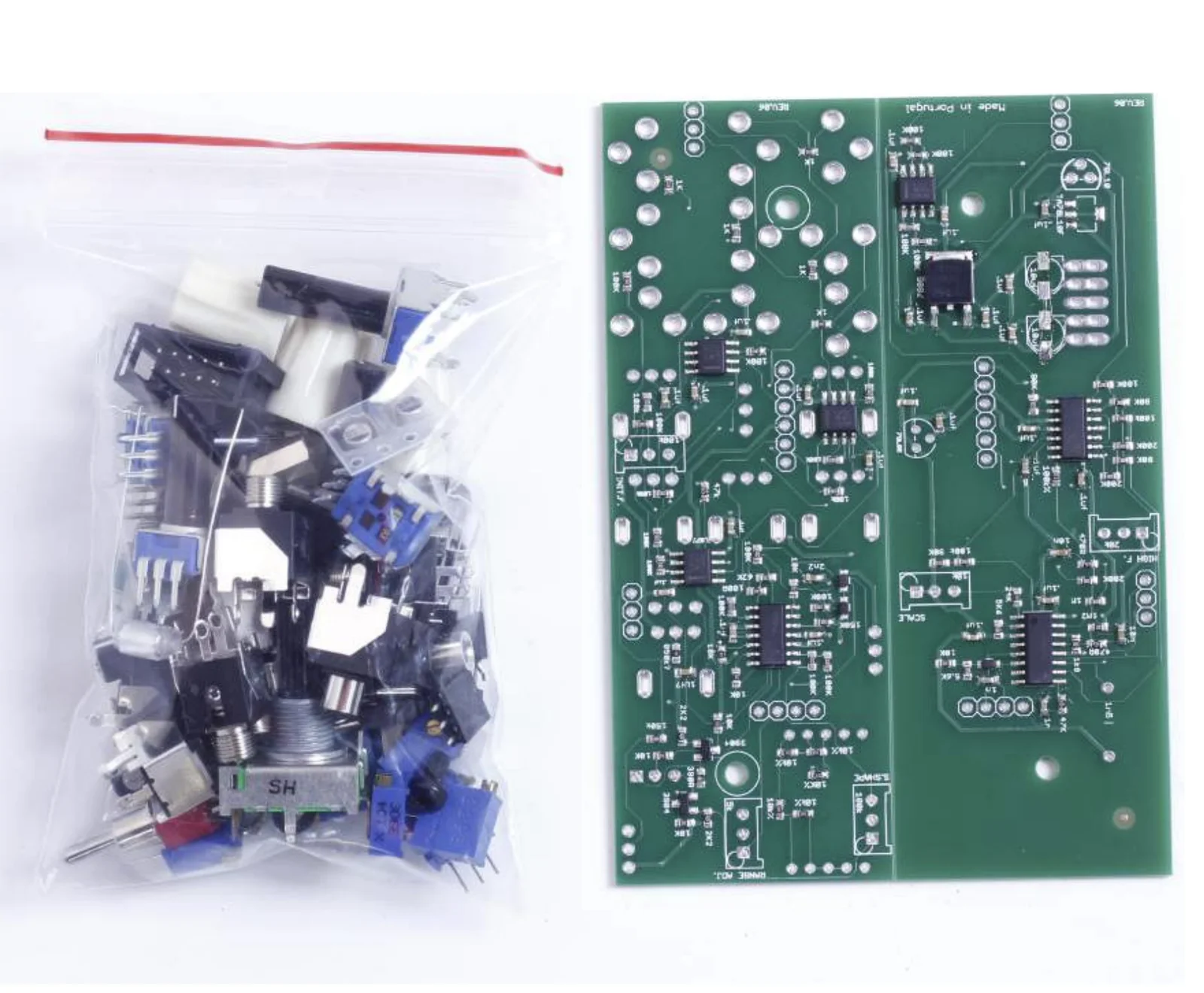
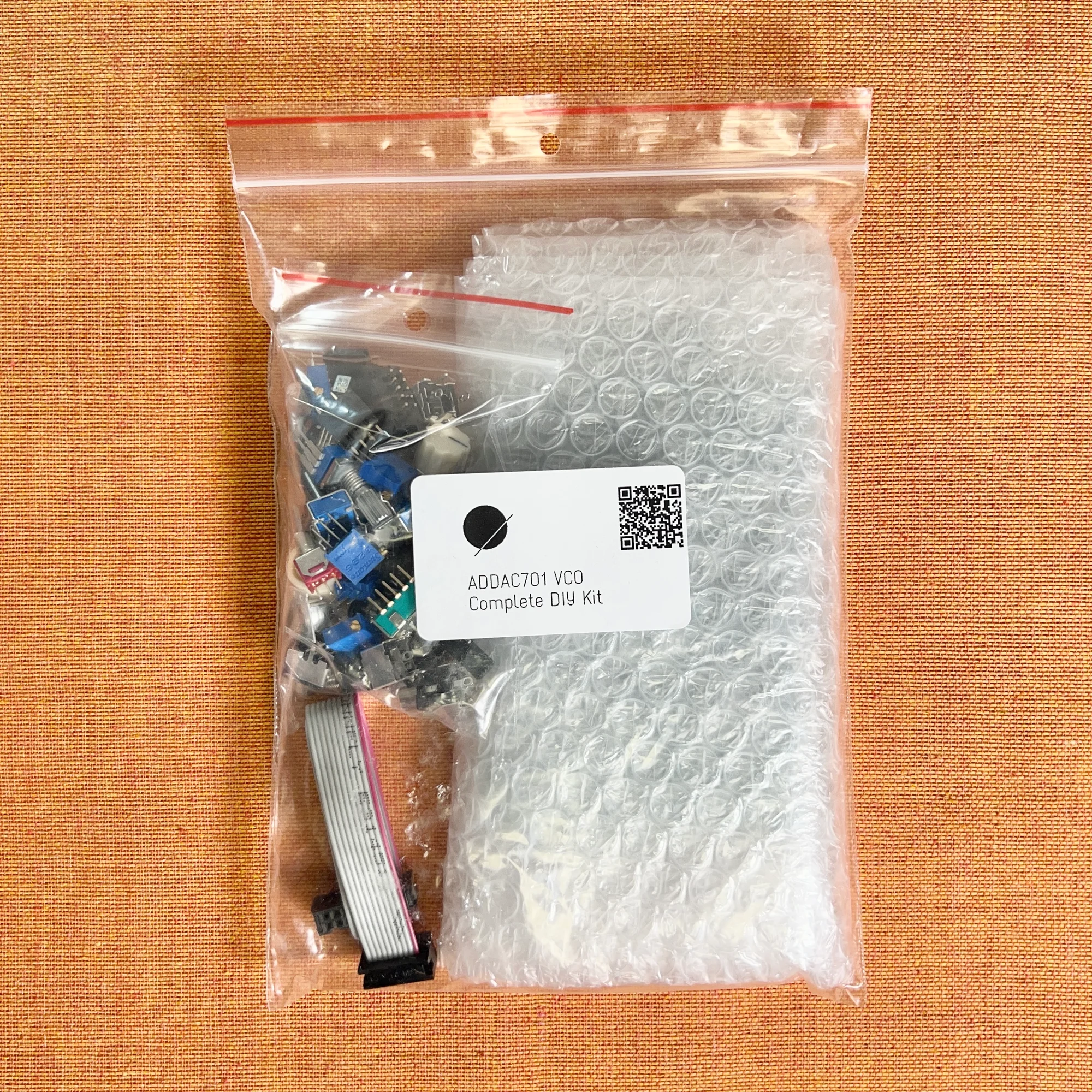
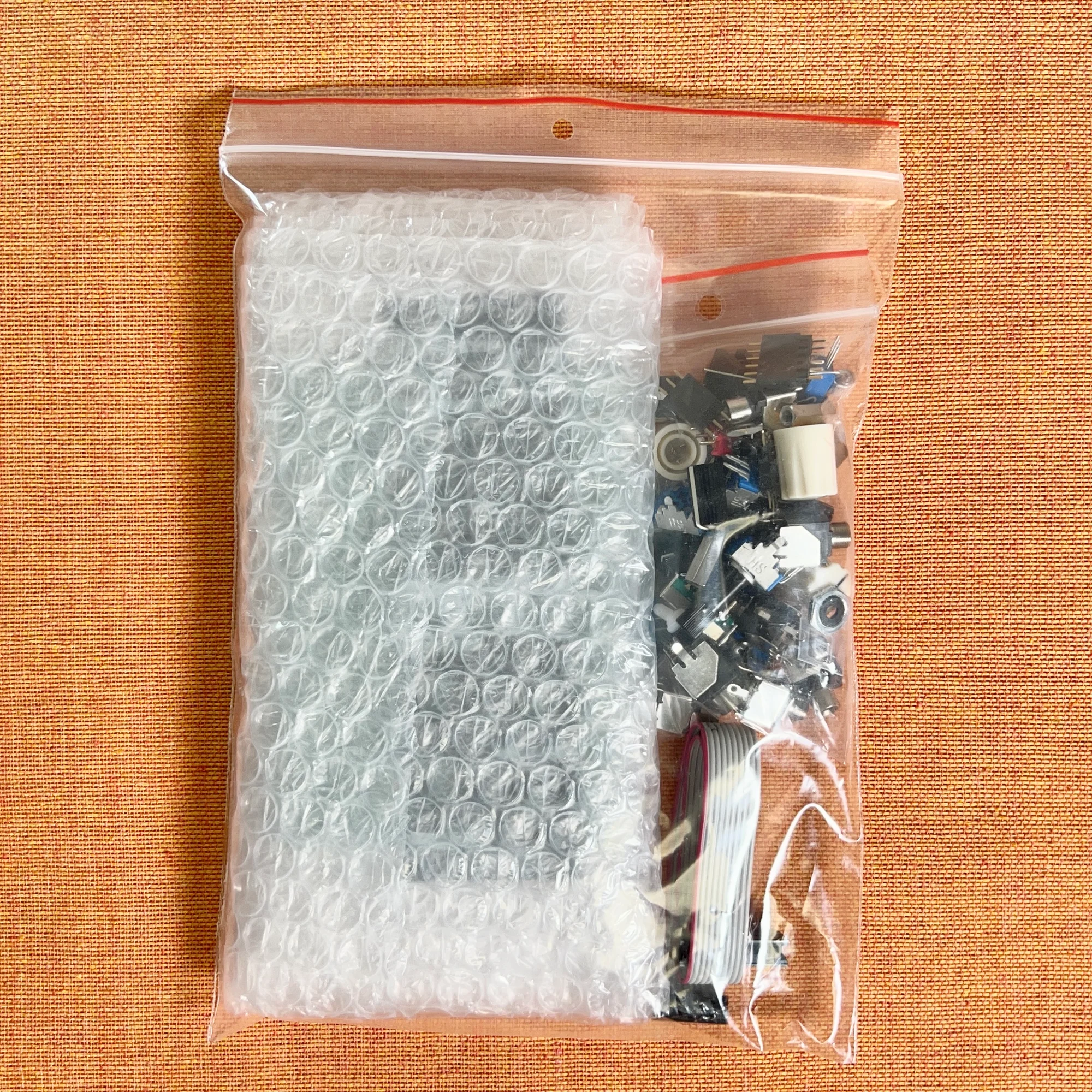
The DIY kit includes the panel, PCB, all components, power ribbon cable, and mounting screws.
ADDAC System provides detailed DIY guides on their website. Please refer to the guide below when assembling your kit.
This module uses many very small parts (SMD parts), but these come pre-soldered to the PCB. The kit is designed so that you only need to solder the relatively larger, easier-to-handle through-hole parts to complete the assembly.
モジュラーシンセのDIYとは?
モジュラーシンセサイザーのDIYについて詳しくご存じない方向けに、以下にDIYの導入的なコラムを用意しました。DIYについてご興味のある方、始めてみようと思う方は、是非ご参照いただければと。
また、組み立てに際して不明点や不安な点がございましたら、以下Takazudo Modularのdiscordチャンネルにてお気軽にご質問等、頂ければと思います。
Notes on This DIY Kit
The kit includes B10K potentiometers (knobs) that need to be soldered in 6 locations. However, the PCB silkscreen labels 2 of these locations as B100K. This is a PCB printing error — simply solder all 6 included potentiometers into the 6 potentiometer positions without concern. (The PCB will likely be corrected in the future, but as of 2024, this is how it is.)
Calibration
Most analog VCOs require calibration after assembly, and this module is no exception. Calibration is the process of adjusting the module’s output to match the intended design specifications. For VCOs, this primarily involves ensuring the output waveform pitch accurately corresponds to the incoming 1V/Oct CV input.
Specifically, calibration involves adjusting trimmers so that when a 1V/Oct value corresponding to the note C3 is input, the output waveform’s pitch is precisely C3. The calibration procedure is described in the build guide mentioned above, so please follow the guide’s instructions.
To perform this accurately, you’ll need a module that outputs CV conforming to 1V/Oct, and a tuner to measure the output waveform’s pitch. For calibration tasks like this, I (Takazudo) output C-D-E-F-G-A-B… 1V/Oct CV from an OXI ONE, have the module receive that CV, then measure the generated sine wave (or similar) with the tuner function of a Mordax DATA to verify that the results closely match C-D-E-F-G-A-B…
While it is possible to produce sound from the VCO without calibration, the pitch won’t be accurate, which may cause tuning issues with other modules.
Reference Video
There are also build videos available on YouTube from other builders, which can be helpful during assembly. However, please note that build videos may not always be perfect, so don’t rely on them 100%.
ADDAC Systemについて
ADDAC Systemはポルトガルのモジュラーシンセメーカーです。
アナログ良さを生かした、ベーシックな機能をしっかり形にしているモジュールラインナップを基本としつつも、CVをMIDIに柔軟にコンバートしたり、高度にコントロール可能なグラニュラープロセッサー等、デジタル技術もうまく調和させた独創的なモジュールも数多くリリースしています。
オマケ: 電氣美術研究會モジュラー小物セット付き

モジュラーシンセをもっと多くの方に触って欲しいという願いの元、電氣美術研究會さまにご協力頂き、モジュラー小物セットを本商品にバンドルさせて販売させていただいております。
パッチケーブルや電源ケーブル、ドレスナットのサンプルセット、モノラルスプリッターなど、内容は時期に応じて変化します。商品に同梱しますので是非お試し下さい!
That concludes the introduction to the ADDAC701.REV2.
We hope you found this helpful.