This is an introduction to the ADDAC713 Stereo Discrete Mixer by ADDAC System, available at Takazudo Modular.
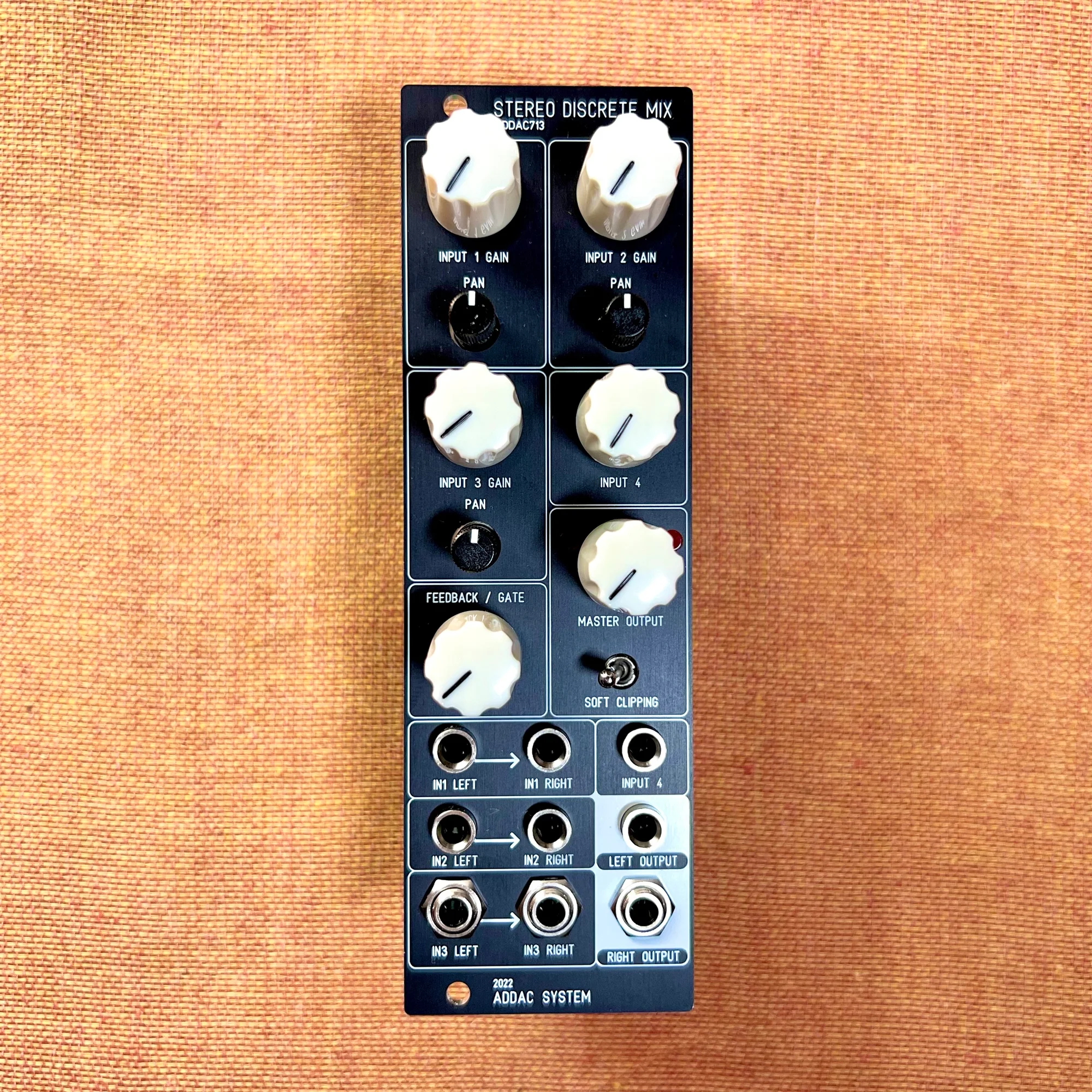
The ADDAC713 is a compact yet feature-rich stereo mixer. It features 3 stereo input channels with Pan control and 1 mono input channel, mixing them together. Each channel and the master output have dedicated gain knobs for flexible volume adjustment. Additionally, it includes a hard clipping function for the input sources, producing dramatic tonal changes. In other words, it can be described as a stereo mixer with built-in hard distortion capabilities.
This product is available as an assembled unit built by ADDAC System, as well as a DIY kit.
This product is available for purchase below.
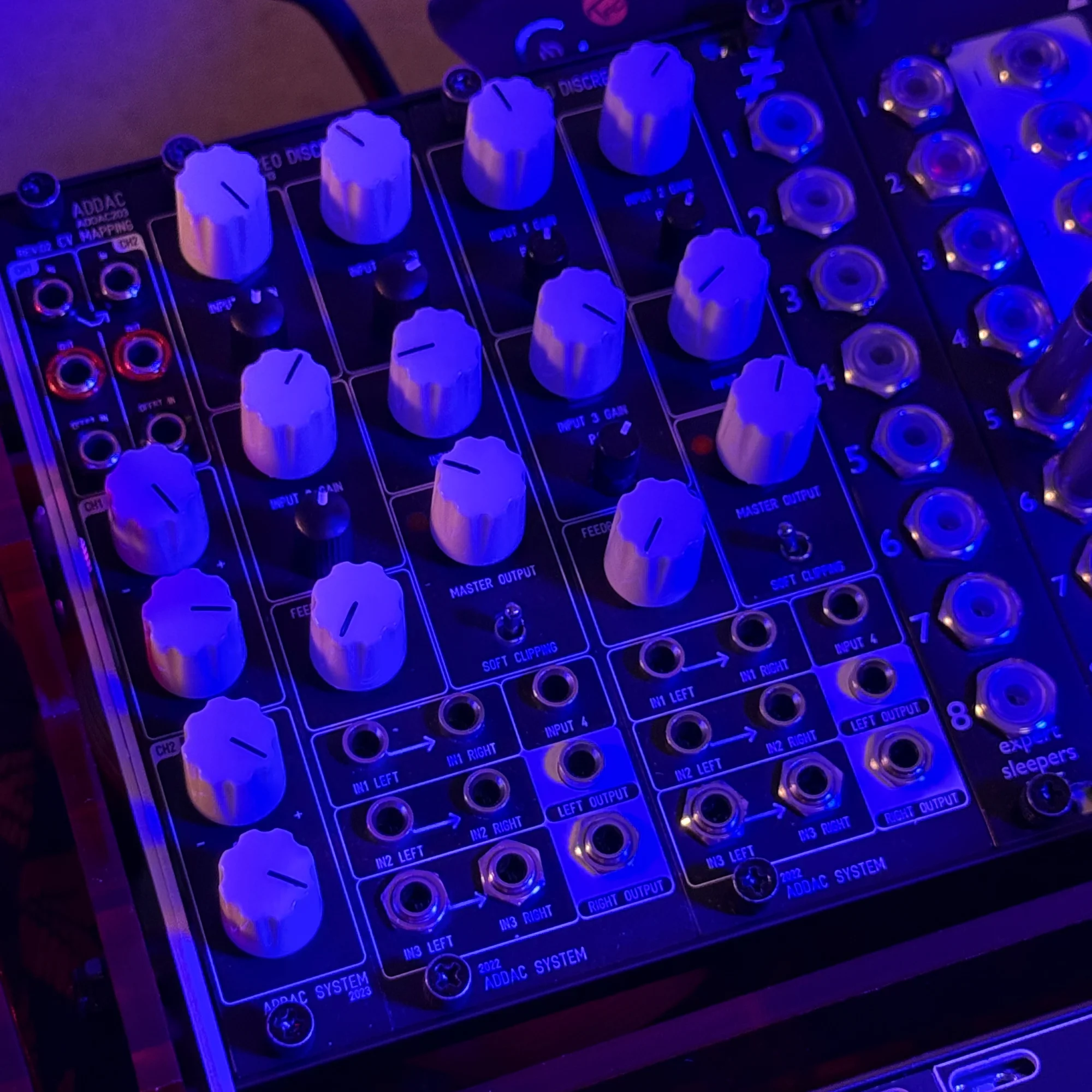
- Product Photos: Assembled
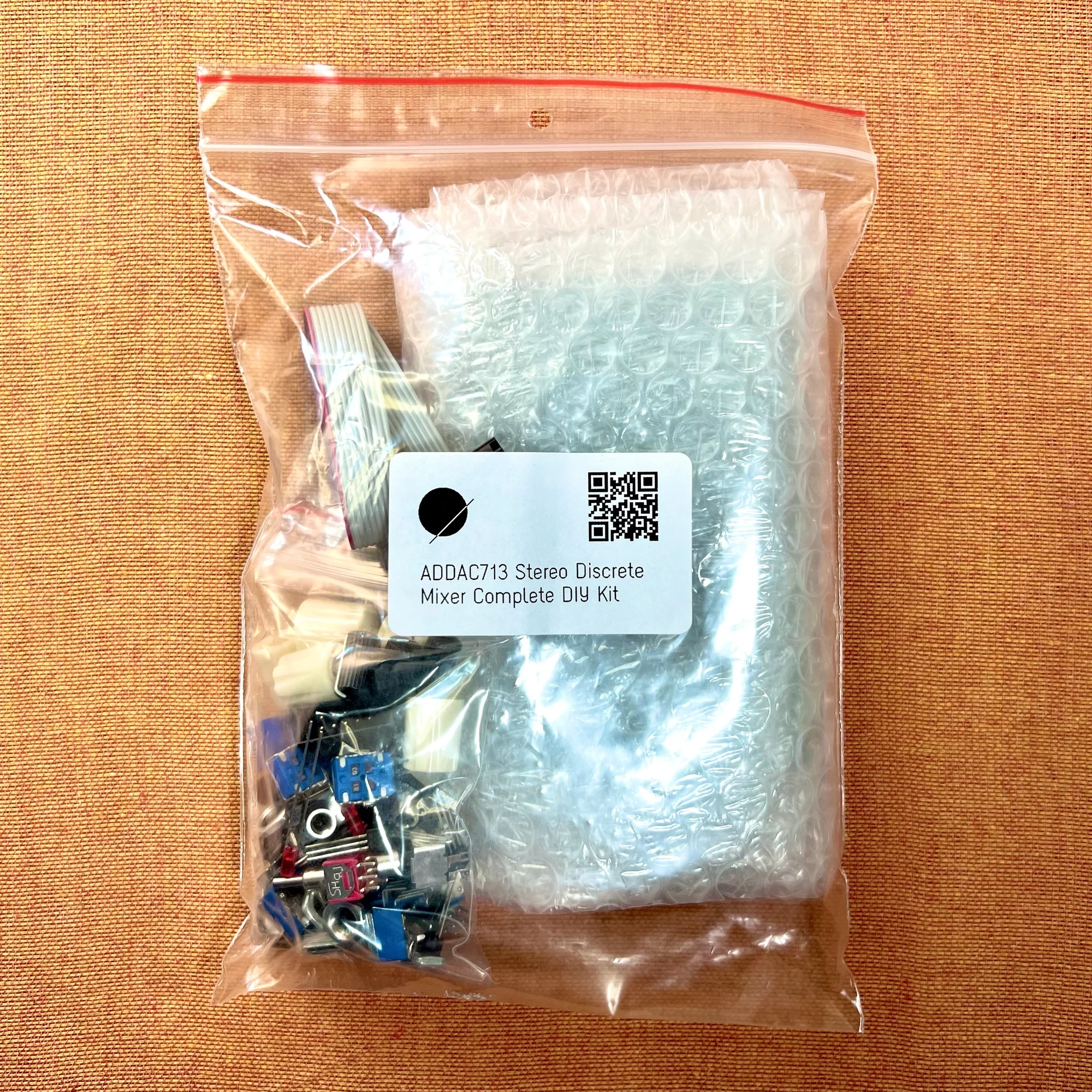
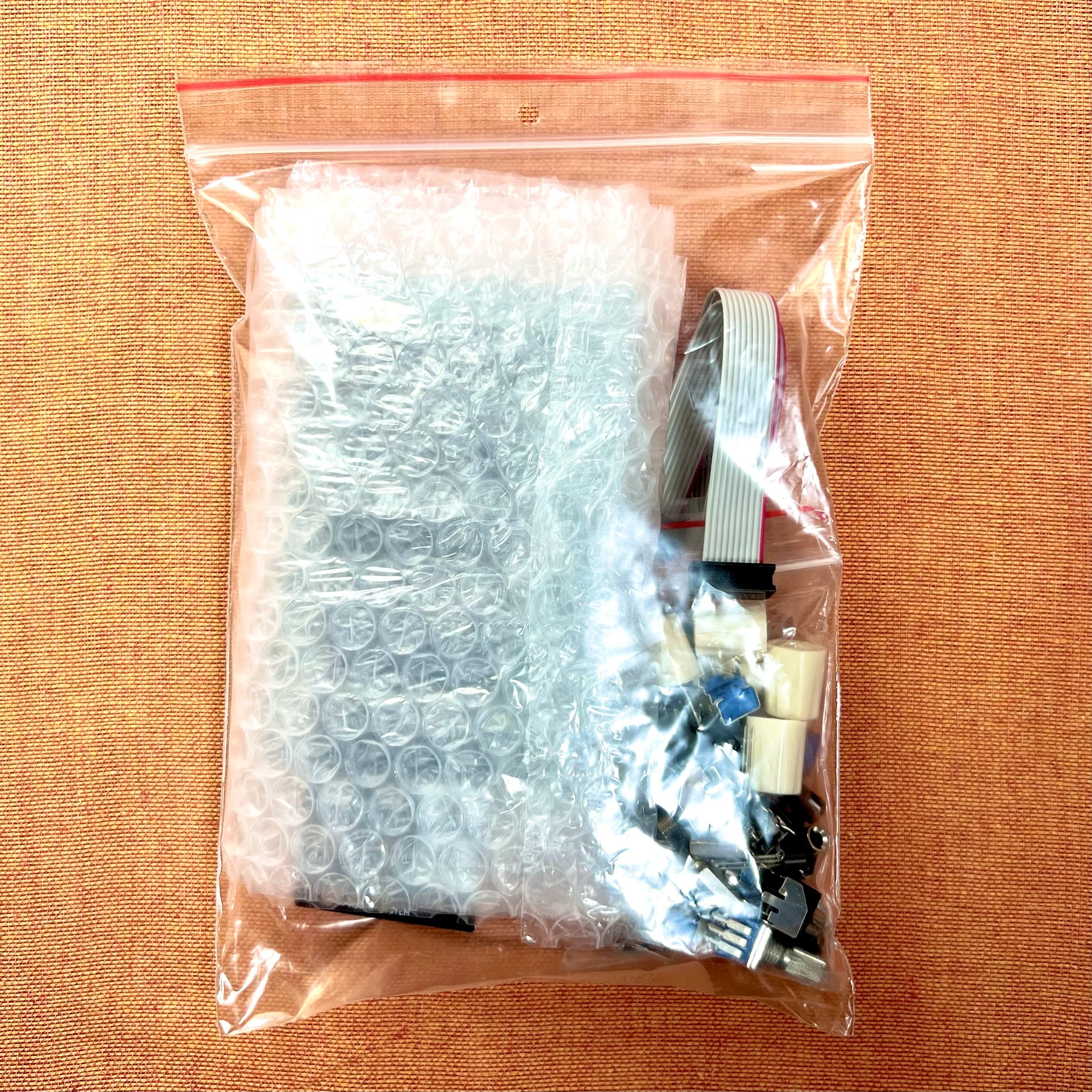
- Product Photos: DIY Kit
- Features of the ADDAC713 Stereo Discrete Mixer
- Hard Clipping
- Similar Modules
- Related Article
- Takazudo’s Impressions
- Technical Specifications
- Included Accessories
- Manual
- DIY Guide
Product Photos: Assembled
Product Photos: DIY Kit
Features of the ADDAC713 Stereo Discrete Mixer
This compact mixer is a strong candidate when you need a stereo mixer. Among the mixers we carry, the following are designed for mixing mono inputs:
However, many modules produce outputs split into L and R channels, creating spatial stereo effects. Among the products we carry, examples include:
- ADDAC System: ADDAC112 VC Looper & Granular Processor
- NoisyFruitsLab: Sproom DSP
- Olivia Artz Modular: Time Machine
To mix stereo audio from modules like these, a mono mixer would require separate mixing for the L and R channels. This is where a mixer like the ADDAC713, which handles both L and R inputs simultaneously, becomes useful.
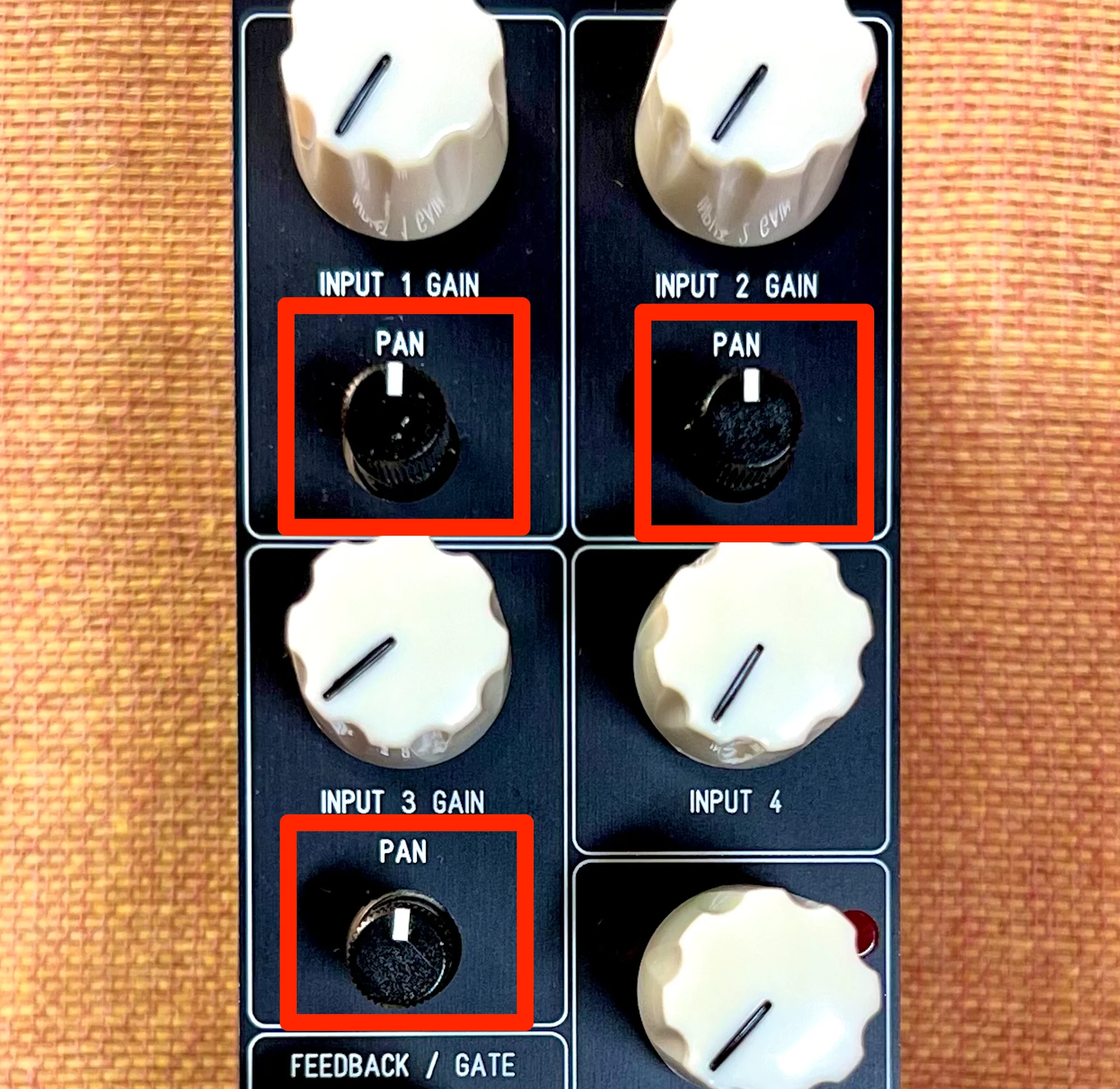
Additionally, this mixer has Pan adjustment knobs for each input. With Pan control, you can not only mix stereo audio straightforwardly, but also pan multiple mono audio sources left and right.
You can pan the outputs of dual-channel filters like these:
Or pan the outputs of oscillators and drum modules with multiple outputs to create stereo effects in your mix:
More feature-rich mixers may include EQ, send/return capabilities, and the ability to handle many more channels. Those are primarily intended as master mixers. This module, however, is a smaller-scale mixer for 3 stereo + 1 mono channels. It’s a convenient mixer when you want to keep things compact.
Hard Clipping
Beyond being a mixer, this module’s other notable feature is its ability to perform hard clipping. ADDAC System’s official description uniquely describes this module as follows:
This is a wolf in sheep’s clothing. Despite its harmless looks there’s a dark snarly soul behind that panel that wants to take your sounds into a realm of gritty, gnarly growls.
What this means becomes immediately clear when you turn the FEEDBACK / GATE knob just slightly. Turning this knob feeds part of the final mixed output back into the mix (= feedback).
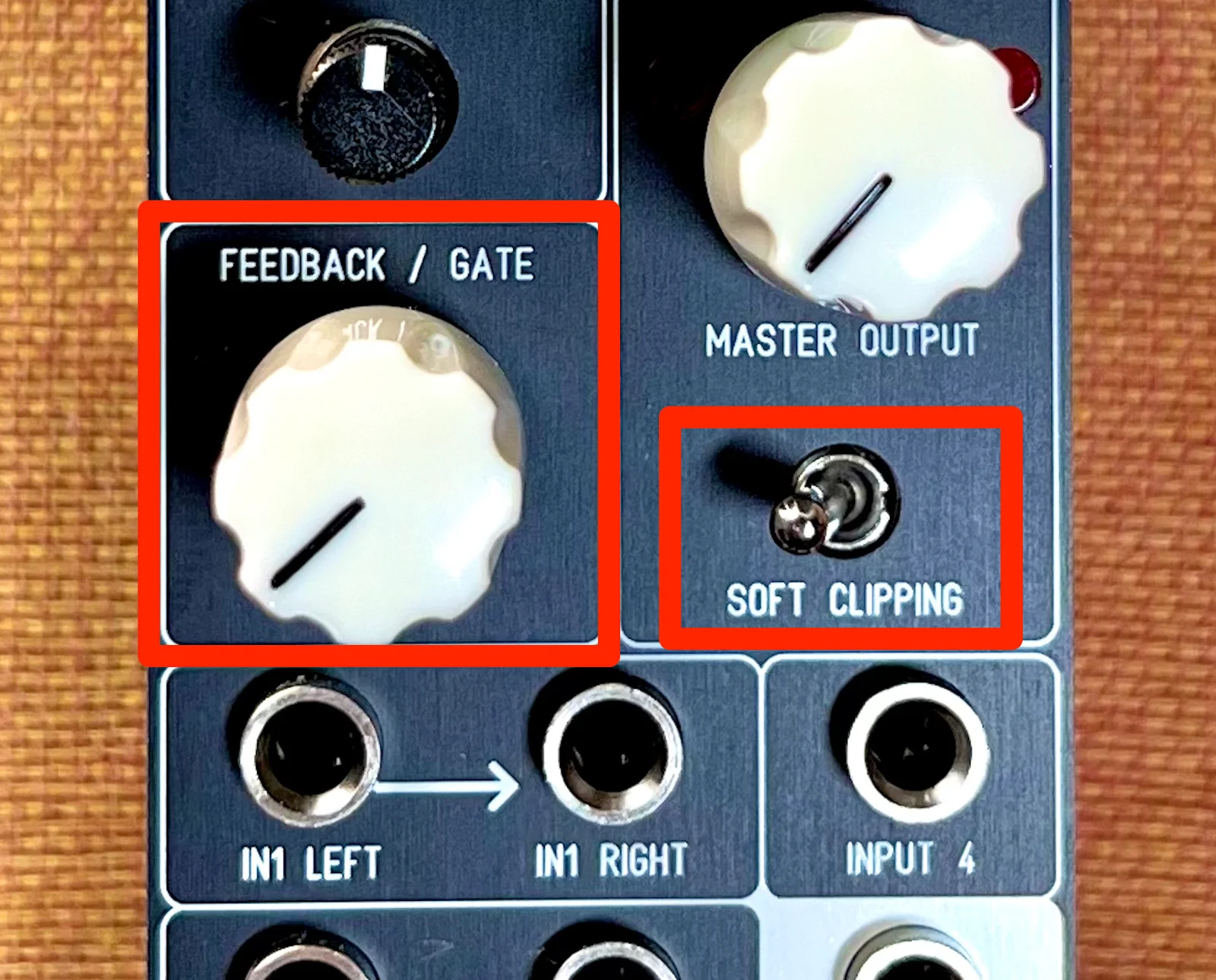
Just a slight turn to the right produces an intensely distorted sound, and turning it all the way creates output that is so distorted it resembles a two-level signal switching between 0V and 5V (which is likely why it’s labeled GATE). This circuit was designed inspired by the Moog CP3 mixer.
What makes the ADDAC713 even more unique is the ability to further shape the output’s character. The SOFT CLIPPING switch directly below the MASTER OUTPUT knob applies a low-pass filter to the output stage and toggles between three modes:
- Left: Soft low pass
- Center: Off
- Right: Hard low pass
The center position is off, the left position applies a gentle low-pass filter, and the right position applies a more aggressive low-pass filter.
You might wonder why a low-pass filter is here. It appears to be provided so that you can round off the hard-clipped sound to a more listenable level. For example, after crushing drum sounds with the FEEDBACK / GATE knob, turning on SOFT CLIPPING can produce a sound that is distorted yet reasonably listenable. It’s also interesting for processing synth sounds.
The basic mixer features, as well as the nuance of rounding clipped sounds, are demonstrated in the video below by Daniel. Please use it as a reference.
In summary, this mixer is fundamentally a compact stereo mixer, but it also doubles as an intense distortion unit.
Similar Modules
A similar module to this one is the AI Synthesis AI022 Harmonic Mixer. The AI022 is a mono mixer, but it was also described as Moog CP3-inspired, suggesting a similar approach. If you’re looking for milder saturation by comparison, the AI106 might be a better choice.
For standalone distortion/saturation, ADDAC System offers the following two modules. Each has its own distinct sonic character.
Personally, I felt that this ADDAC713 Stereo Discrete Mixer tends to clip sounds in a way that transforms them beyond recognition, compared to the two modules above.
Related Article
I wrote a column comparing and explaining mixers of this type that we carry, including this one. If you’re interested, please check it out as well.
Takazudo’s Impressions
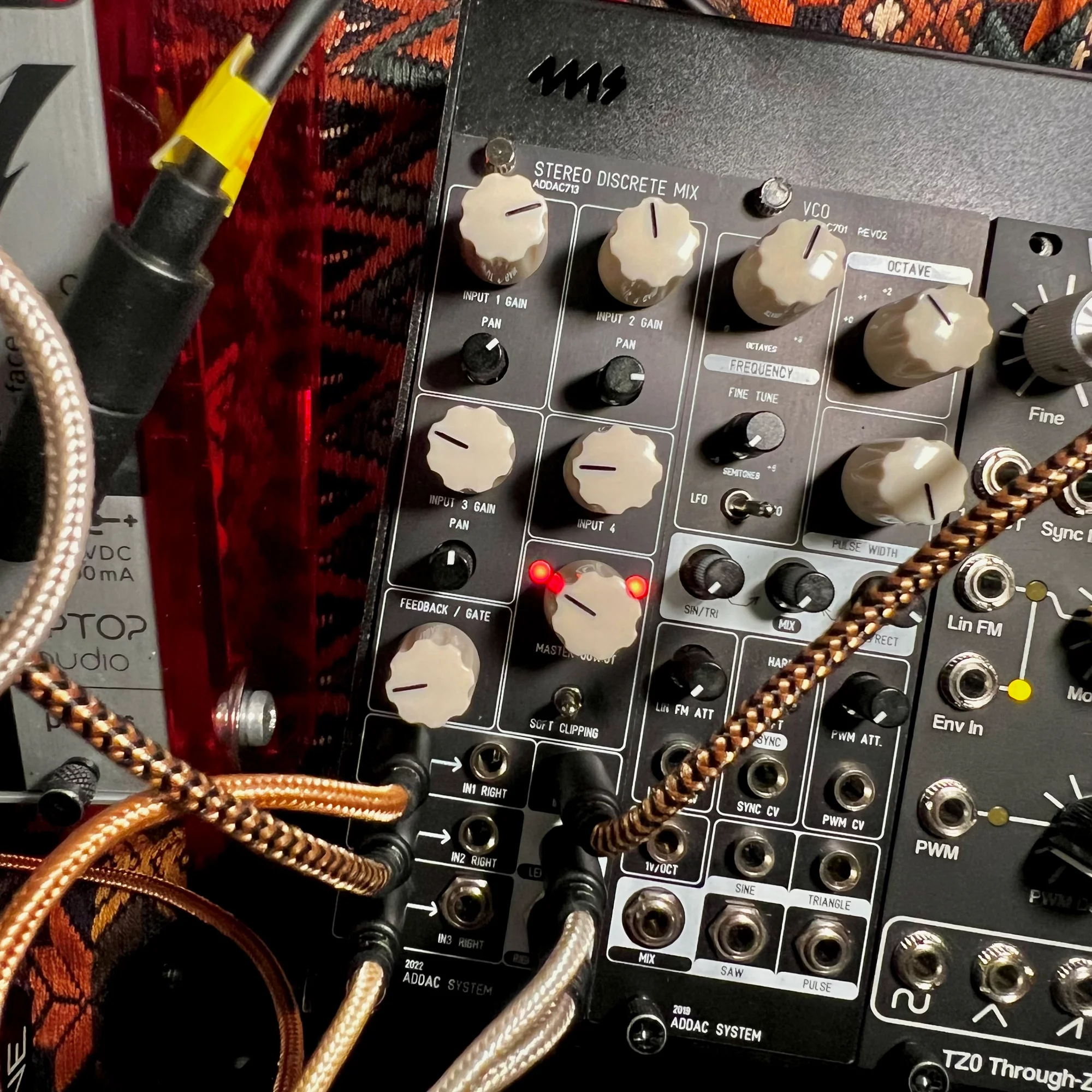
I (Takazudo) own two of these modules and use them regularly. Here’s an example session where I use the sound in a fairly driven manner — in this session, I’m routing drum sounds through the ADDAC713 as the final mixer stage.
Personally, I find the way an analog mixer changes the sound through its inherent characteristics to be a fun and interesting aspect. If you’re looking for something to mix things compactly while enjoying the character of an analog mixer, this is a great option.
Technical Specifications
- Width: 8HP
- Depth: 4cm
- Maximum power consumption: 80mA +12V & 80mA -12V
Included Accessories
- Power ribbon cable
- Screws
Manual
The manual (English only) is available on the official website below.
DIY Guide
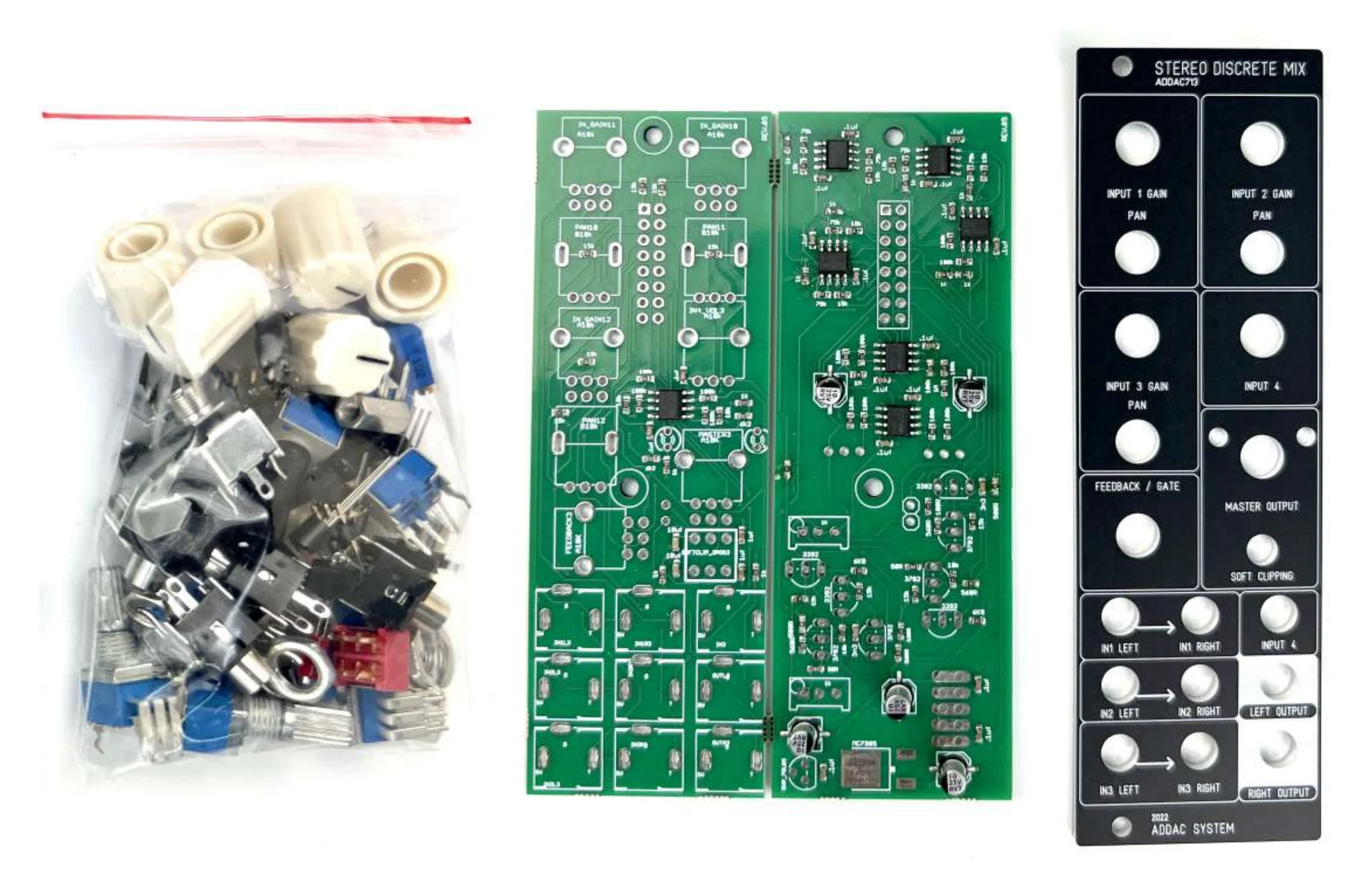
This product is also available as a DIY kit in addition to the assembled version.
The DIY kit includes the panel, PCB, all components, power ribbon cable, and mounting screws.
ADDAC System provides detailed DIY guides on their website. Please refer to the guide below when assembling your kit.
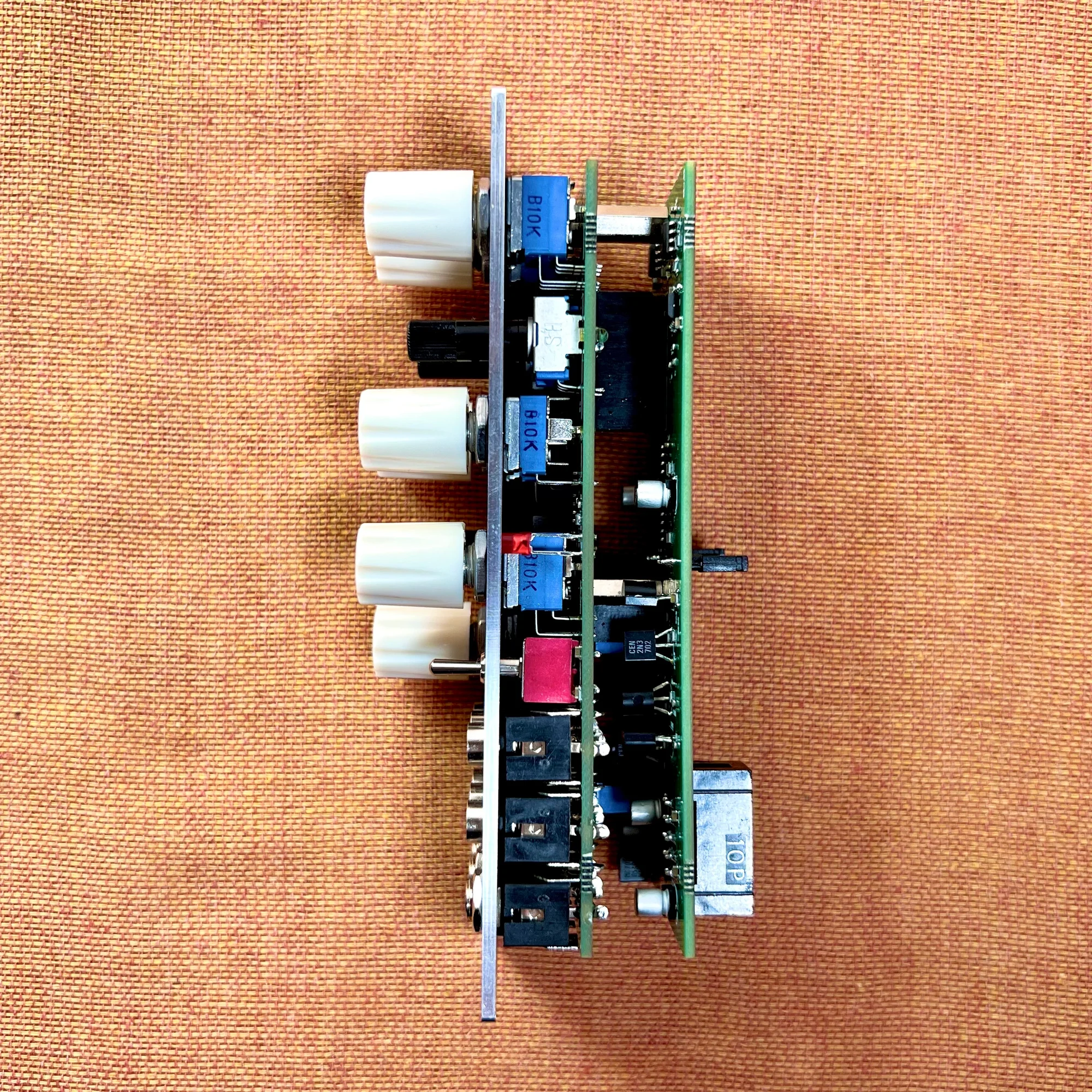
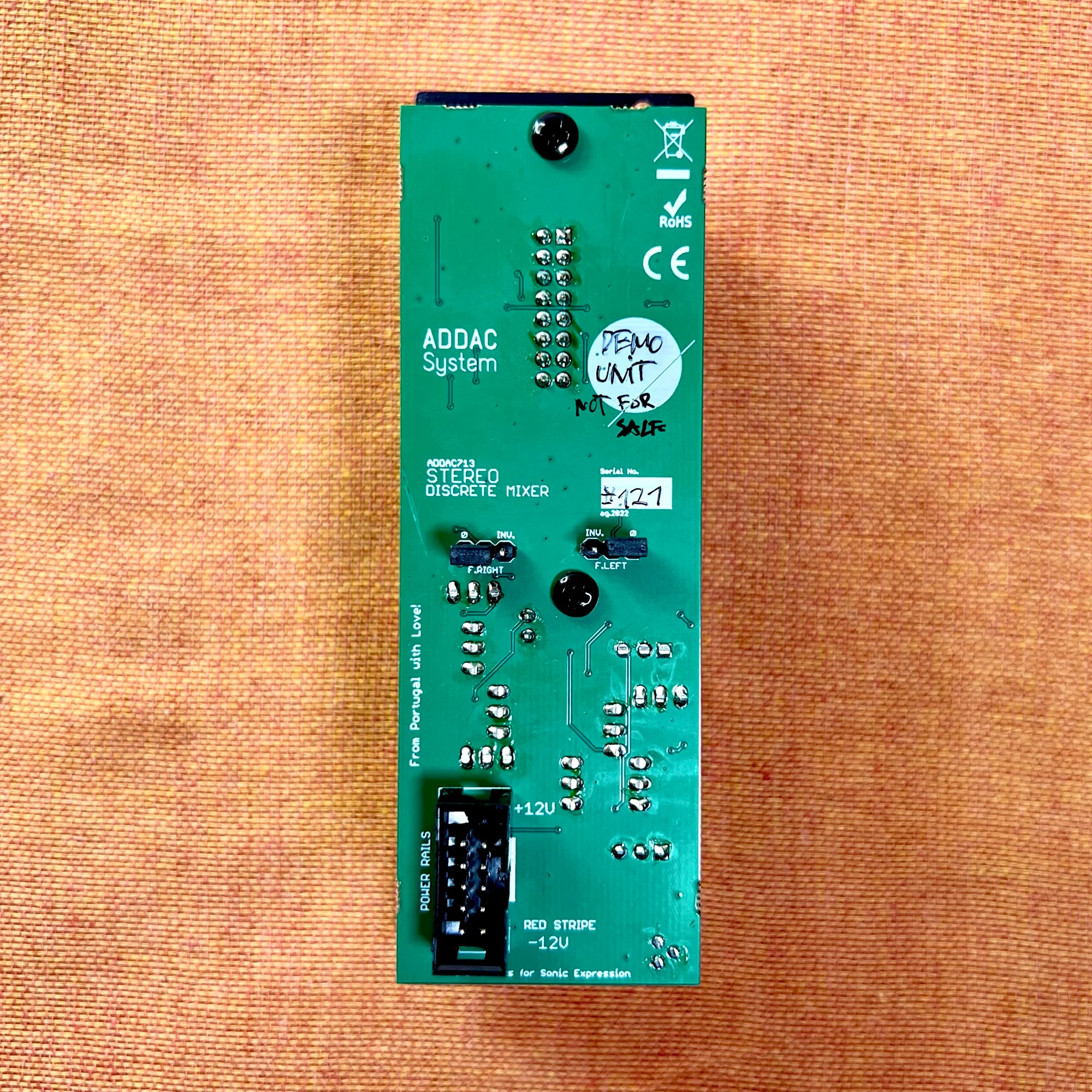
This module uses many very small parts (SMD parts), but these come pre-soldered to the PCB. The kit is designed so that you only need to solder the relatively larger, easier-to-handle through-hole parts to complete the assembly.
Assembly Impressions
I (Takazudo) assembled this kit myself. Below is a video of the process. It’s not specifically made as a tutorial, but it might help give you a sense of what the kit is like.
I noticed two points to be careful about when assembling this kit.
The first is that this module uses many transistors of three different types. This is explained in detail with diagrams in the DIY guide PDF, but you need to check the part numbers printed on the components carefully and make sure you place them in the correct locations.
The second point is that the panel has very tight clearances with the components. Specifically, the holes for potentiometers and jacks are sized to just barely fit. As with any module, but especially with this one, I recommend carefully verifying component positions before soldering to ensure the potentiometers and jacks align properly with the panel.
If you solder components without checking their alignment with the panel, even slight misalignment can make it impossible to attach the panel. To prevent this, it’s best to place all components on the PCB, then attach the panel to verify the spacing between the panel and PCB before proceeding with soldering. In my video above, you can see that roughly half the time is spent on this positioning trial-and-error.
モジュラーシンセのDIYとは?
モジュラーシンセサイザーのDIYについて詳しくご存じない方向けに、以下にDIYの導入的なコラムを用意しました。DIYについてご興味のある方、始めてみようと思う方は、是非ご参照いただければと。
また、組み立てに際して不明点や不安な点がございましたら、以下Takazudo Modularのdiscordチャンネルにてお気軽にご質問等、頂ければと思います。
ADDAC Systemについて
ADDAC Systemはポルトガルのモジュラーシンセメーカーです。
アナログ良さを生かした、ベーシックな機能をしっかり形にしているモジュールラインナップを基本としつつも、CVをMIDIに柔軟にコンバートしたり、高度にコントロール可能なグラニュラープロセッサー等、デジタル技術もうまく調和させた独創的なモジュールも数多くリリースしています。
オマケ: 電氣美術研究會モジュラー小物セット付き

モジュラーシンセをもっと多くの方に触って欲しいという願いの元、電氣美術研究會さまにご協力頂き、モジュラー小物セットを本商品にバンドルさせて販売させていただいております。
パッチケーブルや電源ケーブル、ドレスナットのサンプルセット、モノラルスプリッターなど、内容は時期に応じて変化します。商品に同梱しますので是非お試し下さい!
That concludes the introduction to the ADDAC713 Stereo Discrete Mixer.
We hope you found this helpful.