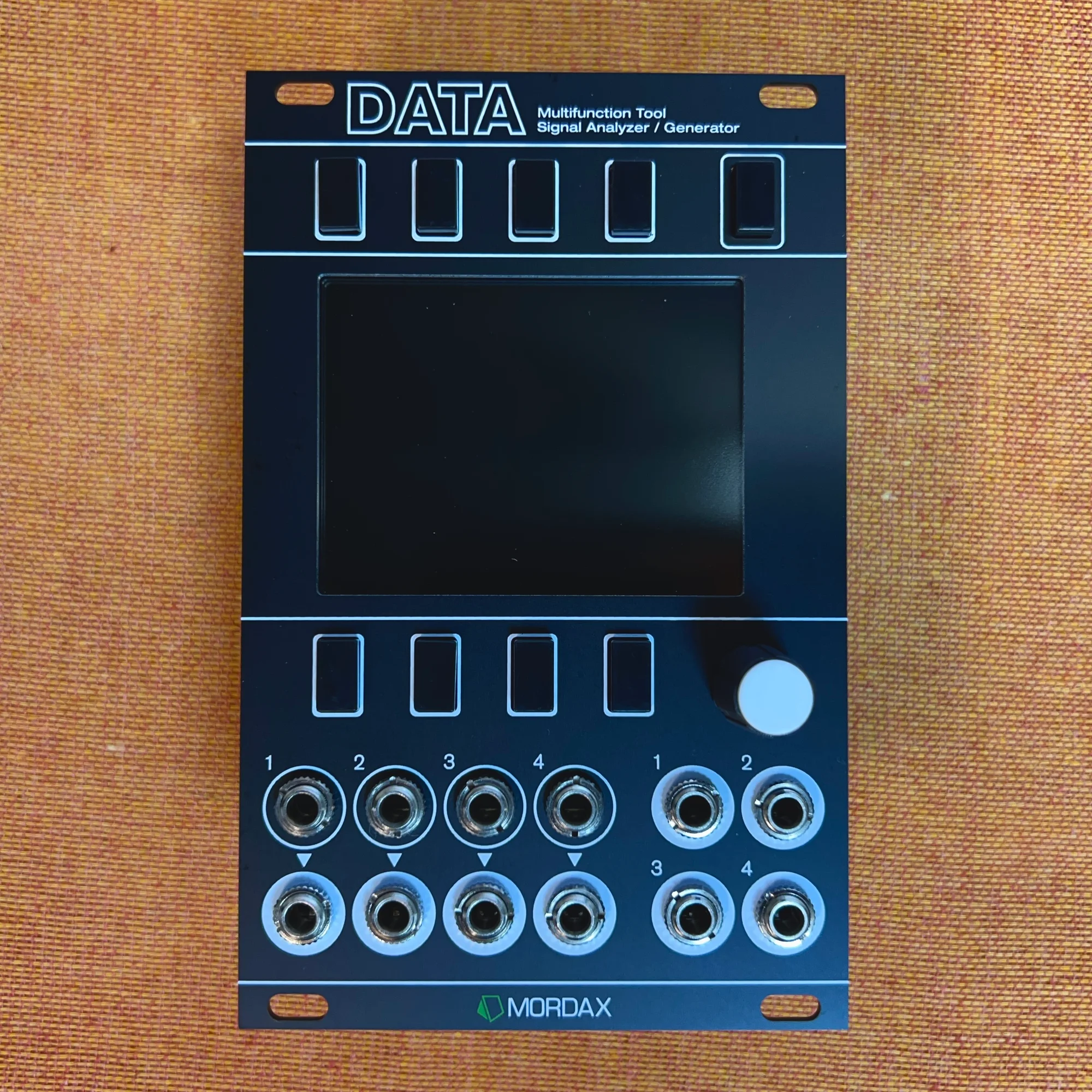
This is an introduction to the DATA by Mordax, available at Takazudo Modular.
DATA is a multifunction utility module for Eurorack modular synthesizers. In addition to test utilities such as an oscilloscope, spectrum analyzer, spectrograph, tuner, and voltage monitor, it also includes a 2-voice digital oscillator and clock generator.
This is a highly recommended module for anyone wanting to dive deep into modular synthesis.
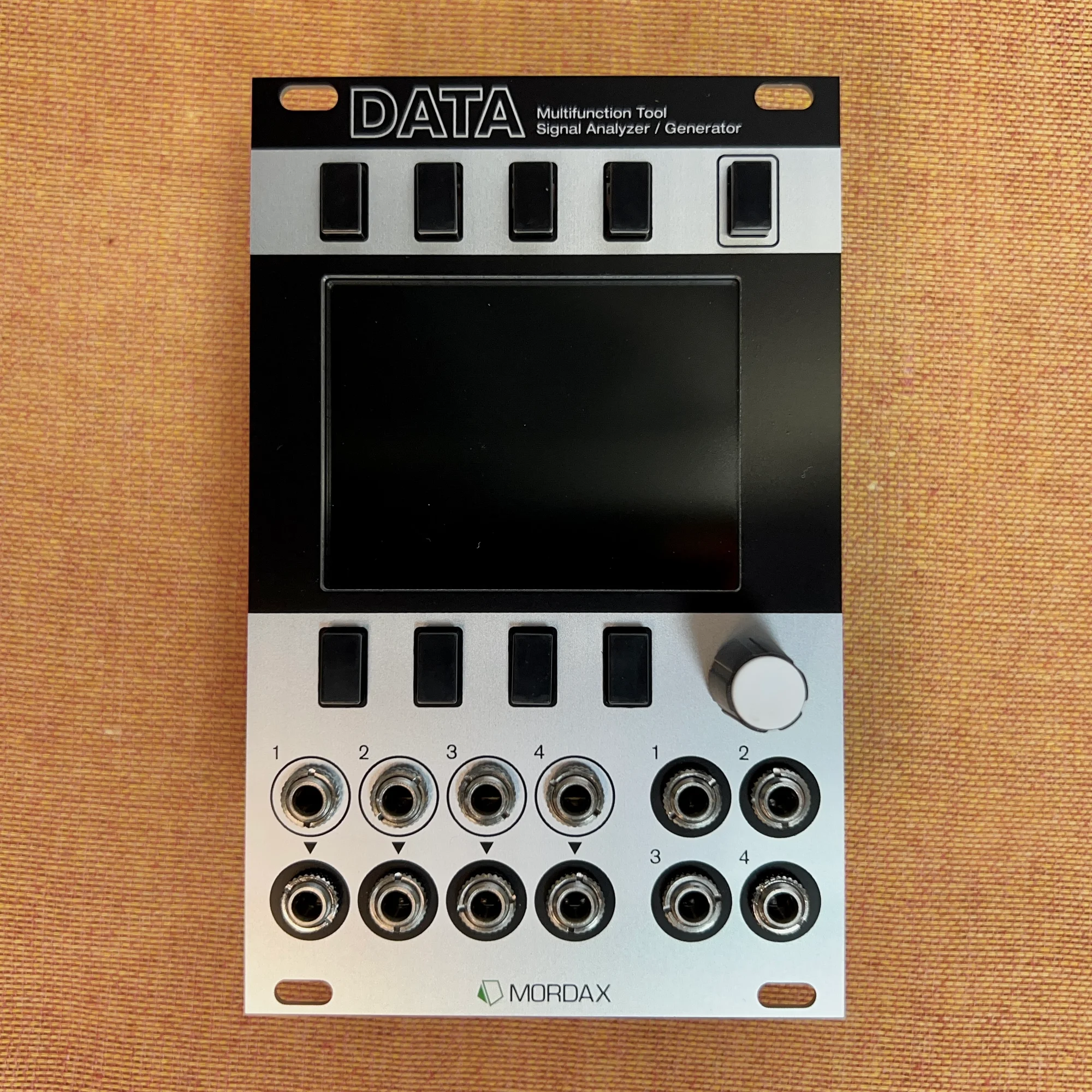
This product is available for purchase below. Available in two panel colors: black and silver.
- Why You Need DATA
- DATA’s Advantages
- Reference Videos
- Manual & Firmware
- Specifications
- Included Accessories
Why You Need DATA
This module is incredibly versatile. For full details, I recommend watching the videos introduced later in this article, and consulting the manual if you have any remaining questions.
Here, I’d like to share what I consider to be DATA’s appeal.
DATA — A Familiar Sight in Videos
First, DATA is a module you’ll encounter quite frequently when watching modular synth tutorial and demo videos on YouTube, so many people are likely already aware of its existence.
However, since it comes at a considerable price, you might hesitate when deciding whether to invest in one. That said, my impression is that DATA is a module that anyone wanting to use modular synths in depth should definitely have on hand.
How Does the Sound Work?
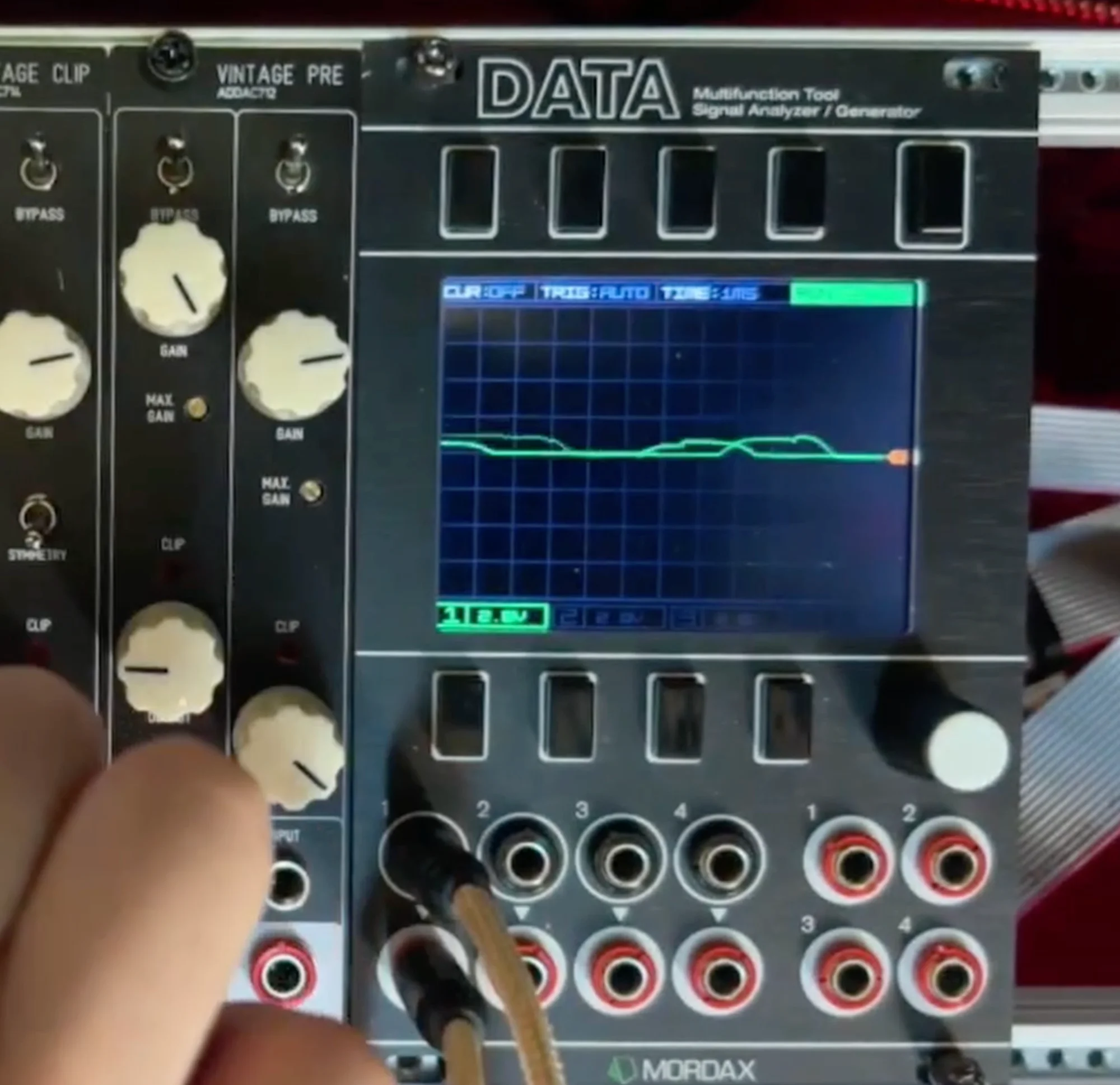
When working with modular synths, what flows through the patch cables connecting modules is electrical current. Each module generates voltage in various ways, and by combining them in different configurations, the voltage ultimately vibrates a speaker cone to produce sound.
Without an oscilloscope, the voltage fluctuations happening inside remain purely in the realm of imagination. Of course, you can make sound without seeing the exact waveforms. You turn this knob this way, and you get this kind of sound… That can be sufficient.
For example, we don’t need to know why blowing into a recorder produces sound, or the exact mechanism by which a piano creates its tones, to enjoy making music with these instruments. Similarly, you can use a synthesizer just fine with the understanding that “this is an instrument that makes these sounds.”
The Joy of Understanding
However, with modular synthesizers in particular, I personally believe that there is great enjoyment to be found in learning how things work. And without knowing what’s happening, it’s easy to try something out randomly, find it confusing, and give up — this is an instrument where that can happen quite easily.
For example, there’s a module called Maths released by Make Noise, which is an extremely well-known module with enduring popularity.
According to some surveys, it has even been ranked number one in popularity. However, this module is a Function Generator that transforms input signals through addition, subtraction, and various other methods, requiring considerable expertise to master well. (It’s quite interesting that such a module would become number one.)
Trying to understand a module like this without an oscilloscope feels nearly impossible to me. At the very least, I imagine many people who start with modular synths and buy Maths right away would naturally feel, “Modular synths are really difficult…”
This feeling of “it’s difficult…” is natural, I believe, because voltage is invisible. When it becomes at least visible, you can see the world of modular synths much more clearly — like putting on glasses. And understanding the various things happening here… I believe that process is one of the joys of modular synthesis.
In other words, people who have DATA on hand can see what’s happening between modules far more clearly than those without it.
DATA’s Advantages
That said, the above is a general argument about oscilloscopes. The reasons I would specifically choose DATA are as follows:
- High refresh rate
- Being rack-mountable
- Various other built-in tools
1. High Refresh Rate
I believe DATA’s greatest advantage lies in its high refresh rate.
For example, the video below shows an oscillator’s waveform being fed through DATA’s oscilloscope.
As you’ll notice, the display updates at a very high frequency. I own a separate, more affordable oscilloscope tool, but it cannot show waveform states with this level of detail and speed. This is purely possible because of DATA’s high mechanical specifications.
So, for those who want to use quality tools to deepen their understanding of modular synths, I believe DATA is an excellent choice. It’s similar to how a carpenter would want to use good hammers and saws.
2. Being Rack-Mountable
The fact that DATA itself is designed to fit in a rack is another excellent point, in my opinion.
If this weren’t a module, I imagine it wouldn’t appear so frequently in tutorial videos on YouTube and other platforms. While being a module does take up rack space, the visibility advantage outweighs that drawback.
It might not make it into a live performance rack, but for experimenting at home, placing DATA in a small case beside your main rack is a very convenient setup.
3. Various Other Built-in Tools
In the roughly three months during which I wrote this article, I built quite a few modules through DIY, and throughout the calibration process, I consistently made good use of DATA.
When tuning an oscillator’s output, I fed a signal into the module’s 1V/Oct while using DATA’s tuner function to verify the exact key. For modules that output fixed voltages, I connected the output jack to DATA and used the voltage monitor to calibrate accurate 5V output.
Going through these DIY steps made me much more attentive to the exact voltages being output by modules.
Additionally, I’ve seen people using DATA’s clock generator. DATA features four CV output jacks, capable of not only outputting its internal clock but also dividing and multiplying external clock signals.
These functions don’t necessarily require DATA specifically, but with DATA alone, you can do all of this — so you can see why having one might be quite handy.
Reference Videos
Below is the official DATA introduction video from Mordax. It provides a light overview of the main features.
A more detailed explanation by DivKid is also available below.
Below is a session video where I tried using DATA’s oscillator. Very few people would consider DATA primarily for its oscillator, but this can serve as a reference for what’s possible. Using it as an LFO could also be convenient, as you can take advantage of the visible waveforms.
Manual & Firmware
The manual and firmware downloads are available from the official website below.
Specifications
- Width: 16HP
- Depth: 35mm
- Full-color, 2.8-inch (71mm), scratch-resistant clear display
- Firmware updates via microSD (included)
- Power consumption (average): ~250mA +12V / ~60mA -12V
Inputs / Outputs
- 4 input jacks (+/-10V)
- One buffered thru jack per input channel, 4 total
- AC/DC coupling selectable via on-screen controls
- 4 output jacks (+10V to -5V)
- Can output CV / Audio / Trigger / Gate signals
Included Accessories
- Power ribbon cable
- Screws
- Mordax sticker
Mordax Systemsについて
Mordax Systemsはアメリカのニューハンプシャー州に拠点を置くモジュラーシンセメーカーです。
このメーカーの看板モジュールは「DATA」という8チャンネルのオシロスコープモジュールで、シンセサイザーの内部で起きていることを直感的に可視化することができます。また、「FOLD」というアナログ・ウェーブフォルダーや「LVL」というルーティングモジュールなど、他では見ない便利なモジュールも精力的にリリースしています。
オマケ: 電氣美術研究會モジュラー小物セット付き

モジュラーシンセをもっと多くの方に触って欲しいという願いの元、電氣美術研究會さまにご協力頂き、モジュラー小物セットを本商品にバンドルさせて販売させていただいております。
パッチケーブルや電源ケーブル、ドレスナットのサンプルセット、モノラルスプリッターなど、内容は時期に応じて変化します。商品に同梱しますので是非お試し下さい!
That concludes our introduction of DATA.
We hope you find this helpful.