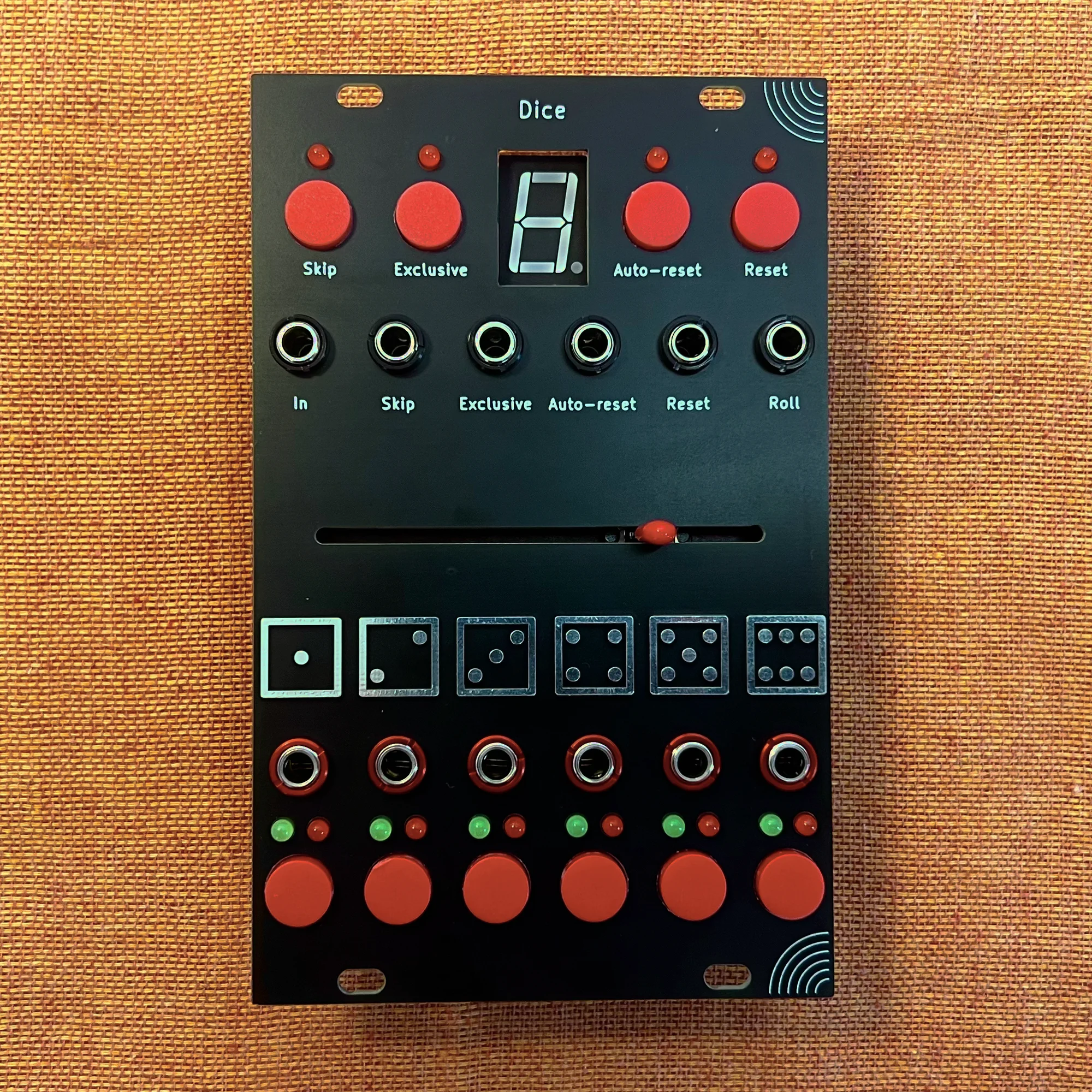
This is an introduction to the Dice modular synthesizer by Divergent Waves, available at Takazudo Modular.
Dice was built from a DIY kit purchased from an overseas retailer, assembled together with a domestic builder. We started selling the ones we built, and during the process, questions arose that were answered with the help of Divergent Waves themselves. We received their permission to sell the finished modules in our shop.
This product is available for purchase below.
- What is Dice?
- Basic Operation
- Three Modes
- How to Use Dice
- Other Specifications
- About Divergent Waves
What is Dice?
Dice is a 1-in, 6-out probabilistic signal router / gate generator.
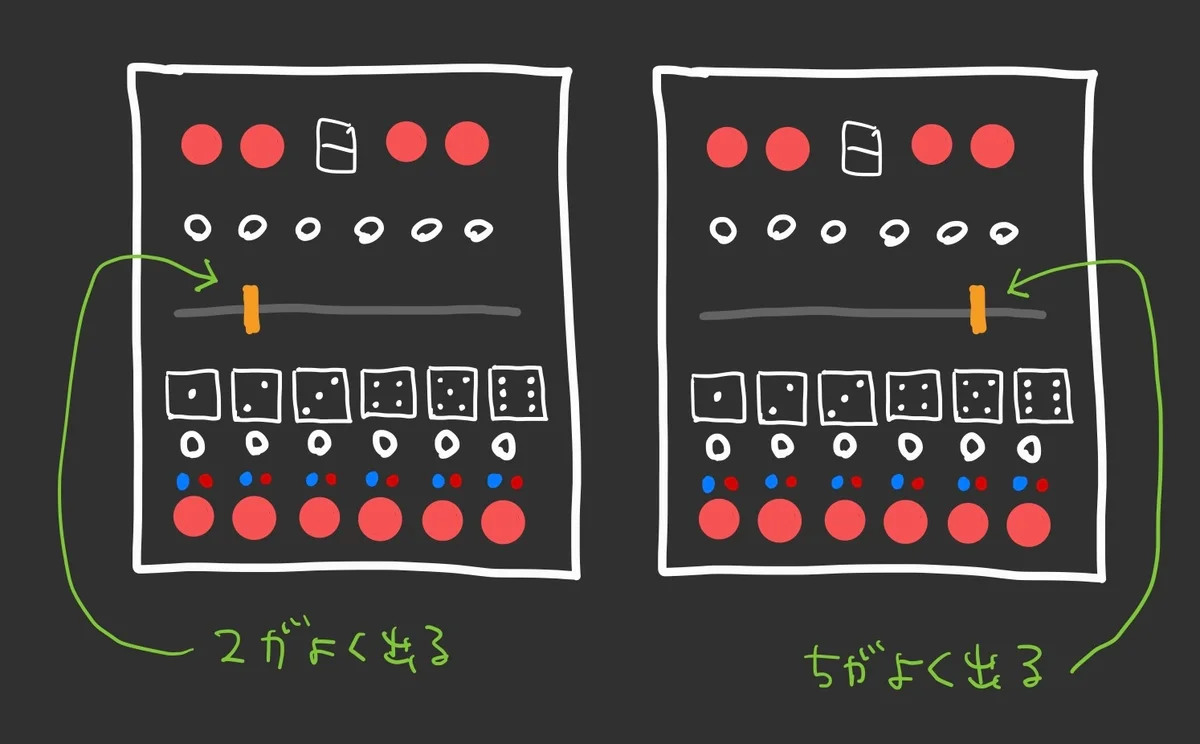
Dice routes the signal received at its In to five Outs. Which Out becomes active is determined by the roll of a die that occurs when the Roll jack receives a gate. The routing algorithm has variations, and the center slider controls the probability of each outcome. For example, when the slider is toward the left, the probability of rolling a 2 increases, and when toward the right, the probability of rolling a 5 increases.
The In accepts both CV and audio signals. The outputs are zero-crossing-aware, meaning click noise that typically occurs when a signal is abruptly cut off does not happen.
When there is no input at In, each output jack outputs 5V while its routing is On. When the Roll jack receives a gate, the Outs output gates. This means that by sending continuous gates like a clock to the Roll jack, Dice can be used as a 6-gate-out sequencer.
Basic Operation
Dice has three modes that can be toggled On/Off via the buttons at the top of the module. This section first explains the behavior when all modes are Off.
When all modes are Off, Dice operates as a simple signal router. The buttons below the die icon toggle each Out On/Off, and when On (green LED lit), the signal from In is routed to that Out jack.
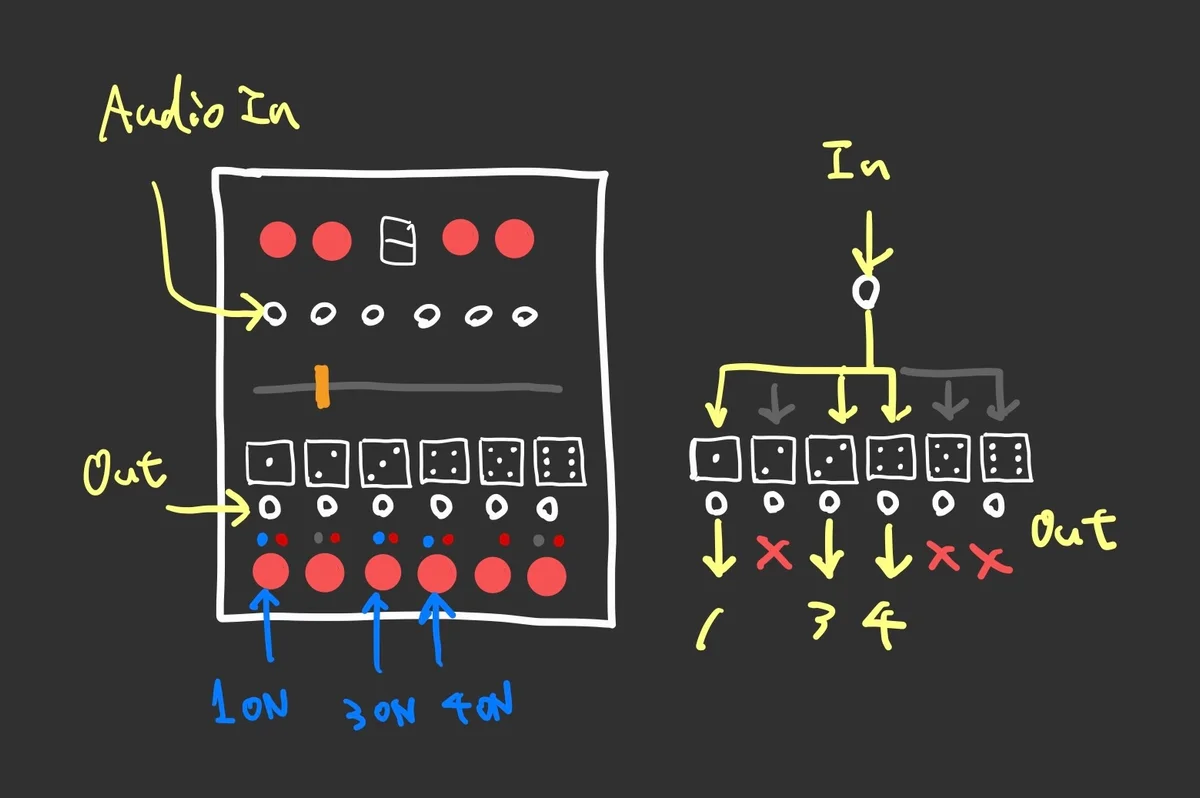
When the Roll jack receives a gate, one random Out’s On/Off state is toggled.
As a usage example, you could receive Outs 1-6 through a mixer and pan them left and right, creating an effect where the input appears to come from scattered directions. The official demo video below shows this type of patching.
Since the In also accepts CV, you can input LFOs or Envelopes to randomly toggle complex routing.
Three Modes
Dice has three modes, each toggled On/Off via the buttons at the top. Additionally, inputting a gate to the jacks directly below each button produces the same behavior as pressing the button.
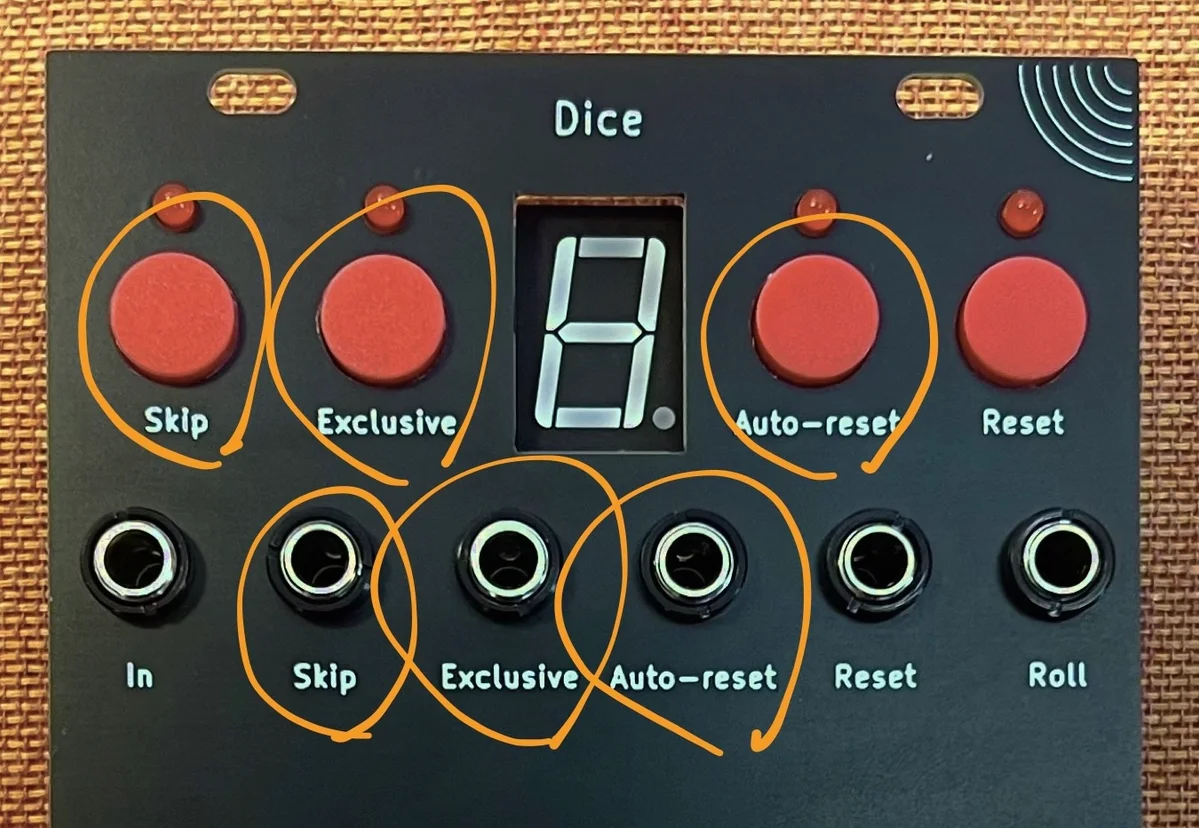
The three available modes are:
Exclusive Mode
A mode where no more than two Outs are active simultaneously — only the Out corresponding to the rolled number becomes active.
Skip Mode
Once an Out has been activated, its LED turns red, entering a Skip state. An Out in Skip state is skipped in subsequent rolls and will not become active again until a reset occurs.
Reset is performed by sending a gate to the Reset jack or pressing the Reset button.
Auto Reset Mode
When Skip mode is On, if all Outs enter the Skip state, all Skip states are cleared.
How to Use Dice
After reading the above explanation, it’s perfectly natural to wonder how to actually use Dice. This module is probably best understood not as having a specific prescribed use, but rather as one where you should try to use it creatively based on your own ideas — that’s my (Takazudo’s) take.
Below is a session I uploaded from my first time using Dice. Here’s a brief explanation of how I used Dice in this session.

In this session, I used Dice as a gate generator. I continuously sent 1/16 clock to the Roll input with Exclusive mode On. This results in a gate being output from one randomly chosen Out every 1/16 note.
Five of the Outs are connected to separate Envelope Generator triggers, and the sixth is connected to a hi-hat trigger. The hi-hat sounds when a 6 is rolled.
When a 5 is rolled, the triggered envelope is sent to the Dry/Wet CV input of a Mimeophon, causing reverb/delay to vary continuously.
When 1-4 are rolled, they trigger envelopes sent to the CV inputs of respective VCAs, through which white noise from a Noise Plethora is fed to In.
Wingie2 is inserted in between — noise plays continuously with different envelopes, and the resonator adds tonal character. By occasionally moving the die probability slider, the trigger frequency for 1-6 changes. Occasionally turning on Skip mode / Auto Reset mode reduces trigger frequency (since rolling the same number results in a Skip).
In this setup, Dice simply receives a continuous 1/16 clock — there is no sequencer. As a performer, I adjust each envelope’s Attack/Release, manipulate the center slider, and operate the Mimeophon.
Other Specifications
- Width: 16HP
- Depth: 28mm
- +12V max 50mA, -12V max 20mA. 5V rail not used
About Divergent Waves
Divergent Waves is a small company that has been designing Eurorack synthesizer modules since 2020. All their projects are published as open source, and Dice is one of those projects.
オマケ: 電氣美術研究會モジュラー小物セット付き
モジュラーシンセをもっと多くの方に触って欲しいという願いの元、電氣美術研究會さまにご協力頂き、モジュラー小物セットを本商品にバンドルさせて販売させていただいております。
パッチケーブルや電源ケーブル、ドレスナットのサンプルセット、モノラルスプリッターなど、内容は時期に応じて変化します。商品に同梱しますので是非お試し下さい!
That concludes our introduction of Dice. My (Takazudo’s) first impression of using Dice was that the ability to control the frequency of randomness was interesting. There are many modules in modular synth that output something random, but simply using such modules often results in something that obviously sounds like “I’m randomly playing something.”
In contrast, Dice always gives one particular outcome a higher probability based on the center slider position. This creates a sense that after setting things up, simply moving the center slider can shift the musical scene. The usage described in this article is just one example, and I think Dice is a fun module that invites experimentation — “what if I use it this way?” — as you patch.
We hope you find this helpful.