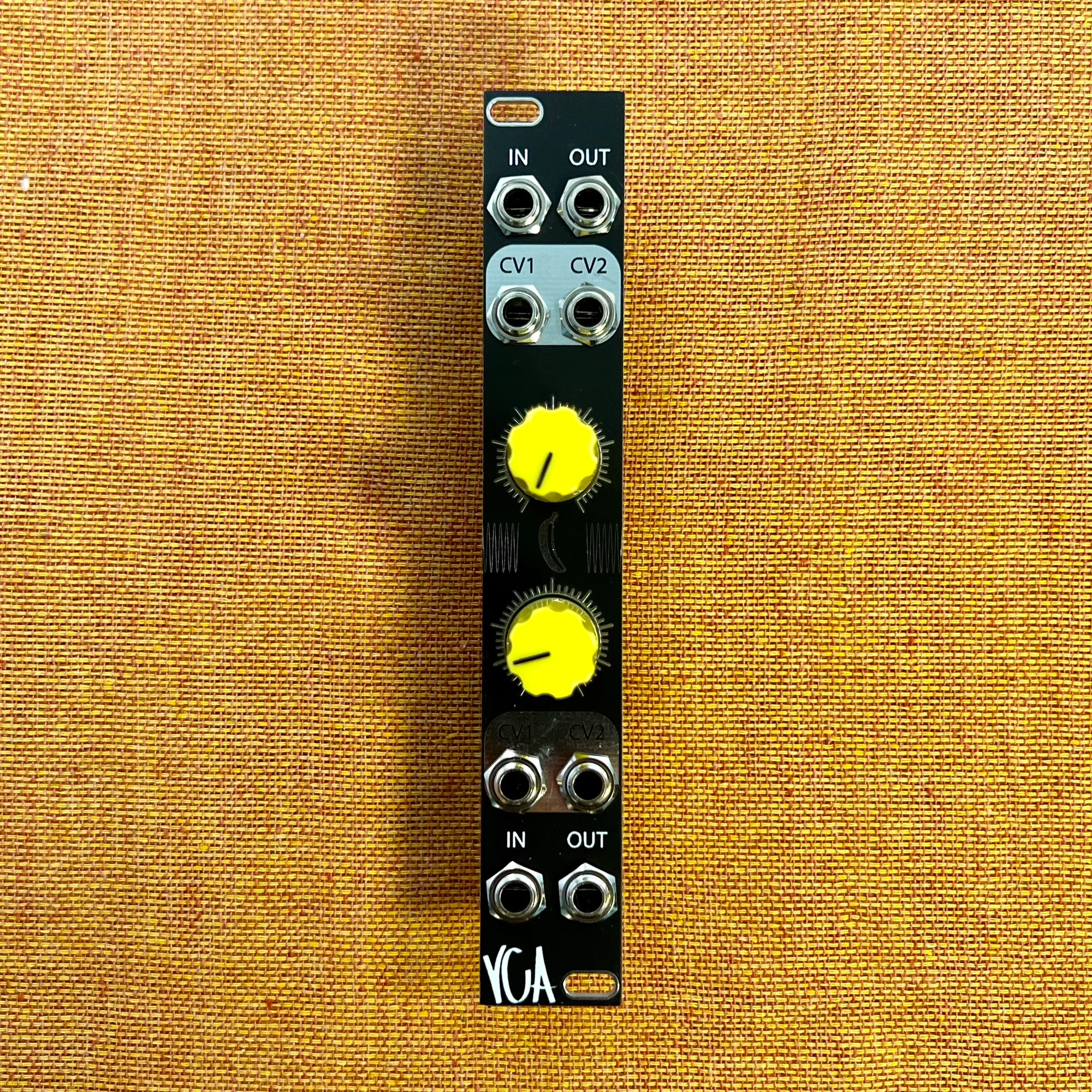
This is an introduction to the Dual VCA by NoisyFruitsLab, available at Takazudo Modular. Dual VCA is a 2-channel VCA. Each VCA features knob-based level control and two CV-based level controls.
This product is available for purchase below.
What is Dual VCA?
As the name suggests, Dual VCA is a module with two VCA channels. Each VCA features a knob-based level control and two CV inputs for level control. It’s a simple module that’s a natural candidate whenever you simply need a VCA.
Behind the knobs on the back of this module, there are LEDs that light up according to the output level. This is not only visually appealing but also useful for checking output levels at a glance among rows of modules.

Two CV Inputs
While it works perfectly fine as a straightforward VCA with large, easy-to-use knobs, the noteworthy feature of this module is that each VCA has two CV inputs. The VCA’s output level is controlled by the combination of these three factors:
- Knob position
- CV input to CV1 jack
- CV input to CV2 jack
Most VCAs have only one CV input jack, but the Dual VCA has two, allowing for various applications.
Here’s a brief explanation of how to use them, based on a basic VCA use case.
Per-Trigger Volume Control
The following discussion assumes you’re using the VCA alongside a separate Envelope Generator (EG), LFO, or other CV-controlling module.
The most basic VCA use case is: a sequencer outputs a gate to an EG, the EG outputs CV to the VCA, and the VCA controls the level of the input signal. This lets you apply time-based decay to the continuous output of an oscillator.
Putting this in text makes it sound complicated… In simpler terms, an oscillator on its own continuously outputs sound like a drone, but with a VCA, you can make it decay after each trigger — turning it into piano-like notes that fade out after being played.
The diagram below shows a VCA receiving a single envelope to control level:
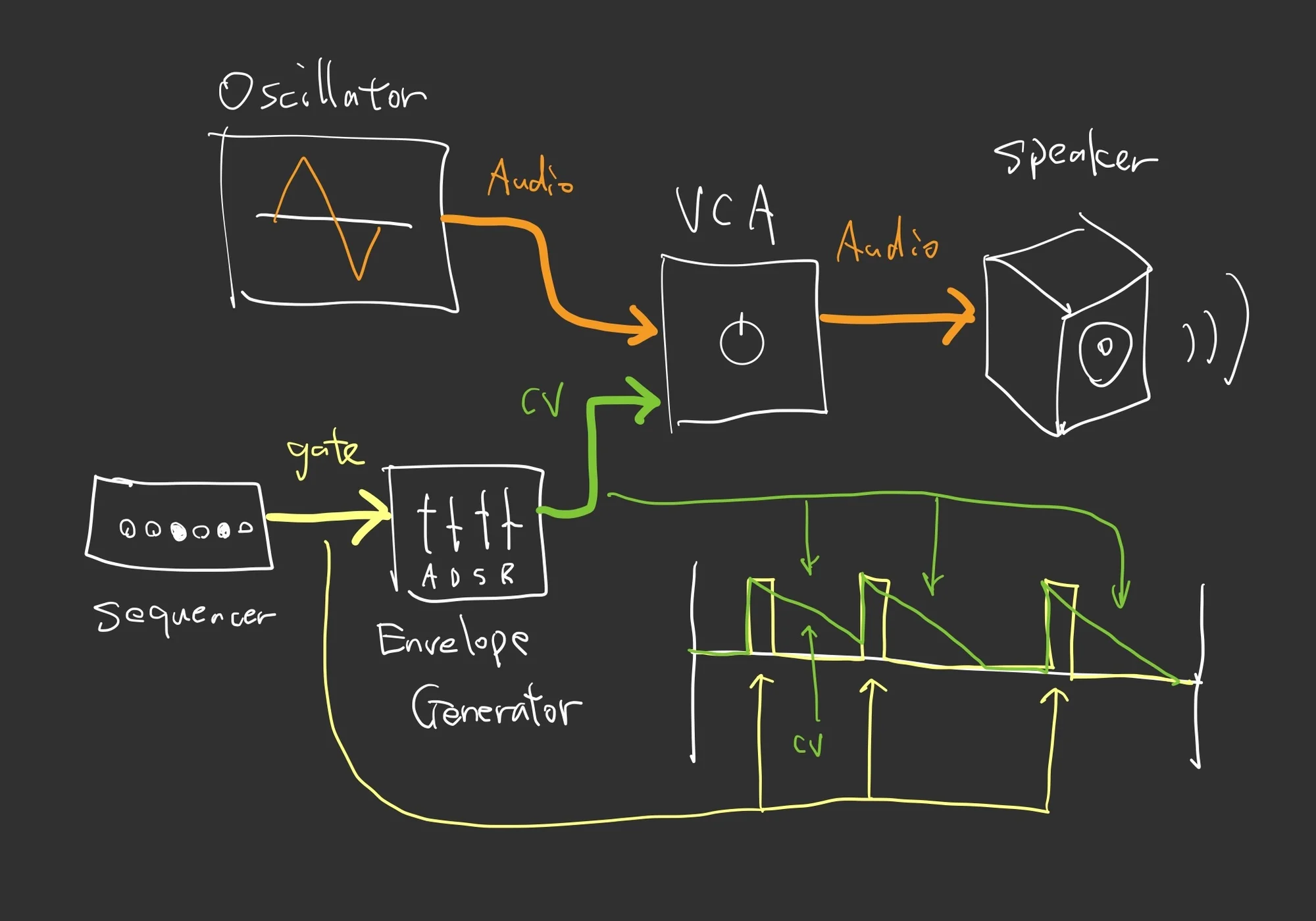
Assuming this VCA is the Dual VCA: a sequencer sends a gate to an EG, which creates an envelope CV. The VCA receives this CV at its CV1 jack, and separately receives the oscillator output at its In jack. The result is that the signal received at In is output from Out at a level controlled by the CV from the EG. This is the basic flow of what a VCA does.

That’s how per-gate level control works — the most fundamental VCA use case.
When Receiving Two CVs
So the VCA receives CV, but what happens when it receives two CVs? That might not be immediately obvious. It wasn’t clear to me (Takazudo) either, so I tested it quite a bit.
Building on the previous example, consider adding a slower envelope to the mix. When this slow envelope is received at the CV2 jack, the input audio signal is attenuated as follows:

What’s happening is that the audio signal received at In is output attenuated by the combined result of the CVs at CV1 and CV2. (Based on my testing, the attenuation seems to work roughly like (CV1 + CV2) / 2.)
As for why this is useful — it depends on the user, but for example, you could input a gentle LFO into CV2 to add accent to simple envelope decay, or input a fast LFO into CV2 for a hard modulation effect, among various other possibilities.
Personally, I recommend feeding something faster than an LFO — like an actual oscillator signal — into both CVs and applying extreme modulation to the audio at In for experimental sound design.
Specifications
- Width: 4HP
- Depth: 24mm
- Power consumption: +12V 10mA / -12V 10mA
Included Accessories
- Power ribbon cable
- Screws
- Banana keychain
- Banana sticker
Noisy Fruits Labについて
Noisy Fruits Lab (Timo Johannes)はドイツベルリン在住のMixerモジュールに特化したモジュラーシンセメーカーです。
モジュラーシンセサイザーにおけるMixerへの熱意と技術的な探求心は他に類を見ず、高度に洗練されたミックスとルーティングをモジュラーシンセで実現しています。
オマケ: 電氣美術研究會モジュラー小物セット付き

モジュラーシンセをもっと多くの方に触って欲しいという願いの元、電氣美術研究會さまにご協力頂き、モジュラー小物セットを本商品にバンドルさせて販売させていただいております。
パッチケーブルや電源ケーブル、ドレスナットのサンプルセット、モノラルスプリッターなど、内容は時期に応じて変化します。商品に同梱しますので是非お試し下さい!
That concludes our introduction of the Dual VCA.
The Dual VCA is one of the first modules stocked from NoisyFruitsLab. My reason for carrying NoisyFruitsLab modules is that I wanted to introduce modules that are simple enough for modular synth beginners to understand easily, with good ergonomics and appropriate sizing. The Dual VCA is exactly that kind of module.
VCAs can sometimes be part of a mixer or combined with an LPF, rather than existing as standalone modules. So there may be few cases where you absolutely need this Dual VCA specifically, but when you want a simple, ergonomic VCA, the Dual VCA is a strong candidate.
I especially want to recommend this to people who are just starting with modular synths — before buying a feature-packed mixer module and feeling overwhelmed, learning modular through combinations of simple modules like this one is a great approach.
We hope you find this helpful.