
This is an introduction to the Honey, a standalone electronic instrument by Meng Qi, available at Takazudo Modular.
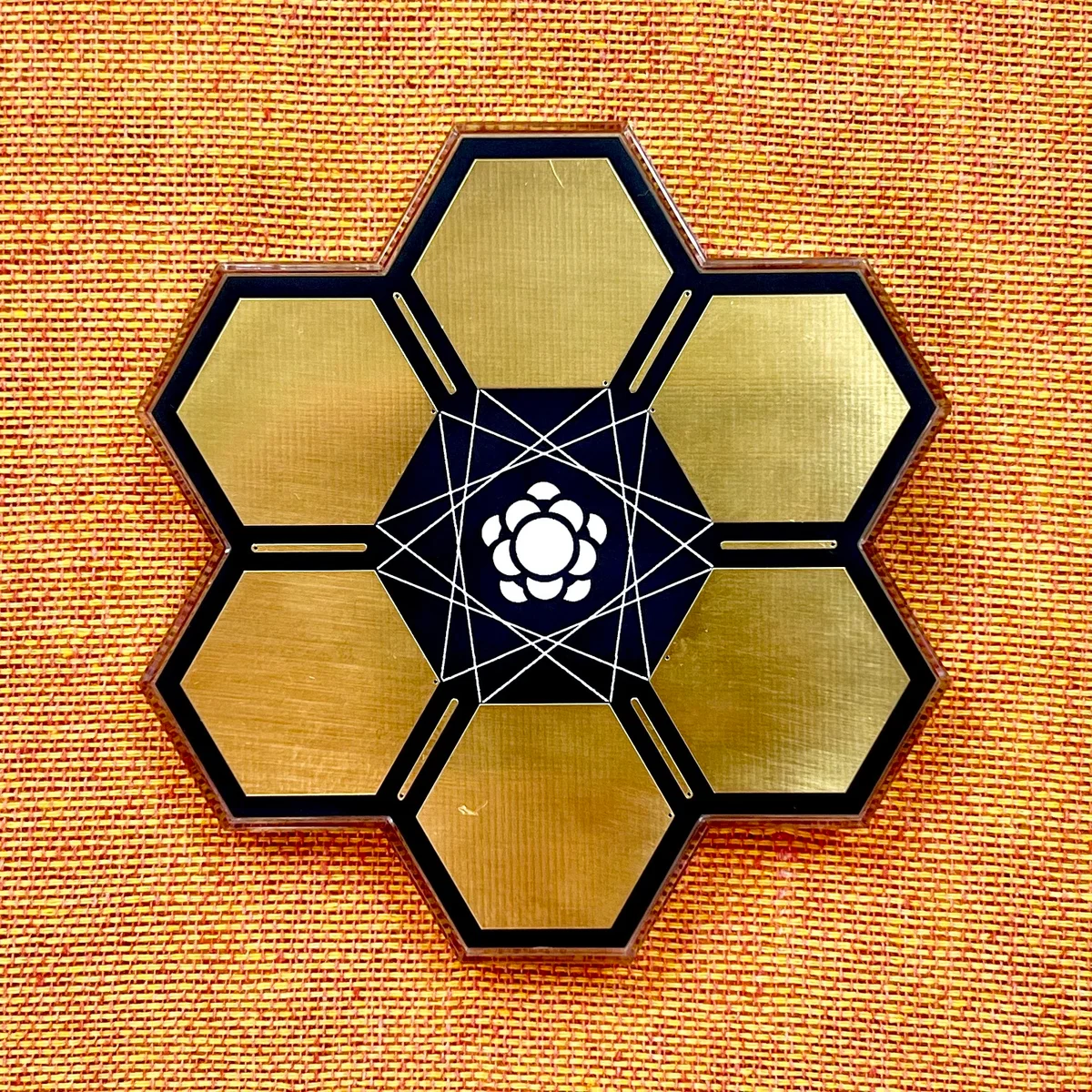
Honey could perhaps be described as a palm-sized, touch-operated noise music generating electronic instrument based on the concept of Bytebeat. It runs on a single AAA battery and has no audio jack, outputting sound through its built-in speaker. Touch operation changes variables and mathematical operations to produce dynamic sounds.
This product is available for purchase below.
- How to Use Honey
- What is Bytebeat?
- Honey and Bytebeat
- Exploring Bytebeat
- Reference Videos
- Technical Specifications
How to Use Honey
At first glance, this Honey looks like a mysterious device shaped somewhat like the James Webb Space Telescope, but once you insert a battery and touch it, the magic happens — a diverse range of noise and sine wave-mixed sounds are produced.
The sound changes (or doesn’t) depending on which of the 6 panels you touch, which can seem elusive and hard to pin down. But as you keep touching it, you start to get a sense of how it works… or maybe not. In any case, Honey is a touch-operated electronic instrument that functions entirely on its own.
What is Bytebeat?
To fully enjoy Honey, it helps to understand what Bytebeat is — which I mentioned is the conceptual basis for this instrument.
I (Takazudo) had only occasionally seen the term Bytebeat on X (Twitter) and had a vague understanding that it was something about making music with short programs. When stocking Honey, I researched it a bit more and came to understand what it actually is. And knowing what Bytebeat is deepened my understanding of what kind of instrument Honey is.
Bytebeat began in 2011 when Viznut noticed that a short program he had written produced musical output and shared it on the internet. Below is that code and the sound it generates.
The sound is produced by an extremely short C program like this:
main(t){for(t=0;;t++)putchar(t*(((t>>12)|(t>>8))&(63&(t>>4))));}This video attracted widespread interest and sparked a small boom of people trying to generate sounds with similarly short code.
Bytebeat doesn’t require a programming environment to run — web applications for creating Bytebeat in the browser have appeared, making it easy for anyone to enjoy:
Viznut found this phenomenon fascinating and documented the spread of Bytebeat in the following blog post and paper:
- countercomplex: Algorithmic symphonies from one line of code — how and why?
- Discovering novel computer music techniques by exploring the space of short computer programs
He noted that the spread of Bytebeat-like experiments could potentially lead to the discovery of interesting musical approaches that cannot be found within previously explored expressive spaces.
Honey and Bytebeat
So about this Honey — as I mentioned, it’s based on the concept of Bytebeat. Like Bytebeat, Honey’s sound output is the result of mathematical operations. These operations involve 5 variables, 4 arithmetic operators, and 6 other operators, all of which change through touch panel manipulation. This is the purpose behind the touch panels.
The sounds Honey creates are generated by a circuit designed by Meng Qi, and these sounds can be partially modified through the 6 panels.
In other words, Honey can be described as Meng Qi’s electronic instrument work that incorporates a Bytebeat-like approach, including the nuances of how the generated sound changes in response to touch.
Exploring Bytebeat
When I (Takazudo) first watched Bytebeat videos, honestly, I had no idea how I could use this for anything. However, learning about the concept of Bytebeat made me realize that Honey was never made to follow existing musical approaches — such as steady tempos, melodies, rhythms, or chord progressions — to achieve some predetermined goal.
When Honey actually arrived and I picked it up, it was quite mysterious. Within the seemingly random noise, I started to sense certain rules depending on which panels I was touching. Whether it’s truly controllable or not, I still can’t say. Knowing the background of Bytebeat, Bytebeat and Honey itself start to feel almost like an antithesis to existing musical approaches.
There are many ways to enjoy Honey. You could simply pick it up and try to sense how its mysterious noise is generated. You could also sample or process the sounds Honey creates and use them as a random element in your own music.
For me (Takazudo), the very existence of Honey conveys a message — that even elements outside our control can be crafted as part of an instrument that creates music, and can be controlled through bodily movements. For those bound by conventional music, Honey may remind them of the freedom in creating sound.
Reference Videos
Below is a video of me playing the Honey. It’s an instrument that produces sound when you touch the panels.
Technical Specifications
- Runs on 1 AAA battery (not included)
- No audio jack — sound is output through the built-in speaker
Meng Qiについて
Meng Qiは中国北京を拠点に活動する電子楽器のクリエイターです。
Meng Qiの作る楽器は非常にユニークなモノばかり。それでいて音楽的に高いセンスで作られており、触るとワクワクするものばかりです。是非彼のInstagramを見てください。Meng Qiがすべて手作りしている様子と、異常なまでに細かい技巧に驚くはずです。