This is an introduction to the Leveling EQ Amplifier [LEQA] by 4ms Company, available at Takazudo Modular.
Leveling EQ Amplifier is a 14HP Eurorack module that combines stereo width control, EQ, and compression/limiting. It is intended for shaping width, frequency balance, and level near the end of a patch, whether on an individual sound, a stereo bus, or a full master bus.
- Product Photos
- Manuals and Guides
- Overview
- Stereo Width Processor
- EQ
- Compressor
- Specifications
- Product Warranty
- Demo Video
Product Photos
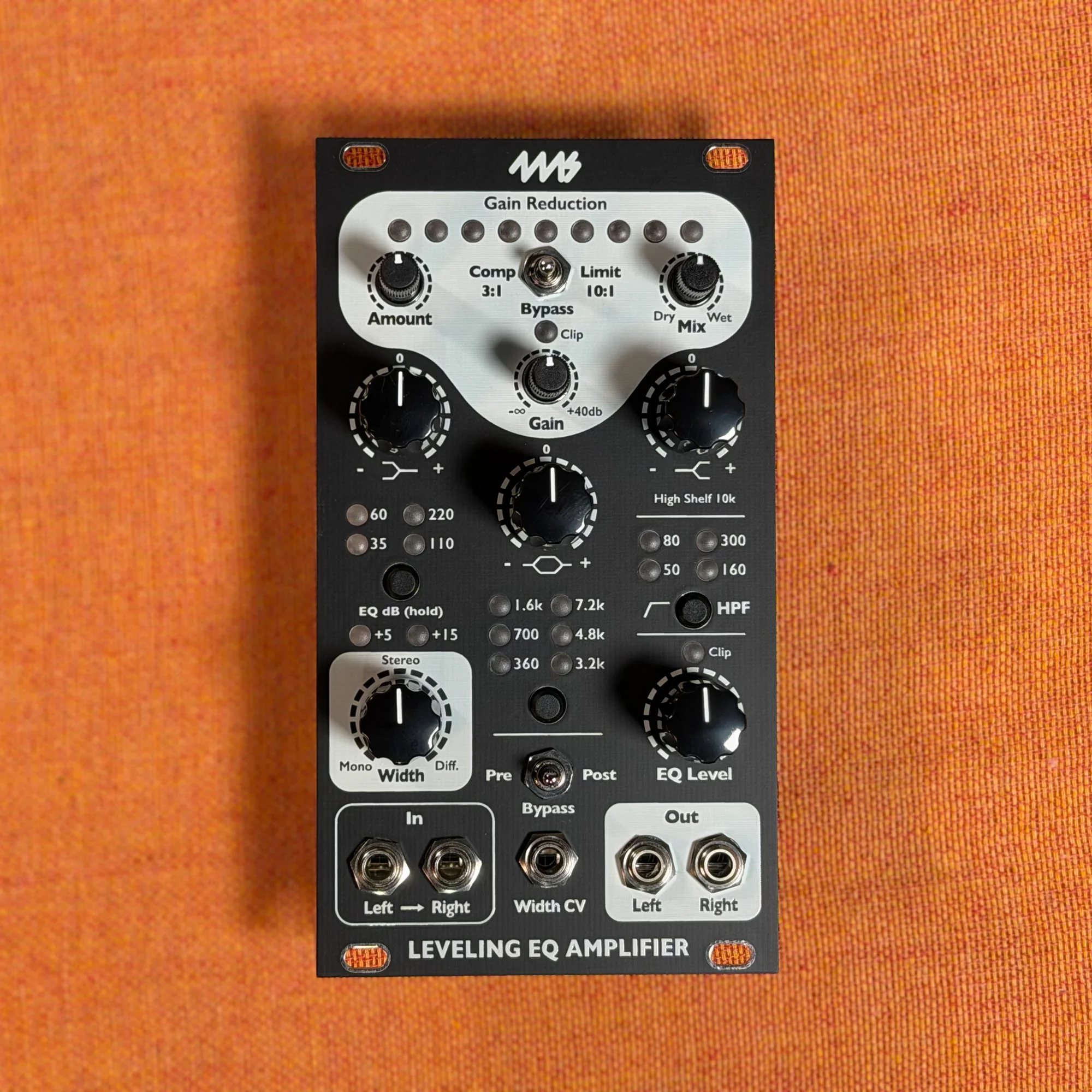
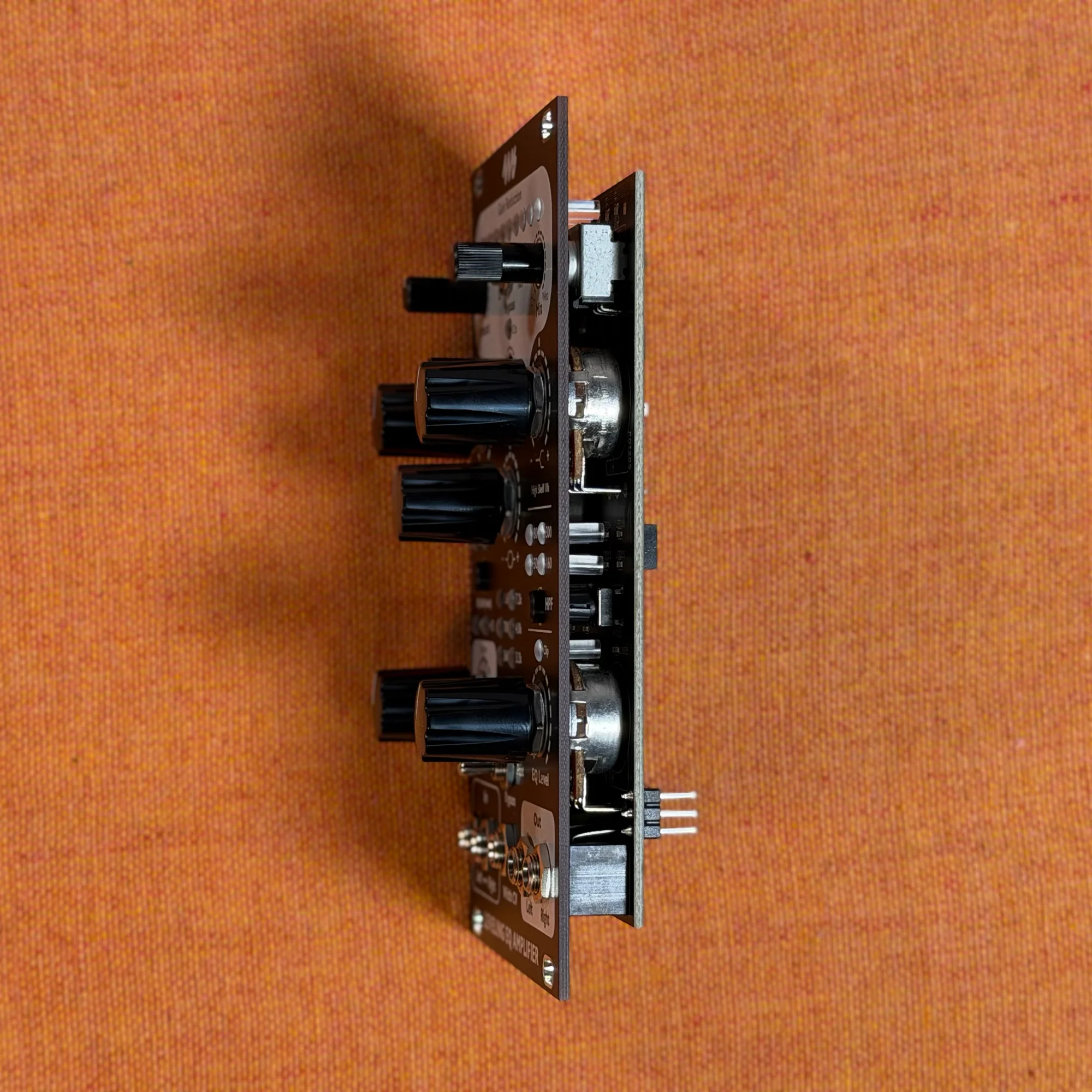
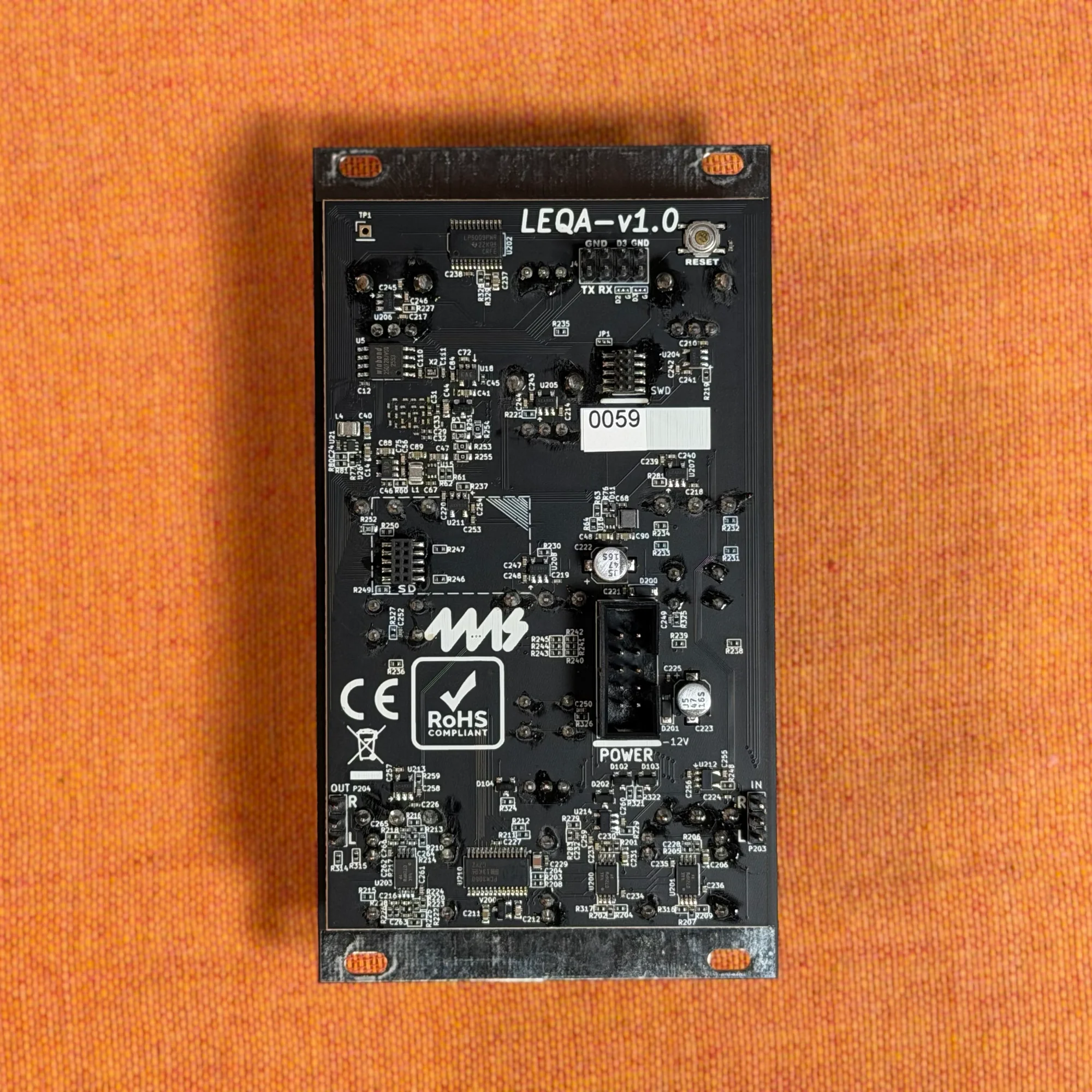
Manuals and Guides
Takazudo Modular publishes manuals and guide articles for this product. Please see below.
Overview
Leveling EQ Amplifier is a stereo end-of-chain audio processor that 4ms lists with a global release date of June 30, 2026. It is designed to polish sound at the end of a patch, whether on an individual part, a stereo bus, or a full master bus.
The module draws inspiration from two iconic cornerstones of mixing: the LA-2A optical compressor and the Neve 1073 EQ. Rather than being fully parametric, it uses pre-defined curves and selectable frequencies to keep mixing intuitive, so very little effort is needed for great-sounding results.
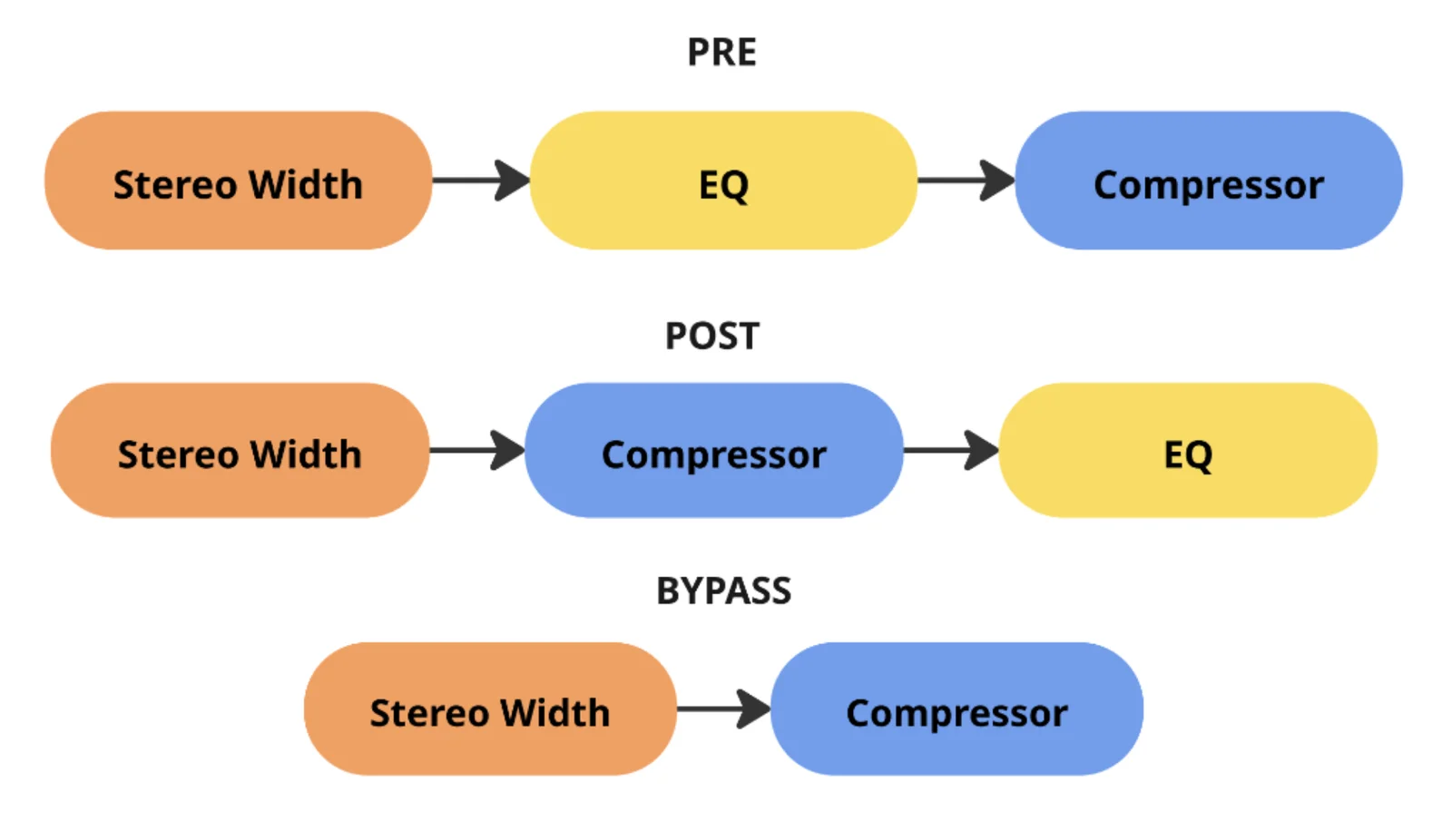
Its main processing blocks are the Stereo Width Processor, EQ, and Compressor. The EQ can be placed before the compressor, after the compressor, or bypassed. Together, these sections cover mono-to-stereo widening, stereo bus width control, tone shaping, peak control, and parallel compression in one module.
Stereo Width Processor
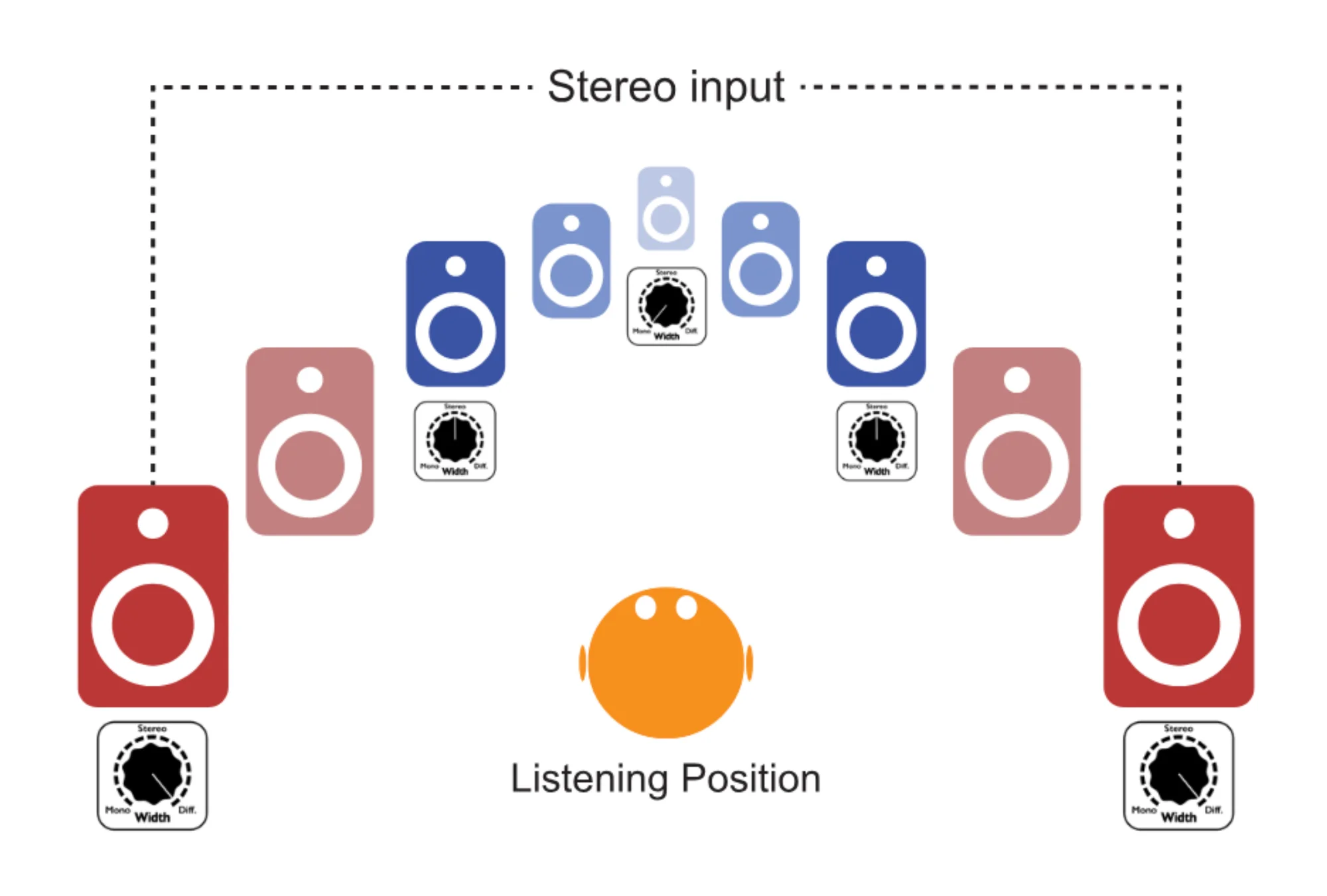
The Stereo Width Processor creates a rich stereo field from a mono or stereo signal using a combination of psychoacoustic techniques. It is controlled by the Width knob and the Width CV input (0V to +5V).
With only the left input patched it operates in Mono Mode; with both left and right patched it operates in Stereo Mode, and each mode behaves differently.
Mono Mode
With only the left input patched, mono-input mode combines two techniques — the Haas effect and Mid/Side processing — to create stereo width from a mono signal.
The Haas effect duplicates the signal to both channels and delays one side by a few tens of milliseconds (about 20ms on the LEQA). When you sit in the center, your brain can no longer pinpoint the source, and the result is perceived as a rich stereo image. Mid/Side processing uses the sum (Mid) and difference (Side) of the two channels to control how much the sound appears to come from the center versus the sides.
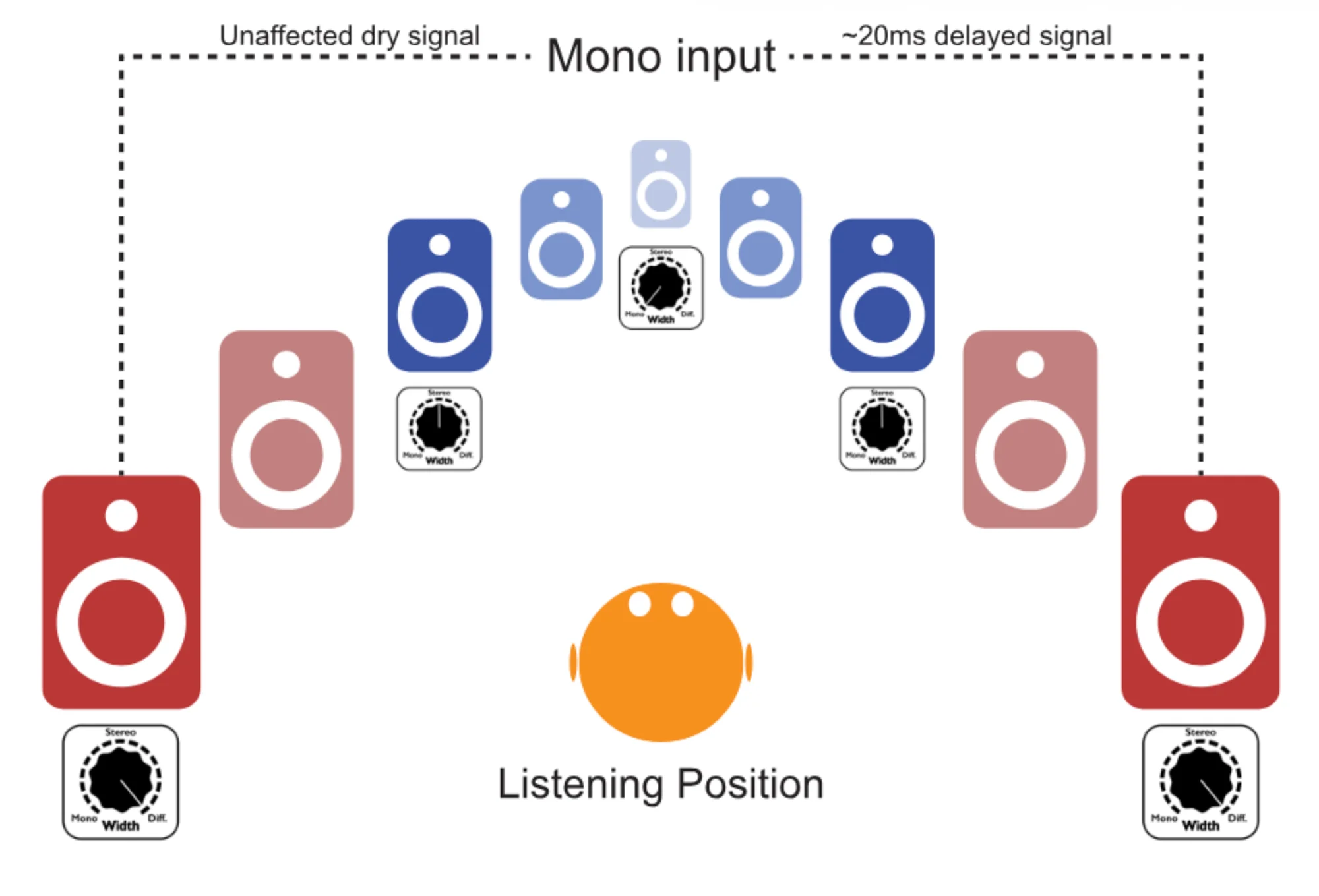
The Width knob and CV crossfade between different mixes and phase relationships of the dry (original) and wet (delayed) signals.
0%(minimum): the Stereo Width section is bypassed and both channels output the dry signalaround
5%: the delayed signal begins to fade in on both outputsaround
50%: the dry and delayed signals pan from mono to fully stereo (dry hard left, delayed hard right)50%to100%: more difference signal is added, adding gain and distinctive phase relationships for an even wider image
Note: if you process a mono signal in Mono Mode and then collapse the outputs back to mono, it is recommended to bypass the Stereo Width section by turning Width to 0. Because of the Haas effect, a collapsed signal is perceived as a simple delay and may cause phase cancellation.
Stereo Mode
With both inputs patched, the LEQA adjusts width using Mid/Side-style processing only, with no delay.
0%to50%: fades from a mono sum (left + right) to fully stereo (left→left, right→right)50%to100%: increases the difference signal, moving from fully stereo into "super stereo"
The Width CV input accepts 0V to +5V and is added to the knob setting.
EQ
The EQ section boosts and cuts specific frequencies of the mix. It has four filters — high-pass, low shelf, mid bell, and high shelf — and the frequencies are chosen with a button in each section (selections are saved across power cycles).
Filter Ranges
High-pass: selectable50Hz,80Hz,160Hz, or300HzLow shelf: selectable35Hz,60Hz,110Hz, or220HzMid bell: selectable360Hz,700Hz,1.6kHz,3.2kHz,4.8kHz, or7.2kHzHigh shelf: fixed at10kHz
The low shelf, mid bell, and high shelf are all broad, roughly 6dB/oct curves that you boost or cut with the knob. The high-pass slope depends on the EQ dB setting: 18dB/oct at +/-15dB, and 6dB/oct at +/-5dB.
The EQ gain range can be set to +/-5dB or +/-15dB (hold the low-shelf select button for 2 seconds to toggle). The +/-5dB range suits subtle stereo bus or master adjustments, while +/-15dB allows stronger tone shaping on individual instruments.
EQ Level adjusts the overall EQ output from 0% to 100% (silent at 0%, unity gain at 100%). The output hard-limits at +/-10V, indicated by the Clip LED.
Placement and Routing
Inside the EQ, the filters are in series: high-pass → low shelf → mid bell → high shelf. Placing the high-pass before the low shelf is deliberate — removing unwanted DC and very low frequencies before boosting the low shelf improves headroom and definition (this supports the classic "Pultec" trick).
The three-position Pre/Post/Bypass switch sets where the EQ sits: before the compressor (Pre), after it (Post), or removed from the signal path entirely (Bypass).
Compressor
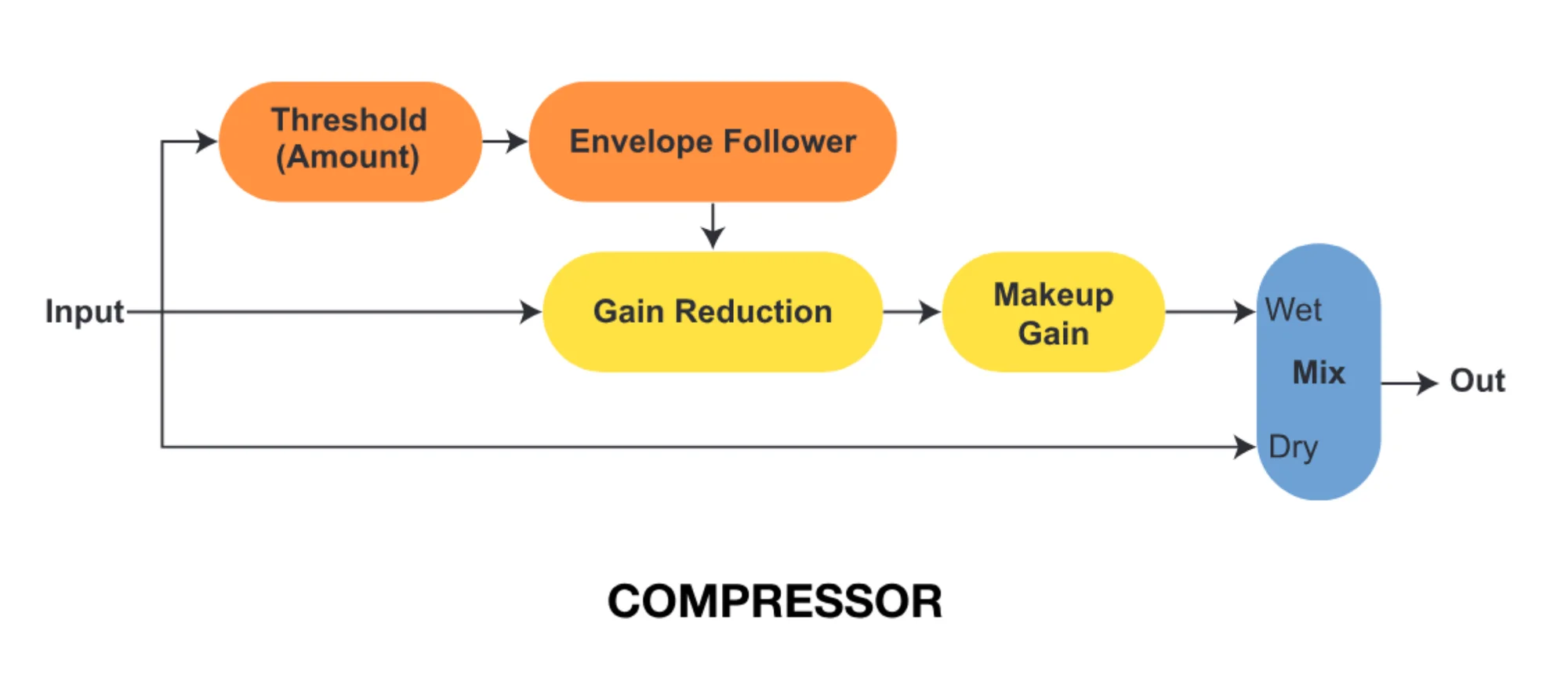
The compressor tames the dynamic range of a sound source and is inspired by the LA-2A optical compressor. It is not an exact clone, but it emulates how an optical compressor behaves.
In an optical compressor, the brightness of a lamp tracks the input level, and a photocell responds to that light to reduce the output gain. The slow, logarithmic response of the lamp charging and discharging gives slow attack and release times, which is what produces the "warm," "vintage" character.
The Amount knob changes the threshold at which gain reduction begins, setting how much compression is applied. Lower Amount compresses only the loudest peaks; higher Amount compresses more of the signal.
The Comp/Bypass/Limit switch selects the ratio: Comp is 3:1, Limit is 10:1, and the center Bypass removes the compressor from the path. A heavier 10:1 is commonly used on individual sources, and a gentler 3:1 on stereo buses or the full mix — but there are no strict rules.
The nine-LED meter above the compressor shows gain reduction, with 0dB at the far right and -24dB at the far left. Unlike a typical VU meter, it reads right to left, because it displays how much the signal is being reduced rather than its level.
The Gain knob provides up to +40dB of makeup gain. It is mainly used to bring the compressed level back up, but it can also be pushed for crunch or distortion as an effect. The output hard-clips at +/-10V, indicated by the Clip LED.
The Mix knob crossfades between the dry (original) and wet (compressed) signals. Blending a little heavily compressed signal into the original — "parallel compression" — adds density and body while keeping the dynamics of the original.
Specifications
Basic Specifications
Format: Eurorack
Size: 14HP
Depth: 25mm including power cable
Power consumption: +12V 120mA max, -12V 10mA max, +5V not used
Audio / CV
Bypassed frequency range: 8Hz-24kHz +/-0.1dB
Maximum amplitude: 19.2Vpp
Width CV input: 0V to +5V
DSP
Sample rate: 96kHz
Codec: 24bit
Internal processing: 32bit
Processor: 1GHz Cortex-A7
Product Warranty
This product carries a 1-year manufacturer warranty covering normal use under typical operating conditions. Please contact us if you notice any issues with the product.
Demo Video
The following is 4ms's own tutorial for the module. It works through each section — EQ, stereo width, and the compressor/limiter — chapter by chapter, using a sampler as the source to demonstrate how each control shapes the sound.
The following is a walkthrough by DivKid, a Eurorack-focused YouTuber. More than a straight demo, it digs into what EQ, compression, and stereo-width processing actually do and why you would reach for them, with patch examples across a range of styles.
About 4ms Company
4ms Company is an American maker that has been designing and building innovative audio electronics for musicians since its founding in 1996. Today they are based in Portland, Oregon, right in the heart of the West Coast synthesizer scene.
They are known for products that fuse the intuitive feel of hardware with the flexibility of software — MetaModule (a hardware interface for software modules), Catalyst Sequencer, Looping Delay, Sampler, and more. With a focus on clean, low-noise, great-sounding instruments, and a lineup that spans both fully-built modules and DIY kits, they have something for everyone from beginners to seasoned builders.

Bonus: Modular Accessory Set by 電氣美術研究會 (Denki Bijutsu Kenkyukai) Included
In the hope that more people will get hands-on with modular synths, we have teamed up with 電氣美術研究會 to bundle a modular accessory set with this product.
The contents vary by season — patch cables, power cables, a dress-nut sample set, a mono splitter, and more. The set is included with the product, so please give it a try!
That concludes our introduction of the Leveling EQ Amplifier [LEQA].
We hope you find this helpful.