This is an introduction and overview of The Mystic by Recovery Effects And Devices, available at Takazudo Modular.
By intentionally not supporting 1V/Oct, The Mystic directs the performer’s attention to the act of synthesis itself. A standalone semi-modular synth with a 2-operator FM configuration and analog delay, capable of generating sustained, organic drone and noise textures.
*Note: This product requires a DC 9V, center-negative, 200mA+ AC adapter (standard Boss-style adapter) for operation, which is not included. Please prepare one separately.
This product is available for purchase below.
- Product Photos
- Basic Usage
- Latch Switch and Momentary Button
- FM Synthesis to Delay
- My Take on The Mystic
- Reference Videos
- Specifications
Product Photos
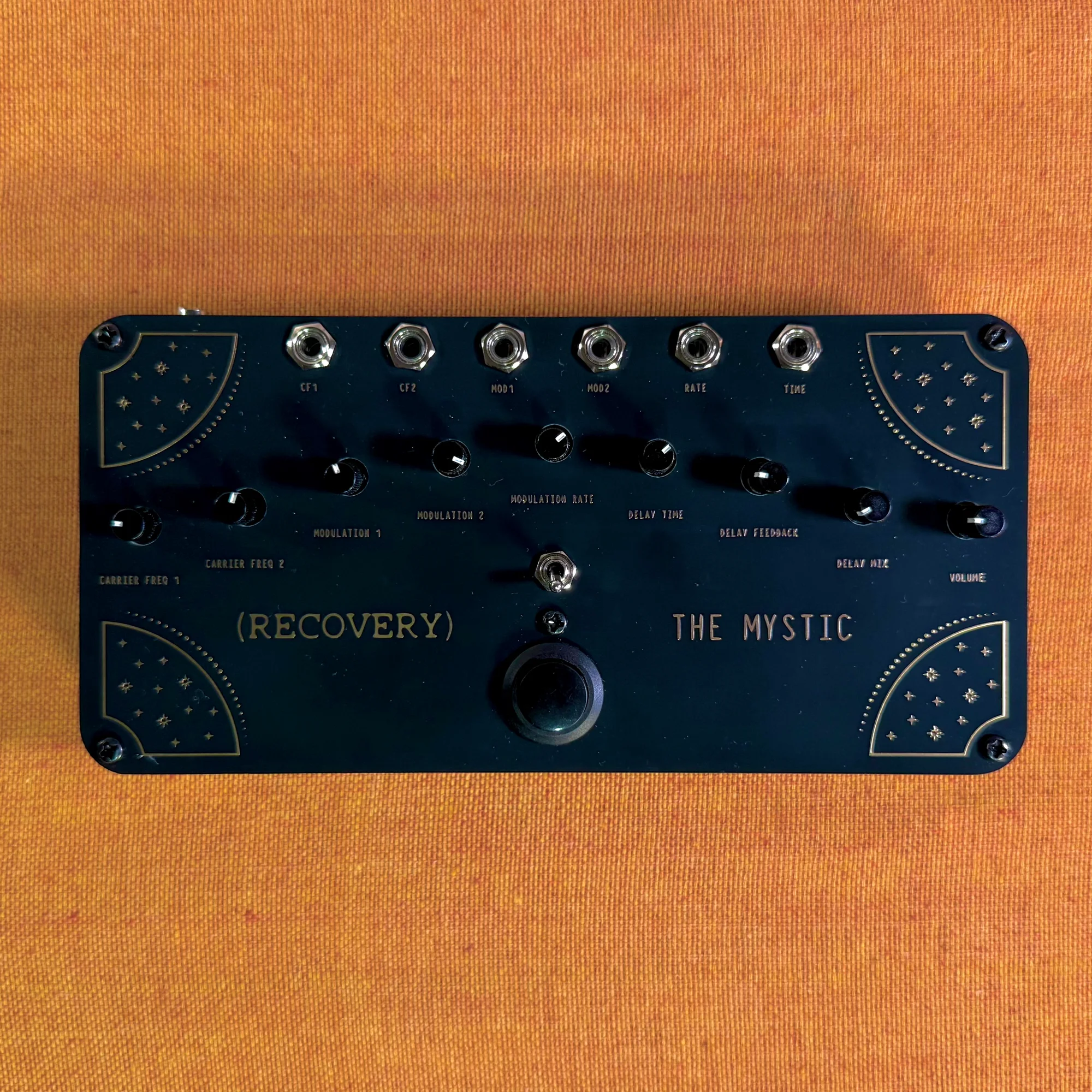
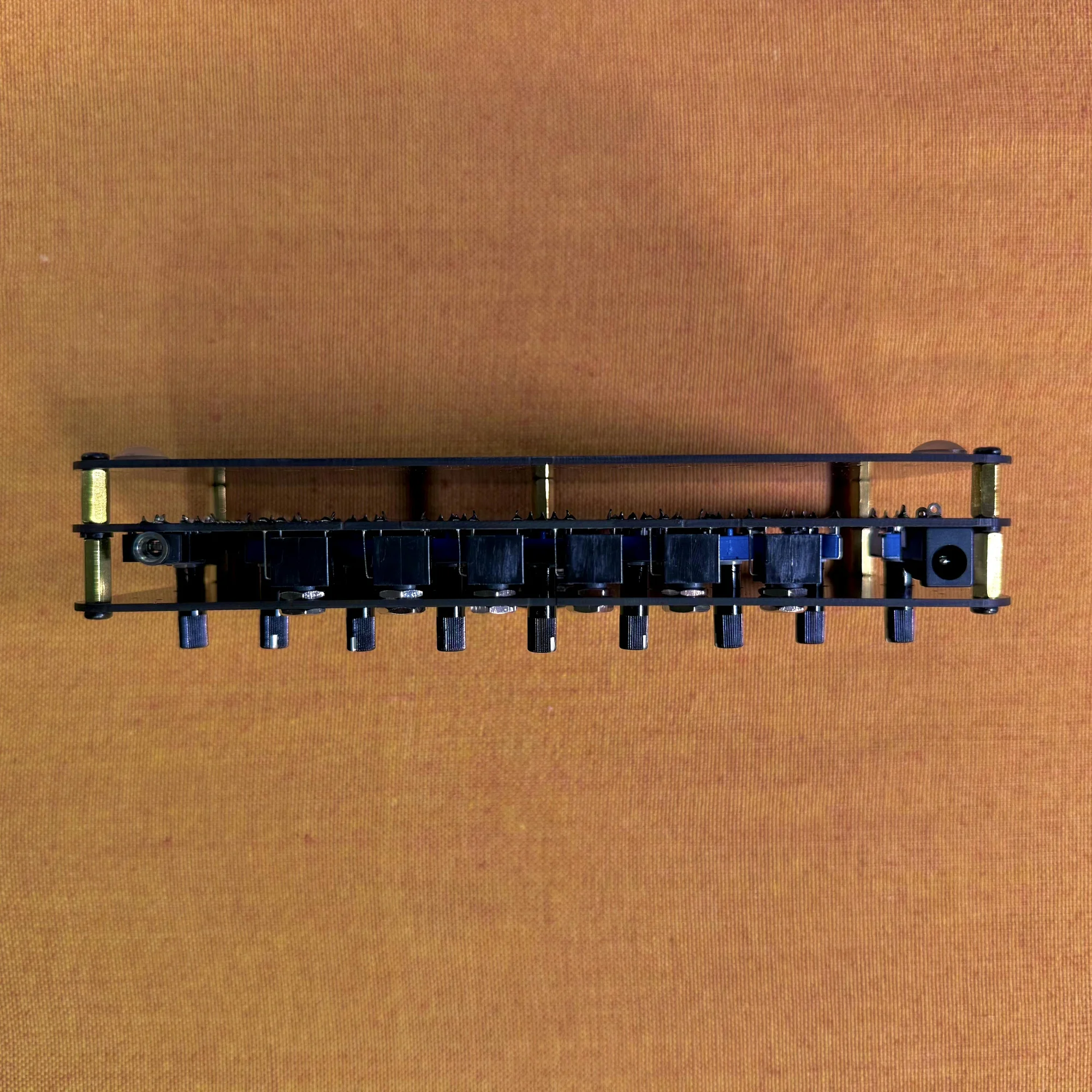
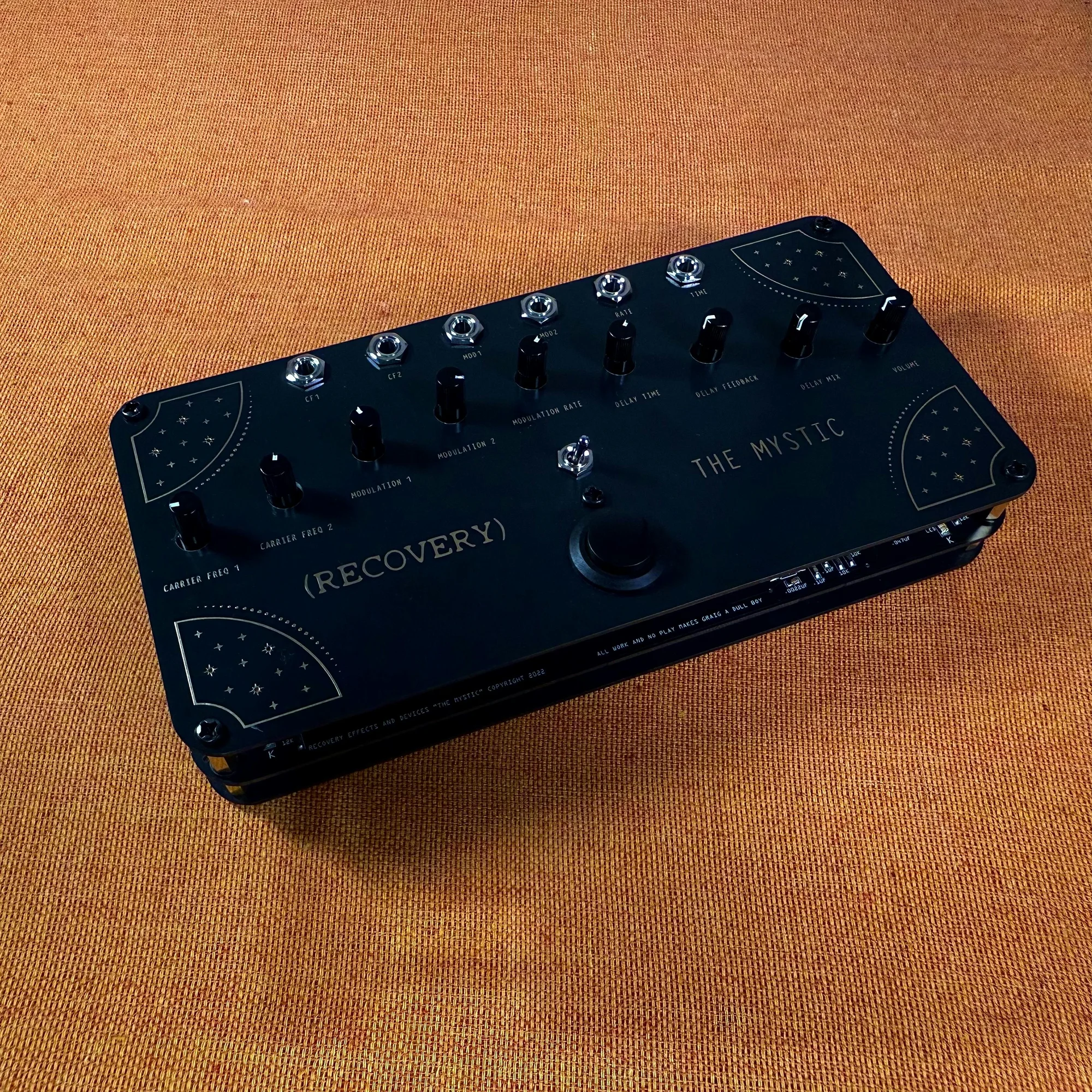
Basic Usage
The Mystic has a mono 3.5mm output jack on the back. Essentially, twisting various knobs and switches produces drone/noise-style audio signals for you to enjoy. That’s the kind of synthesizer it is.
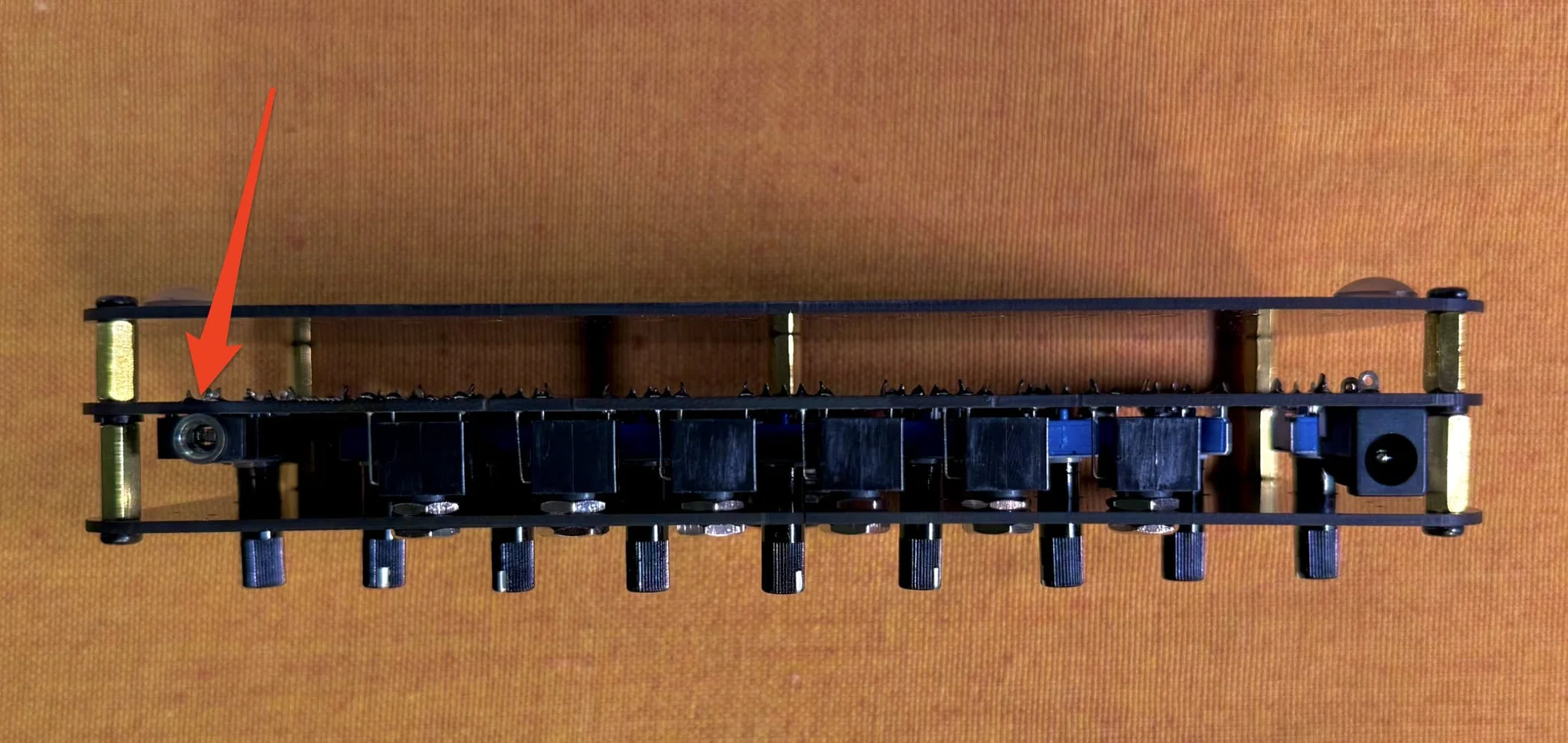
However, this synthesizer has some interesting synthesis features that make The Mystic a truly unique instrument.
Latch Switch and Momentary Button
The first thing to know when using The Mystic is the Latch mode ON/OFF capability. The switch in the center of the unit (shown in the photo below) toggles Latch mode ON when pushed up and OFF when pushed down.
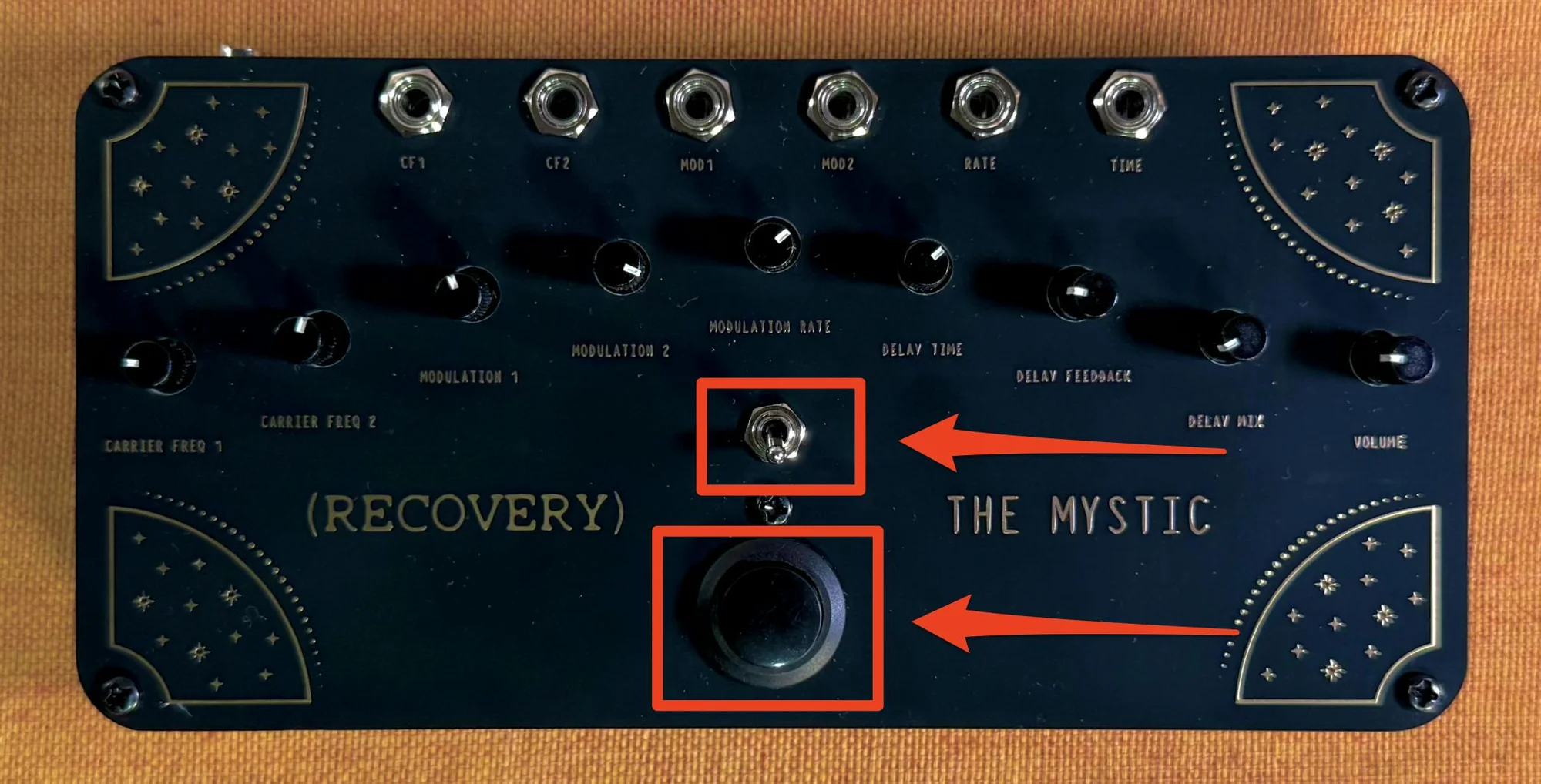
When Latch mode is ON, a droning audio signal is continuously output. When Latch mode is OFF, audio is only output while holding down the Momentary button at the bottom of the unit (shown in the photo).
This allows you to either use it as a continuous drone sound source or create accented one-shot sounds.
FM Synthesis to Delay
The sound generated by The Mystic is based on a 2-carrier, 2-modulator FM synthesizer. The exact audio processing details aren’t published in detail on the official website, but from my experimentation and research, it appears to work roughly as follows:
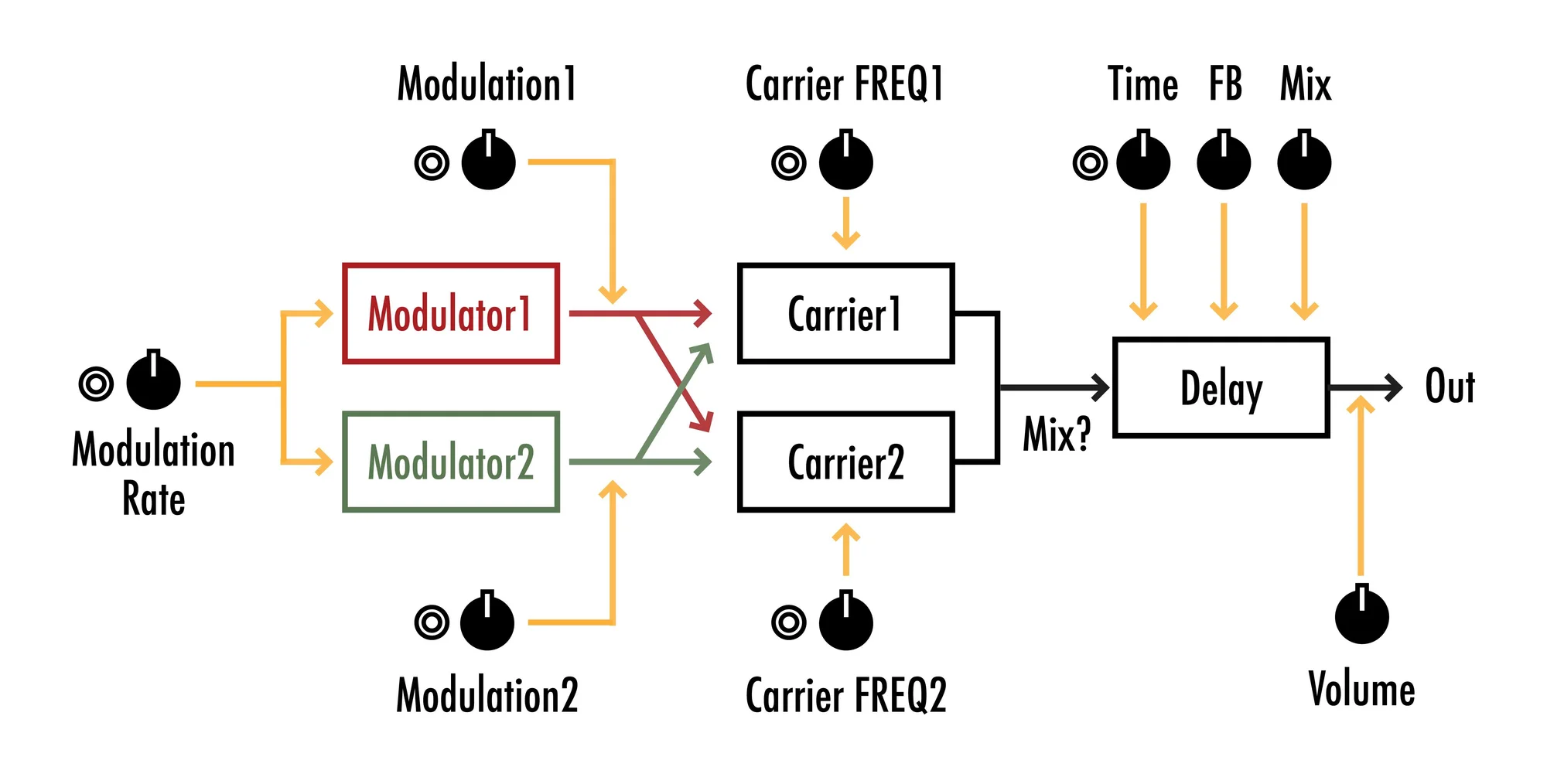
Let me explain this signal flow.
Two Carriers
The raw sound of this synth is essentially a mix of two oscillators. Following FM synthesis terminology, The Mystic calls these Carriers. These two Carriers can each have their frequency controlled independently via knobs and CV input through their jacks. The waveforms from these two Carriers are then summed together. The corresponding interface controls are:
- Carrier 1 frequency control
CARRIER FREQ 1knob- CV input via
CF1jack
- Carrier 2 frequency control
CARRIER FREQ 2knob- CV input via
CF2jack
The waveforms generated by these two Carriers are likely pure sine waves (as is standard in FM synthesis).
What’s interesting here is that the pitch control of these two Carriers does not support 1V/Oct. This means it’s not intended to play melodies as a harmonic oscillator, but rather seems designed as an instrument for creating textural sounds on its own.
Two Modulators
In addition to the two Carriers, two more oscillators are provided. In FM synthesis terminology, these are called Modulators, which modify the frequency of the Carriers. The Mystic uses this same terminology. These two Modulators simultaneously modulate the frequencies of both Carriers.
The frequency of these two Modulators is controlled by the MODULATION RATE knob and CV input via the RATE jack. This frequency change affects both Modulators simultaneously. The modulation depth (ratio) that each Modulator applies to the Carriers is controlled separately.
This may seem complex, but here’s a summary:
- Modulator 1 / Modulator 2 frequency control
MODULATION RATEknob- CV input via
RATEjack
- Modulator 1 → Carrier 1 / Carrier 2 modulation depth
MODULATION 1knob- CV input via
MOD1jack
- Modulator 2 → Carrier 1 / Carrier 2 modulation depth
MODULATION 2knob- CV input via
MOD2jack
What’s unique here is that the frequencies of Modulator 1 and Modulator 2 cannot be independently controlled, and both Modulators simultaneously modulate both Carriers.
This kind of configuration is uncommon even among FM synths. This unique architecture is the key to producing extreme noise textures and sustained drone sounds.
The waveforms generated by these two Modulators are also likely pure sine waves.
Delay
The generated audio signal then passes through a Delay circuit before output. This Delay has a maximum of 500ms, and shorter settings produce echo-like effects.
The Delay time is controlled by the DELAY TIME knob and CV input via the TIME jack, the feedback (repeat) amount by the DELAY FEEDBACK knob, and the delay level by the DELAY MIX knob.
Thanks to this Delay, it’s easy to add spatial depth to the drones and noise produced upstream.
Note that the sound ON/OFF controlled by the Latch mode described earlier is processed before this Delay circuit.
My Take on The Mystic
The Mystic feels like an instrument saying “enjoy the FM synthesis sound-making process!”
Among the FM synth oscillators we carry, RYK Modular’s ALGO and Vector Wave come to mind. Both can be used for drones, but they’re fundamentally designed to be driven by 1V/Oct. That’s normal for oscillators, but The Mystic intentionally can’t be controlled via 1V/Oct. While that’s a limitation of sorts, this design effectively focuses the user’s attention on the FM synthesis aspect through its interface.
Personally, while writing this article, I initially didn’t understand much just from reading the description, so I tried it out a bit, and it’s surprisingly fun even when just casually tweaking things. In my case, I tend to only think about sounds within scales, and I feel like I haven’t fully explored the sonic expressions that exist outside that framework. The Mystic feels like it’s telling me, “That’s not what a synthesizer is all about.”
Among instruments we carry, combining it with these might be interesting:
In particular, I’ve been trying various things with the ADDAC112 without great success, and I suspect that might be because feeding it melodic content doesn’t work well. Using textural sounds from The Mystic as a source might prove more interesting, and I’m planning to try that out.
Reference Videos
Below is a demo video of The Mystic from the official Recovery Effects And Devices YouTube channel.
Below is a walkthrough of The Mystic by Patchwerks.
Both videos showcase The Mystic’s unique sound, so please check them out.
Specifications
- The Mystic Manual
- Dimensions: 17.4cm x 8.5cm x 4.3cm
- Compatible AC adapter: DC 9V, center-negative, 200mA+ (standard Boss-style adapter)
- Audio output: Line level
Recovery Effects Devicesについて
Recovery Effects Devicesはアメリカシアトルのモジュラーシンセメーカーです。
このメーカーのモジュールは非常に実験的でありつつも、実用性が高いユニークなモノばかりです。現在最も看板となっているモジュールは「Cutting Room Floor」で、これは高度にサンプルスライシングとグリッチを行うことができる、他では見ないタイプのモジュールとなっています。
オマケ: 電氣美術研究會モジュラー小物セット付き

モジュラーシンセをもっと多くの方に触って欲しいという願いの元、電氣美術研究會さまにご協力頂き、モジュラー小物セットを本商品にバンドルさせて販売させていただいております。
パッチケーブルや電源ケーブル、ドレスナットのサンプルセット、モノラルスプリッターなど、内容は時期に応じて変化します。商品に同梱しますので是非お試し下さい!
That concludes our introduction of The Mystic.
We hope you find this helpful.