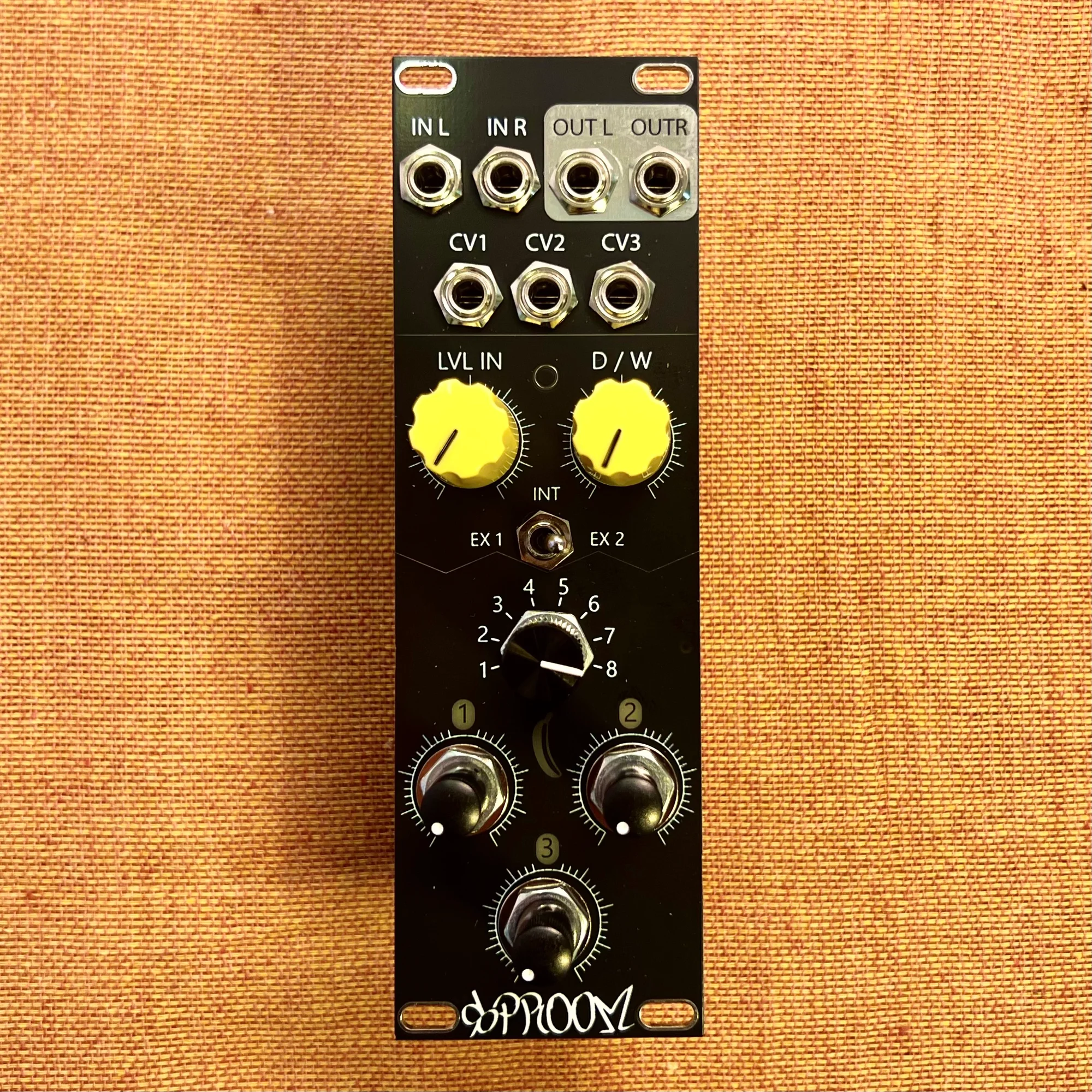
This is an introduction and overview of the Sproom DSP by NoisyFruitsLab, available at Takazudo Modular. The Sproom DSP is a compact multi-effect module.
This product is available for purchase below.
- What Is the Sproom DSP
- 24 Effects
- Effect List
- Clear LEDs
- When to Use the Sproom DSP
- Other Specifications
- Bank Rewriting
- Reference Videos
- Other Notes
- Included Items
What Is the Sproom DSP
Sproom — half SPace, half ROOM.
The Sproom DSP is a multi-function effects module using the FV-1 DSP IC chip. The FV-1 is an IC chip made by Spin Semiconductor that gained popularity in guitar pedal-style effects. It covers a wide variety of effect types including high-quality reverb, delay, chorus, flanger, tremolo, and combinations thereof.
Operating in stereo at Fs=48KHz and 6 MIPS*, it provides high-quality audio processing with front-panel knob control over input level and Dry/Wet signal balance.
It features stereo input and stereo output, but when nothing is connected to the R input, the L input is used for both channels.
*Fs: Sampling Frequency *MIPS: Million Instructions Per Second
24 Effects
The Sproom has a 3-bank configuration with 8 algorithms per bank, giving you a total of 24 effects to choose from. Bank selection is done with the toggle switch in the center of the panel, and algorithm selection with the dial knob below it.
Each algorithm can have its parameters controlled with 3 knobs at the bottom of the panel. These can also be controlled via CV input through the CV1-CV3 jacks at the top of the panel.
With each knob turned fully left (minimum), the result is equivalent to 0V CV input; fully right (maximum) equals 10V. The sum of the CV input voltage and the knob voltage determines each parameter’s value.
Effect Demo
I prepared a demo showing the effects you get when switching between algorithms. Here’s the video for reference.
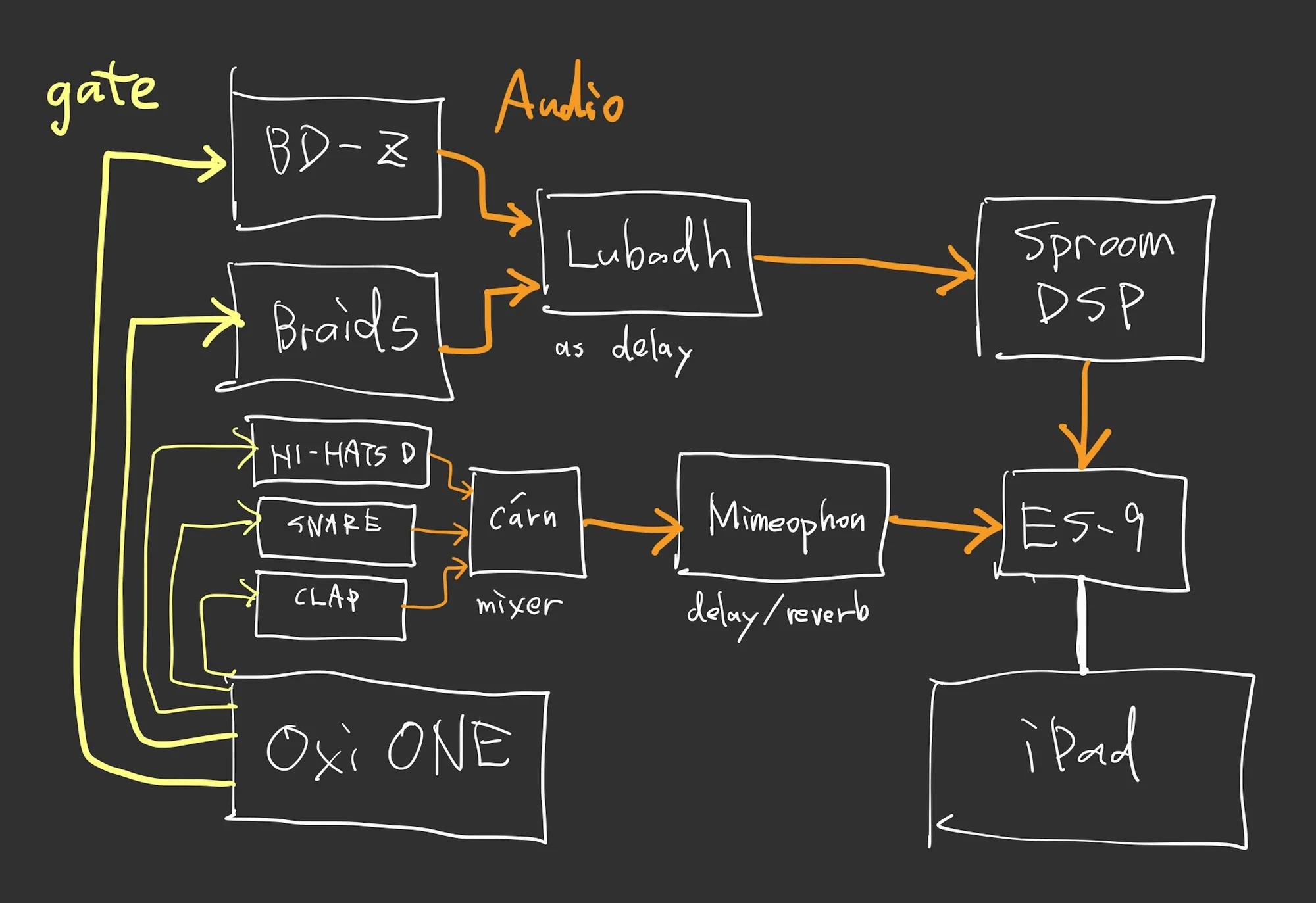
The patching configuration for this video is shown below. Two types of kicks (low and high) are run through a delay, then fed into the Sproom DSP.
Effect List
Here’s a list of algorithms and their 3 knob/CV input parameters for each bank.
Bank1 (Int)
| Bank | Algorithm | Effect Type | Pot1 | Pot2 | Pot3 |
|---|---|---|---|---|---|
| 1 | 1 | Chorus – Reverb | Verb Mix | Chorus Rate | Chorus Mix |
| 1 | 2 | Flange – Reverb | Verb Mix | Flange Rate | Flange Mix |
| 1 | 3 | Tremolo – Reverb | Verb Mix | Tremolo Rate | Tremolo Mix |
| 1 | 4 | Pitch Shift | +/-4 semitones | ||
| 1 | 5 | Pitch – Echo | +/-4 semitones | Echo Delay | Echo Mix |
| 1 | 6 | Test | - | - | - |
| 1 | 7 | Reverb | Size | HP Filter | LP Filter |
| 1 | 8 | Reverb | Size | HP Filter | LP Filter |
Bank2 (EX1)
| Bank | Algorithm | Effect Type | Pot1 | Pot2 | Pot3 |
|---|---|---|---|---|---|
| 2 | 1 | Stereo Ring Modulator | Blend | Carrier Offset | Chorus |
| 2 | 2 | Reverb Reverse | Pre-Delay | Decay | Damping |
| 2 | 3 | Tape Delay 1 Head Ping Pong | Rate | Feedback | Damping |
| 2 | 4 | Tape Delay 2 Head Ping Pong | Rate | Feedback | Damping |
| 2 | 5 | Tape Delay 2 Head Ping Pong + Reverb | Rate | Feedback | Damping |
| 2 | 6 | Digifuzzer / Bitcrusher | Sample Rate | Bit Rate | Level |
| 2 | 7 | Shimmer Reverb | Damping | Shimmer Level | Decay |
| 2 | 8 | Triple Cascaded Delay | Rate | Rate | Rate |
Bank3 (EX2)
| Bank | Algorithm | Effect Type | Pot1 | Pot2 | Pot3 |
|---|---|---|---|---|---|
| 3 | 1 | Reverb Hall | Size | Delay | Damping |
| 3 | 2 | Reverb Large | Size | Delay | Damping |
| 3 | 3 | Reverb Small | Size | Delay | Damping |
| 3 | 4 | Reverb Plate | Size | Delay | Damping |
| 3 | 5 | Reverb Gated | Size | Delay | Damping |
| 3 | 6 | Delay | Feedback | Tempo | Damping |
| 3 | 7 | Flanger | Delay | Width | Rate |
| 3 | 8 | Chorus | Amount | Width | Rate |
Clear LEDs
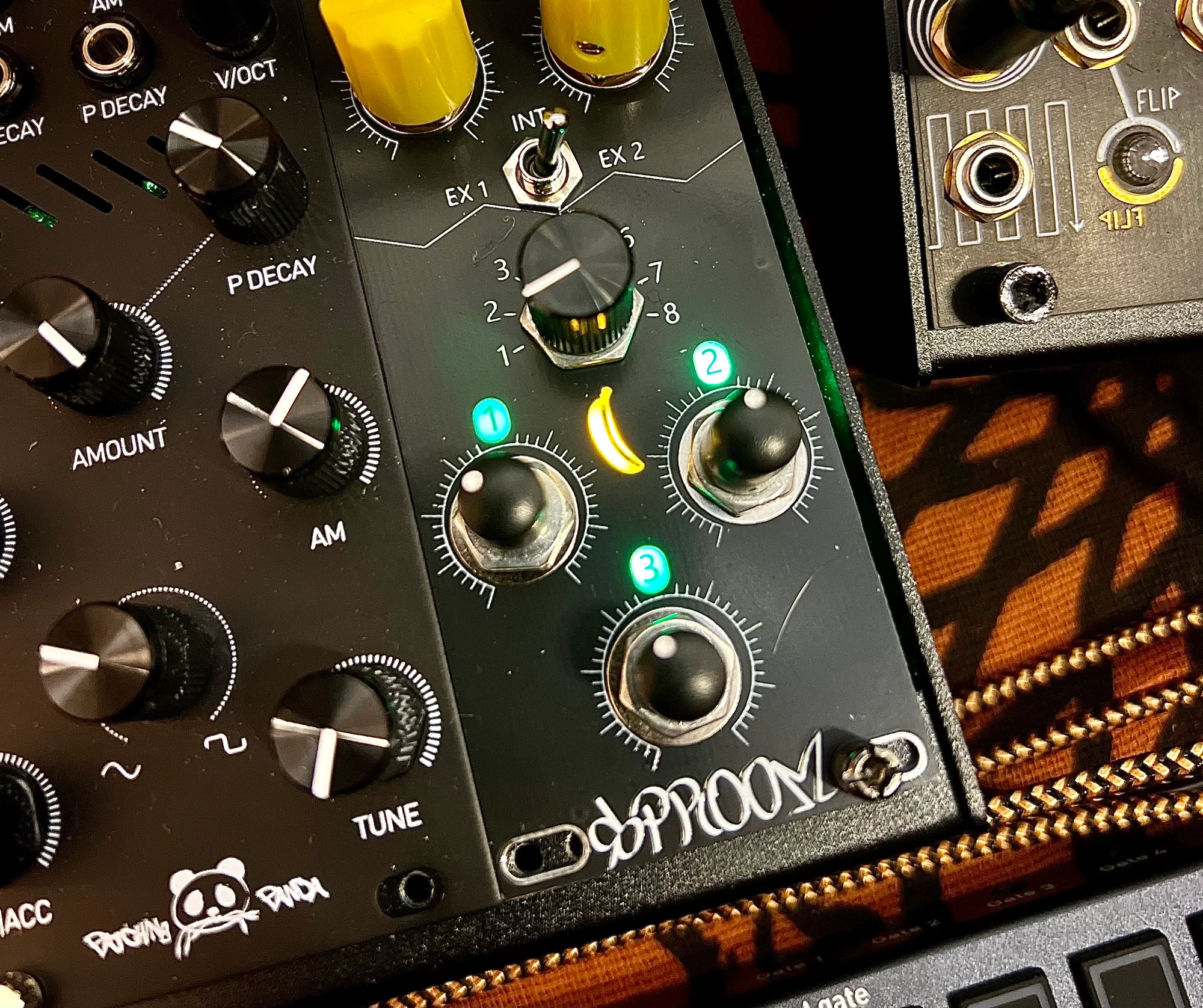
The CV input values for the 3 parameters are reflected in the brightness of the LEDs just above each knob. Additionally, the red LED in the center of the panel lights up when clipping occurs. These LEDs make it easy to visually monitor various states.
When to Use the Sproom DSP
The Sproom DSP has a depth of 42mm, so it won’t fit in shallow cases, but at a compact 8HP with easy-to-use knob sizes, and with a rich variety of built-in effects with strong processing, it’s a module that can be integrated into various setups.
The fact that each parameter can be properly controlled via CV is also a strong point. Depending on your musical style, you’ll often want multiple effects, so this module can serve as a versatile, all-purpose effect unit.
Personally, I often run kicks through delay and reverb, then compress the result, so I’m looking forward to trying various applications with this module.
Other Specifications
- Width: 8HP
- Depth: 42mm
- Power consumption: +12V 92mA / -12V 23mA
Bank Rewriting
Bank 1 algorithms are fixed to the IC and cannot be changed. Bank 2 and Bank 3 algorithms can be freely modified by rewriting the module’s EEPROM yourself.
Reference: EEPROM rewriting method / available algorithms
Reference Videos
Here are some helpful Sproom DSP videos found on YouTube.
Other Notes
The glowing banana is cute.
Included Items
- Power ribbon cable
- Screws
- Banana keychain
- Banana sticker
Noisy Fruits Labについて
Noisy Fruits Lab (Timo Johannes)はドイツベルリン在住のMixerモジュールに特化したモジュラーシンセメーカーです。
モジュラーシンセサイザーにおけるMixerへの熱意と技術的な探求心は他に類を見ず、高度に洗練されたミックスとルーティングをモジュラーシンセで実現しています。
オマケ: 電氣美術研究會モジュラー小物セット付き

モジュラーシンセをもっと多くの方に触って欲しいという願いの元、電氣美術研究會さまにご協力頂き、モジュラー小物セットを本商品にバンドルさせて販売させていただいております。
パッチケーブルや電源ケーブル、ドレスナットのサンプルセット、モノラルスプリッターなど、内容は時期に応じて変化します。商品に同梱しますので是非お試し下さい!
That concludes our introduction of the Sproom DSP.
The Sproom DSP was the most feature-rich and highest-priced module among the first batch we stocked from NoisyFruitsLab. One of the reasons Takazudo started carrying NoisyFruitsLab modules was a desire to introduce simple, well-designed, appropriately sized modules that are easy to understand even for first-time modular synth users.
In that spirit, the Sproom DSP is multi-functional yet compact, with good usability and CV control capability, making it a module I can recommend for incorporation into various setups. This single module can handle many different roles, and it can serve as a starting point for exploring additional effects you might want.
Additionally, I believe that modules with CV parameter control can provide virtually endless enjoyment by sending LFOs, envelopes, and other signals into them. I probably wouldn’t have stocked it if it didn’t have CV control. Please give it a try.
We hope you find this helpful.