This is an introduction and overview of the Tiny Time Machine by Olivia Artz Modular (OAM), available at Takazudo Modular.
The Tiny Time Machine is a compact 8HP granular delay module featuring the same engine as the popular Time Machine. Despite its small package, it can produce a wide variety of sounds including clock-syncable rhythmic glitch effects, reverb, and chaotic acoustic effects.
This product is available for purchase below.
- Product Photos
- Features of the Tiny Time Machine
- My Impressions
- Reference Videos
- Included Items
- Specifications
Product Photos
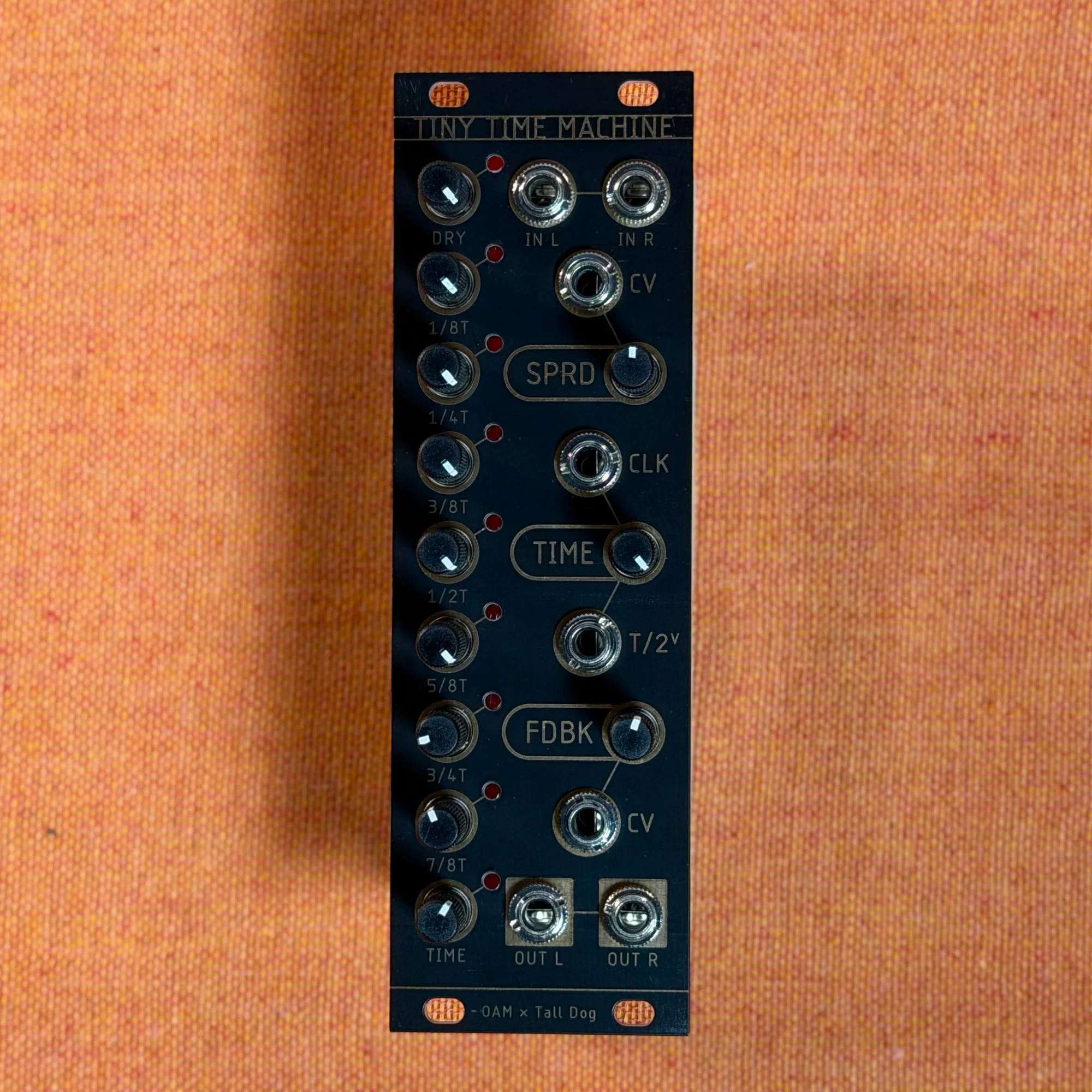
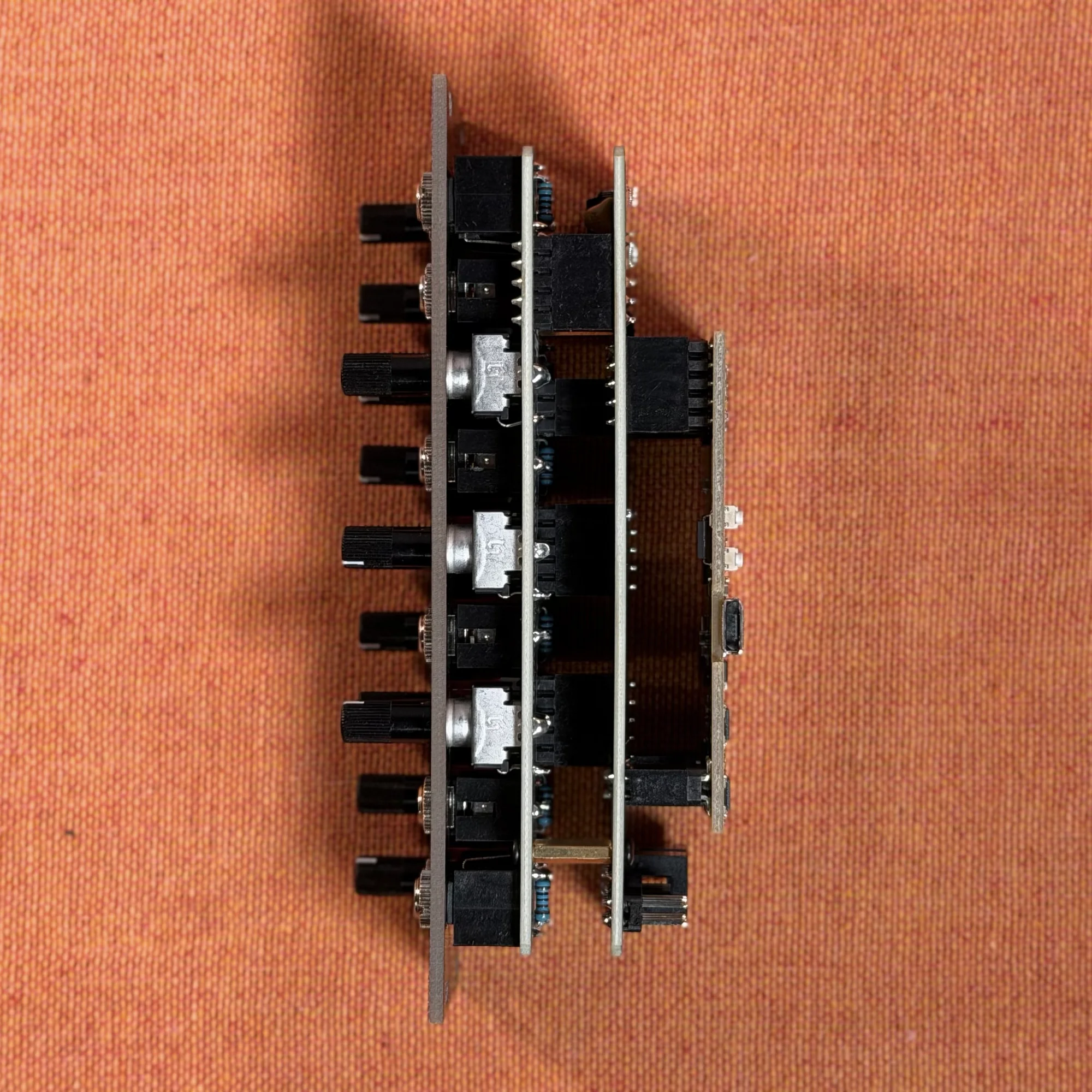
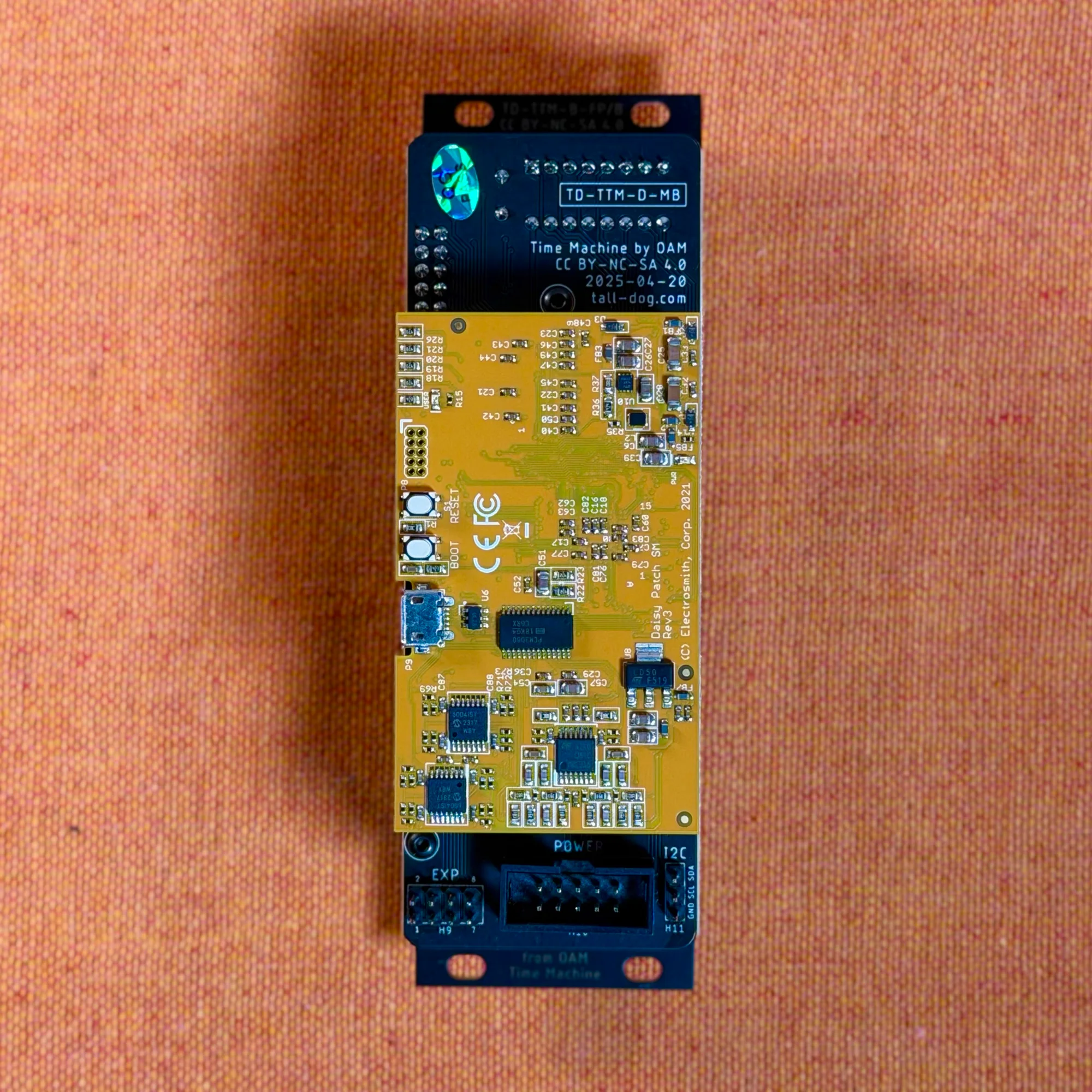
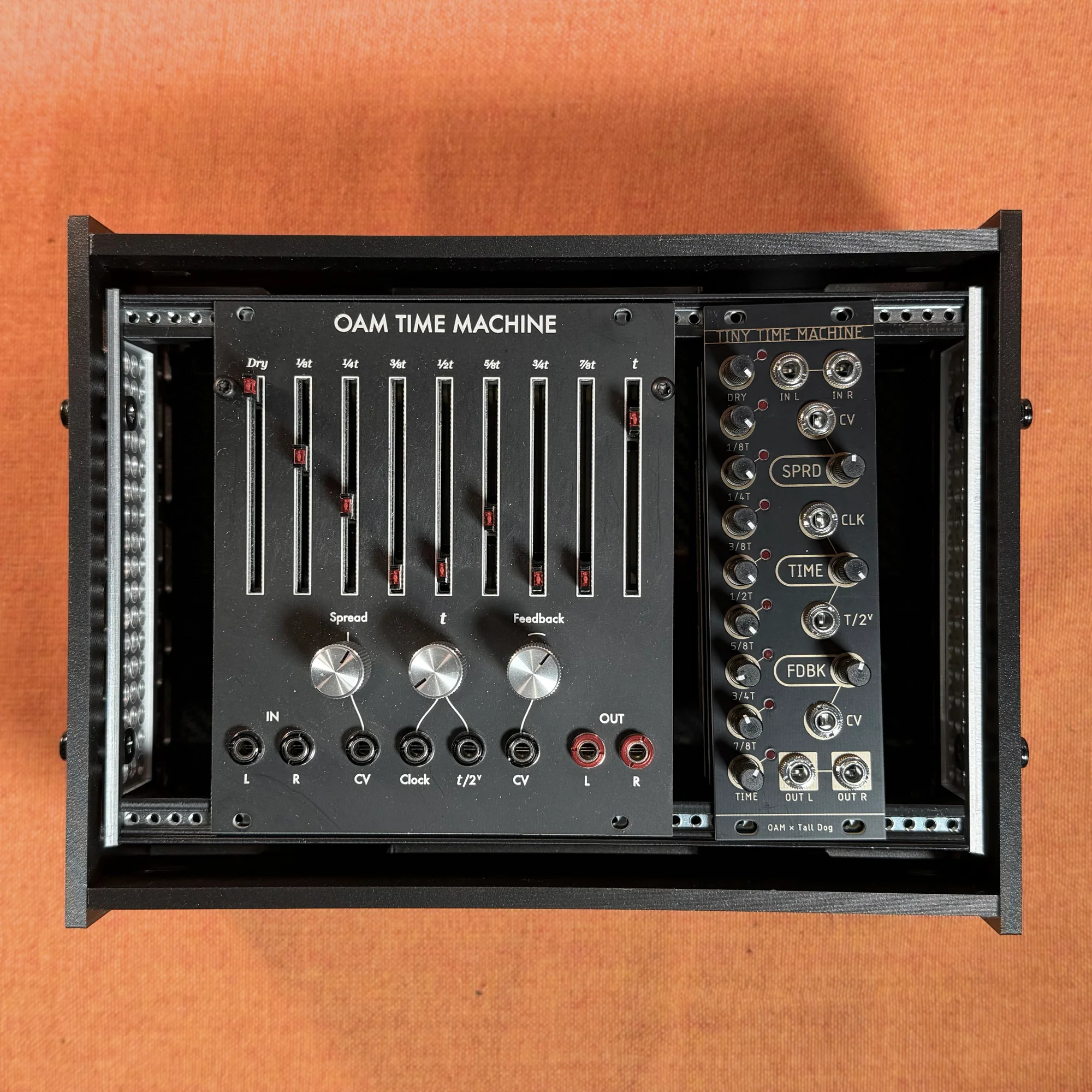
Features of the Tiny Time Machine
The Tiny Time Machine is an 8-tap stereo granular delay for Eurorack modular. It can mix eight delay lines with delay times ranging from milliseconds to several minutes. These delay lines can be evenly distributed across the time axis or biased toward “now” or “the past.” Whether biased or evenly distributed, the delay lines are clock-syncable. Feedback allows past sounds to persist. All of this is CV controllable.
The Tiny Time Machine packs the same engine as the full-size 22HP Time Machine into a space-efficient 8HP design.
Compact Yet Powerful
Featuring the same powerful granular processing engine as the Time Machine, it can produce a wide variety of acoustic effects:
- Clock-synced rhythmic glitch effects - Generate complex rhythm patterns synchronized to tempo
- Reverb effects - Spacious, expansive reverberation
- Chaotic feedback - Intensely changing, unpredictable sounds
- Granular processing - Experimental sound design by slicing and reassembling audio
Delay Time Control
The TIME knob adjusts delay time from (nearly) 0 seconds to 8 seconds. The knob provides exponential control, enabling finer adjustments at very short delay times.
The T/2v CV input provides exponential CV control over the maximum delay time. This means +1V halves the delay time set by the knob, and -1V doubles it. This input can handle CV from -5V to +5V, allowing delay times from 0.0001 seconds to 2 minutes 30 seconds.
When a clock is provided, delay lines quantize to the clock while maintaining the behavior described above.
Delay Spread
With the SPRD (Spread) knob at noon position (and 0V at the spread CV input), all delay lines are evenly distributed. Adjusting the spread can create reverb-like time spaces.
Turning left (or sending negative CV) concentrates the delay lines around “now.” More recent delays and fewer delays near TIME.
Turning right (or sending positive CV) concentrates the delay lines around TIME. More delays near TIME and fewer near “now.”
CV input accepts signals from -5V to +5V.
All eight delay lines quantize to the clock when evenly distributed. Changing the spread causes delay lines to drift off-beat, with one exception. When clock is provided, TIME always quantizes to the clock.
Feedback Behavior
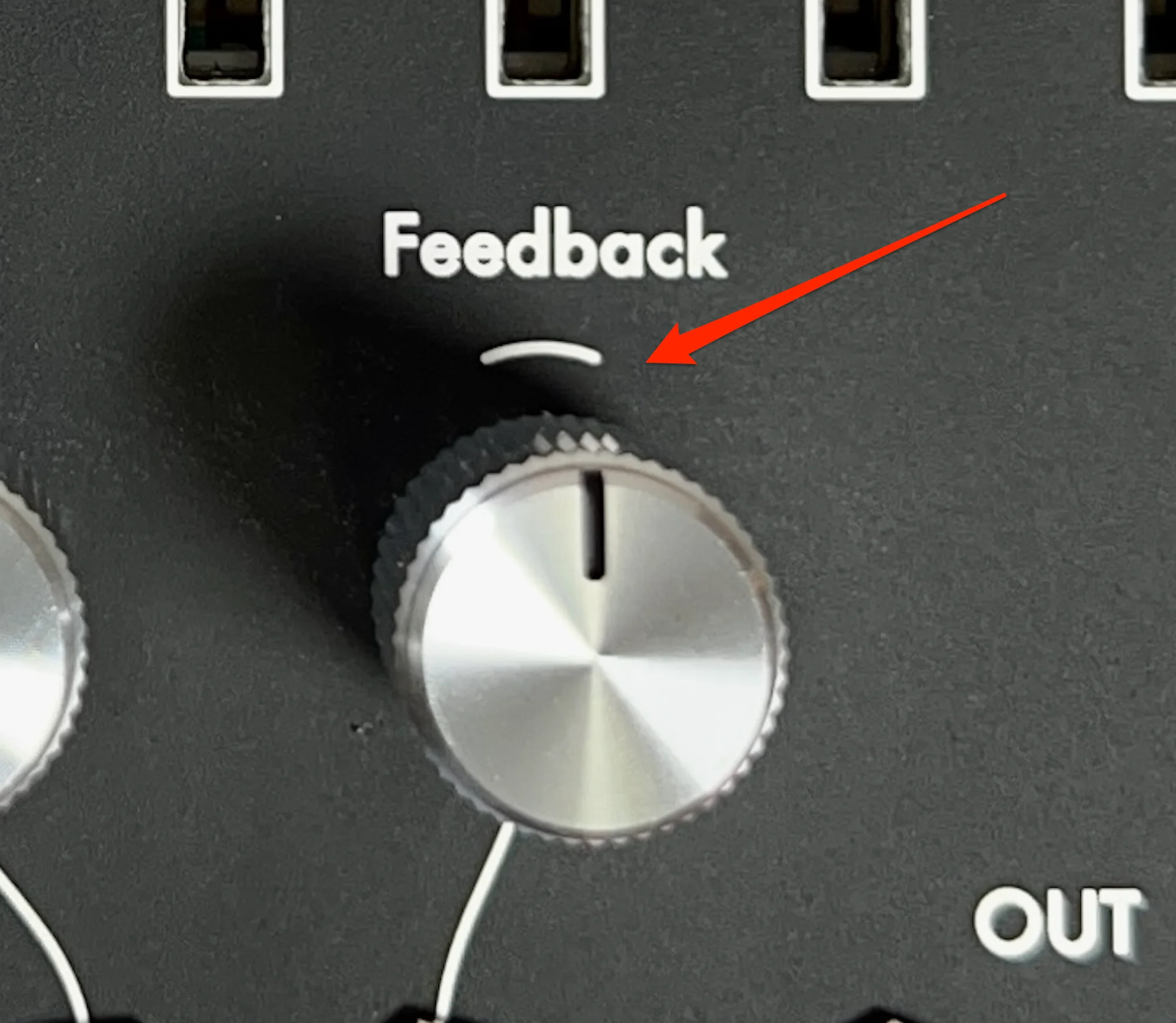
For the full-size Time Machine, when feedback is within the region indicated by the arc on the knob, sound will neither fade away nor swell out of control. The Tiny Time Machine doesn’t have this marking on the panel, but consider roughly the same position as this region. Think of it as the sound-on-sound zone.
Beyond this zone, chaos similar to guitar amp feedback occurs—but more evil and digital.
CV input accepts signals from -5V to +5V.
My Impressions
First, I personally use the Time Machine year-round. To the point where I worry that every video I make ends up looking like a Time Machine promotion…
I’ve heard that sounds we hear in daily life always exist within some kind of space, so we never hear sound completely free of reverb or delay. With that premise, it makes sense that adding reverb or delay makes sound feel more natural.
When using the Time Machine for delay, everything just seems to sound better, and I’ve been wondering why. As I translate and compile the manual into text, I’ve come to feel that the ability to create significant bias in the temporal distribution of sound is a big factor. The word “granular” doesn’t often come up when introducing delay modules, but the Time Machine’s description mentions granular effects, and while I think you probably won’t understand what this means until you try it, once you do, it’ll click.
This is probably because applying very short delay times or hard feedback creates effects that go beyond what typical delay can do. Biasing delays toward the onset time or concentrating sound around the delay time is probably quite rare elsewhere. This is what makes the Time Machine unique.
When I told Olivia Artz Modular about how much I use the Time Machine (along with videos), they advised me that it’s also fun to use it without clock sync in a more chaotic way—since I had always been using it clock-synced. Yes, this module’s ability to clock-sync makes it convenient as a tempo-matched delay first and foremost. But beyond that, it can also serve admirably as a hard feedback effect module. I highly encourage you to give it a try.
The Smaller Time Machine
The Tiny Time Machine is the compact version of the Time Machine. While the compact size is welcome, the module depth is 38mm—a bit deep, so keep that in mind. The full-size Time Machine is 22HP at only 25mm deep.
Personally, I don’t think smaller is always better. I initially thought the 22HP version was too large, but having long vertical faders to control per-step volume gives a sense of higher-resolution sound manipulation—that was a discovery for me. If you want to use the delay as a performance tool, I’d recommend the full-size Time Machine.
On the other hand, if you don’t plan to constantly tweak parameters, the Tiny Time Machine’s compact size is a real advantage. I think it can serve as a compact yet powerful granular delay module.
So depending on your setup—or even putting both in your system—these modules can both find a home.
Reference Videos
Below is a demo video of the 22HP Time Machine, but since the Tiny Time Machine features the same engine, it can produce similar sounds.
The official Olivia Artz Modular YouTube channel has various usage examples of the Time Machine series.
Below is a demo using very fast gates to create intense feedback and spatial acoustic effects.
Below is a patch walkthrough video by DivKid using the Time Machine.
Included Items
- Power ribbon cable
- Screws
Specifications
- Width: 8HP
- Depth: 38mm
- Power consumption: 122mA +12V / 8mA -12V / 0mA 5V
- 24-bit Audio I/O (-5V to +5V)
- 16-bit CV control (-5V to +5V)
Olivia Artz Modularについて
Olivia Artz Modular(OAM)は、北米を拠点に活動する Kate/Rosette/Olivia Artz の3人によるモジュラーシンセ/シンセ関連モジュールのブランドです。"Time Machine" や "Uncertainty" のように、独創性と実験性あふれるモジュールを自ら設計・製造するほか、他者のアイデアを製品化することもあります。ユーロラックを越えた創造の場として、自分たちの「夢」をかたちにする場を提供しています。
オマケ: 電氣美術研究會モジュラー小物セット付き

モジュラーシンセをもっと多くの方に触って欲しいという願いの元、電氣美術研究會さまにご協力頂き、モジュラー小物セットを本商品にバンドルさせて販売させていただいております。
パッチケーブルや電源ケーブル、ドレスナットのサンプルセット、モノラルスプリッターなど、内容は時期に応じて変化します。商品に同梱しますので是非お試し下さい!
That concludes our introduction of the Olivia Artz Modular Tiny Time Machine.
We hope you find this helpful.