
We continue the beginner-friendly series on modular synth power supplies. This is Part 4 of the column for those who find modular synth power confusing. So far, we have covered voltage, current, bus boards, AC adapters, and per-module current draw. This is the final installment, where we discuss the PSU’s rated current and what happens when you exceed its capacity.
Here are the previous installments:
- Column 005: Modular Synth Power Supply Intro: Part 1
- Column 006: Modular Synth Power Supply Intro: Part 2
- Column 007: Modular Synth Power Supply Intro: Part 3
PSU Rated Current
This installment focuses mainly on the power supply unit. Let’s start with the term rated current. The rated current is the total amount of current that a PSU can safely supply. In the previous article, we discussed how each module has different current draw. Here is that table again:
| Manufacturer | Module Name | +12V | -12V | +5V | Width |
|---|---|---|---|---|---|
| ADDAC System | ADDAC701.REV2 VCO | 60mA | 60mA | 0mA | 8HP |
| ADDAC System | ADDAC106 T-Noiseworks | 40mA | 40mA | 0mA | 8HP |
| OXI Instruments | OXI Coral | 110mA | 10mA | 0mA | 14HP |
| AI Synthesis | Stereo Matrix Mixer | 20mA | 20mA | 0mA | 18HP |
| AI Synthesis | AI017 Low Pass Gate | 19mA | 17mA | 0mA | 8HP |
| Weston Precision Audio | AD110 | 75mA | 35mA | 0mA | 16HP |
| Weston Precision Audio | H1 Analog Harmonizer | 200mA | 85mA | 0mA | 18HP |
| RYK Modular | Night Rider | 52mA | 9mA | 0mA | 16HP |
| Meng Qi | DPLPG | 0A | 0A | 0A | 2HP |
When you pack many modules into a case, they are typically all powered by a single PSU. In that case, the PSU must be able to supply more current than the combined total of all the modules’ current draw. Naturally, PSUs are designed with a specific limit on how much current they can stably supply, and that limit is expressed as the “rated current.”
For example, suppose a PSU has the following rated current:
- +12V: 1000mA
- -12V: 1000mA
- +5V: 500mA
This means it can supply up to 1000mA on +12V, up to 1000mA on -12V, and up to 500mA on +5V.
The combined current draw of the modules listed above was:
- +12V: 576mA
- -12V: 276mA
- +5V: 0mA
Given these numbers, this example PSU appears to have more than enough capacity for these modules. You could probably add or swap a few modules without any issues.
Note that the total width of these modules comes to 108HP, though the selection does skew toward larger modules.
Specific PSU Examples
So how much current can real-world PSUs and cases actually supply? Here is a table of rated currents for various products on the market. (As of March 2025.)
For case-integrated types, the rightmost column also shows the case size.
| Manufacturer | Product | +12V | -12V | +5V | Size |
|---|---|---|---|---|---|
| Behringer | CP1A | 1000mA | 1000mA | 500mA | - |
| dotRed Audio Designs | POWERBASE-PD | 1000mA | 1000mA | N/A | - |
| Tiptop Audio | uZeus | 2000mA | 500mA | 170mA | - |
| 4ms | Pod26 Powered | 700mA | 280mA | 1000mA | 26HP |
| 4ms | Pod64X Powered | 1400mA | 670mA | 1000mA | 64HP |
| Cre8 Audio | Nifty CASE | 1500mA | 500mA | 500mA | 84HP |
| Arturia | RackBrute 6U | 1600mA | 1600mA | 900mA | 176HP |
| ALM Busy | Eurorack Powered Case 9U/84HP | 2500mA | 2500mA | N/A | 252HP |
| Befaco | 7U Case | 5000mA | 2500mA | 4000mA | 3U:208HP / 1U:104HP |
| Konstant Lab | HammerPWR | 5000mA | 2500mA | 2000mA | - |
| Doepfer | A-100PSU3 | 2000mA | 1200mA | 2000mA | - |
These are products Takazudo selected from a range of available PSUs and cases.
We can classify them into the following categories and look at the characteristics of each:
- Module type
- Integrated case: small
- Integrated case: large
- Standalone PSU
This is my own classification, but it roughly matches how the community thinks about these products.
1. Module Type
First up: PSUs that mount as a standard Eurorack module. We will call these module type PSUs. The following three products fall into this category:
| Manufacturer | Product | +12V | -12V | +5V |
|---|---|---|---|---|
| Behringer | CP1A | 1000mA | 1000mA | 500mA |
| dotRed Audio Designs | POWERBASE-PD | 1000mA | 1000mA | N/A |
| Tiptop Audio | uZeus | 2000mA | 500mA | 170mA |
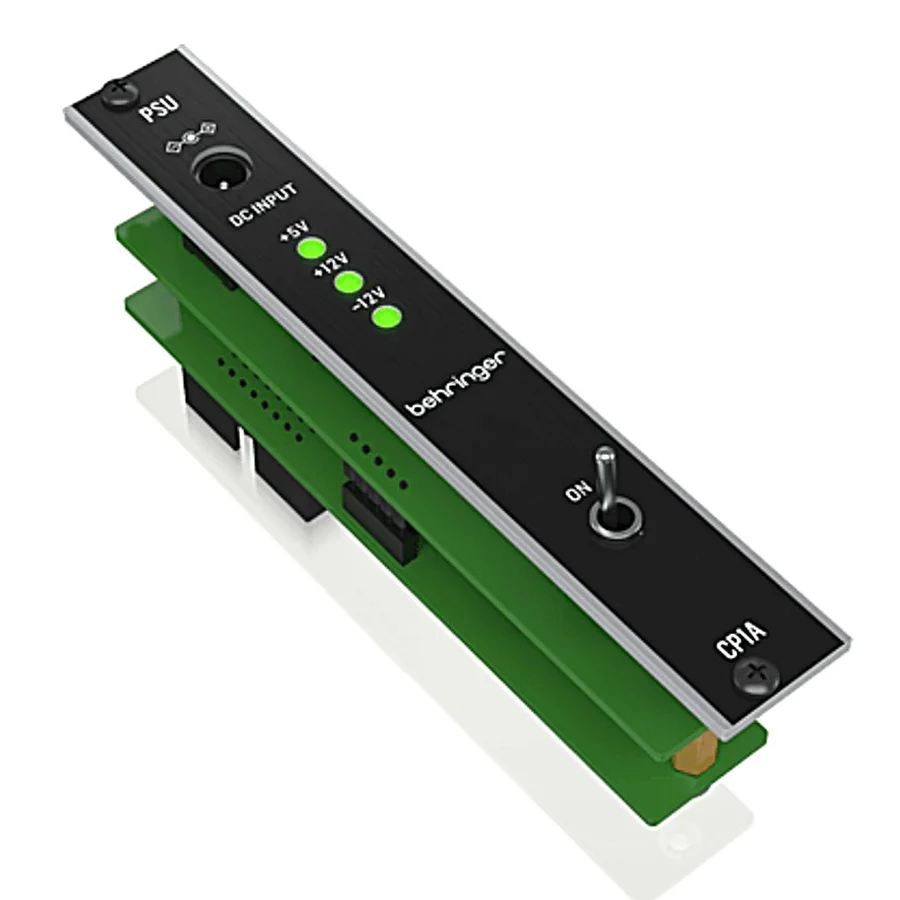
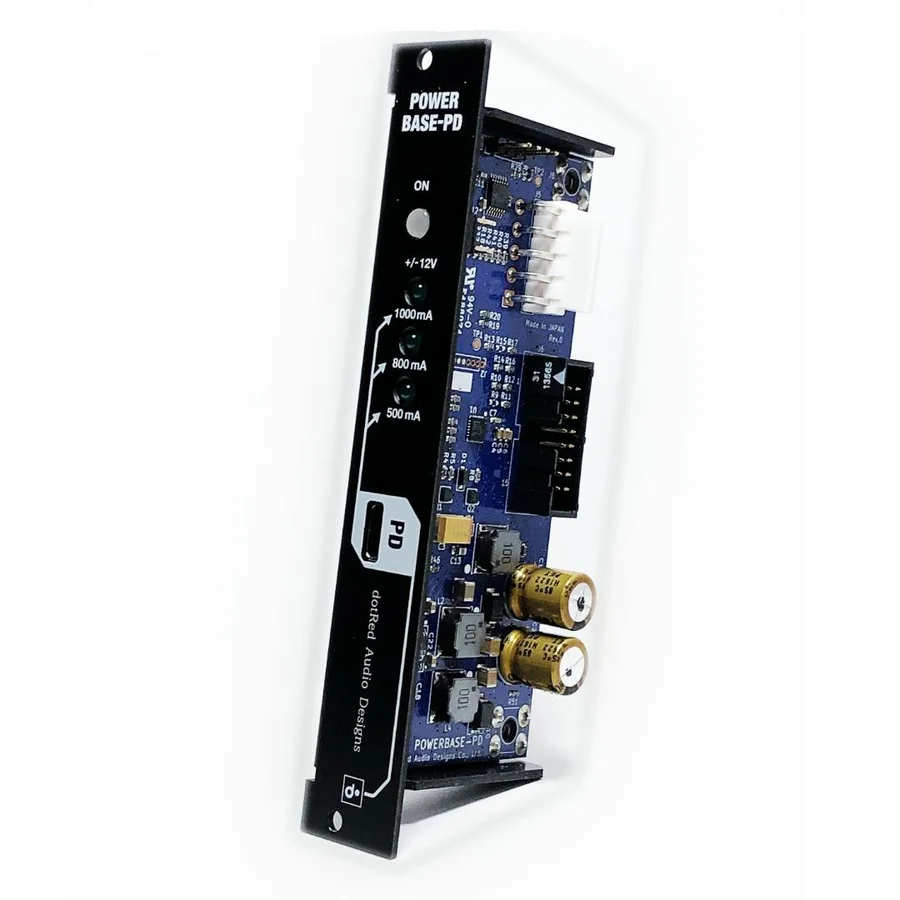
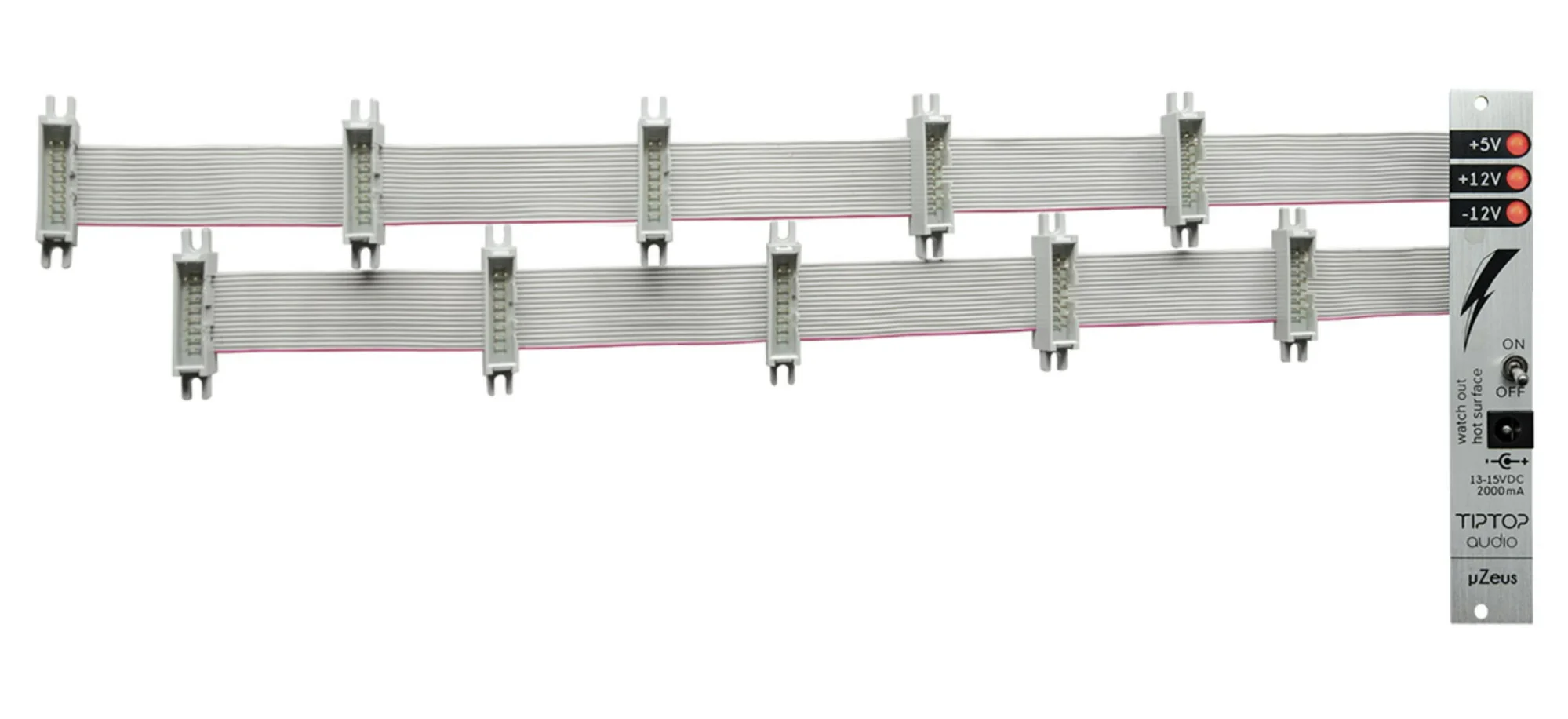
The primary advantage of these PSUs is their relatively low price. All of them come with flying bus cables included, making them all-in-one power solutions out of the box.
This is especially appealing because cases with integrated power supplies tend to be more expensive, so getting a PSU for under 20,000 yen is a welcome option. If you want to build your own case or have found a case you like that does not include a power supply, these module-type PSUs are easy to pair with it.
The downside is that all of them have relatively low rated current. The CP1A and POWERBASE-PD max out at 1000mA on both +12V and -12V. The uZeus offers 2000mA on +12V but only 500mA on -12V and 170mA on +5V.
In Takazudo’s experience, 1000mA on +12V is roughly enough to power the modules in an 84HP case. Considering that the modules from the previous article totaled 576mA on +12V, you can see that mixing in a few high-draw digital modules or narrow modules (2HP, 3HP) with relatively high current consumption could push you toward the 1000mA limit. Also, the uZeus has 2000mA on +12V, but its 500mA limit on -12V is worth keeping in mind.
Another minor consideration: since these PSUs mount as Eurorack modules, they consume about 4-5HP of rack space. The power switch being right there is convenient, but some people prefer not to have a PSU sitting alongside their modules. Admittedly, it does look cleaner without one.
In Part 2, we mentioned that flying bus cables cannot carry large amounts of current. But since this type of PSU cannot supply very large currents to begin with, it is not really an issue. Among these three, the uZeus has a higher rated current but provides two separate flying bus cable connections, which appears to take cable current capacity into consideration.
All in all, Takazudo considers this type of PSU a good choice for setups around 84HP. However, as your module count grows, you need to watch that you do not exceed the rated current.
For the record, Takazudo personally owns and uses all three of these. None have caused any significant problems in practice.
2. Integrated Case: Small
Next up: small integrated case types, where the PSU is built into a compact case.
| Manufacturer | Product | +12V | -12V | +5V | Size |
|---|---|---|---|---|---|
| 4ms | Pod26 Powered | 700mA | 280mA | 1000mA | 26HP |
| 4ms | Pod64X Powered | 1400mA | 670mA | 1000mA | 64HP |
| Cre8 Audio | Nifty CASE | 1500mA | 500mA | 500mA | 84HP |
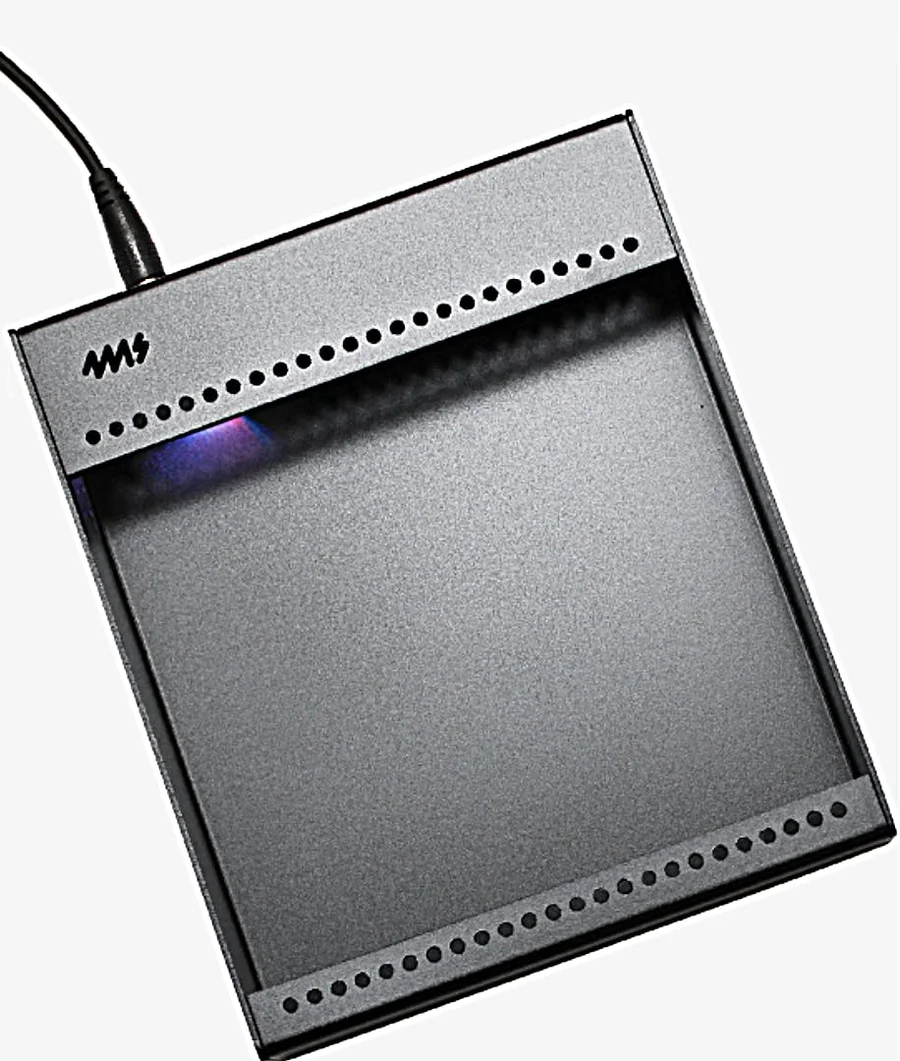
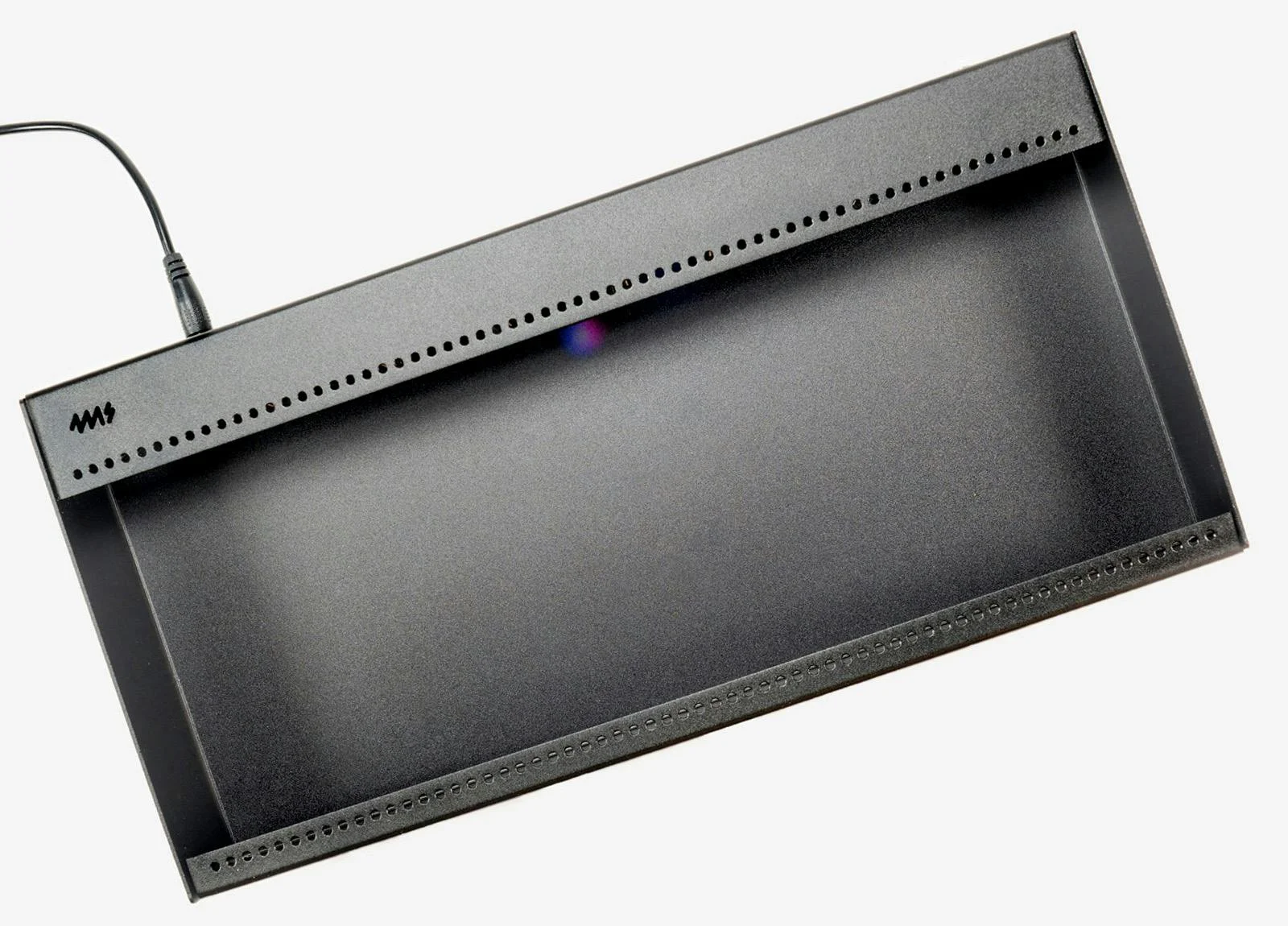
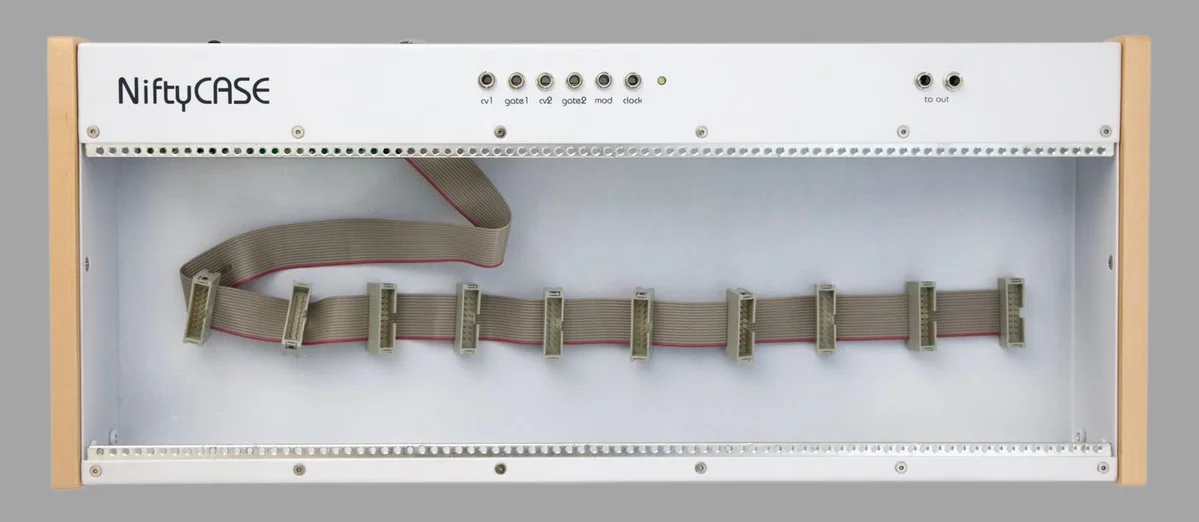
The main advantage of these powered cases is that you do not have to think deeply about power at all. We have covered a lot about power in this series, but these integrated cases basically say, “The power supply is already here, so just go ahead and start using it.” The combination of convenience and reasonable price is a strong selling point.
Their compact size also means you do not have to worry much about where to put them, making them a compelling choice for anyone getting started with modular synths. They are also handy if you already have a large case and just want to add a few extra modules.
Looking at the rated currents, these cases seem to provide fairly adequate power relative to their size. In the previous section, we estimated that 1000mA on +12V should be enough for about 84HP. Among these three, the Pod64X offers 1400mA for 64HP, and the Nifty Case provides 1500mA for 84HP. The Pod26 has only 700mA, but it is just 26HP.
So they have reasonably generous rated currents for their size, and you likely would not run into problems unless you use modules with exceptionally high current draw. That said, this comes down to product design, so checking the case’s rated current against your modules before purchasing is always recommended. (Established manufacturers usually account for this, though.)
The downside of these small integrated cases is that if you want to expand further, things can get bulky, and the power configuration becomes more complicated. We will discuss this in comparison with the large integrated cases below.
Takazudo’s first case was from 4ms’s Pod series. The Pod series has a clever feature that lets you daisy-chain multiple Pods from a single AC adapter, which is very convenient. (Note: when using multiple Pods together, you may need to use a higher-capacity AC adapter.)
3. Integrated Case: Large
Next: large integrated case types, where a substantial PSU is built into a large case.
| Manufacturer | Product | +12V | -12V | +5V | Size |
|---|---|---|---|---|---|
| Arturia | RackBrute 6U | 1600mA | 1600mA | 900mA | 176HP |
| ALM Busy | Eurorack Powered Case 9U/84HP | 2500mA | 2500mA | N/A | 252HP |
| Befaco | 7U Case | 5000mA | 2500mA | 4000mA | 3U:208HP / 1U:104HP |
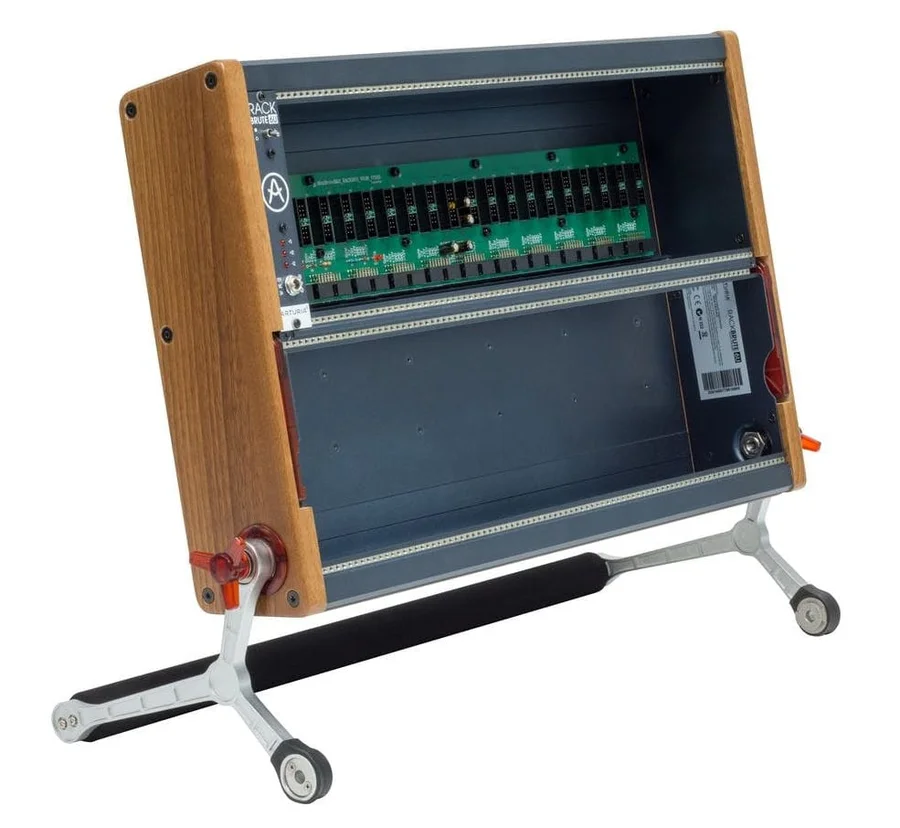
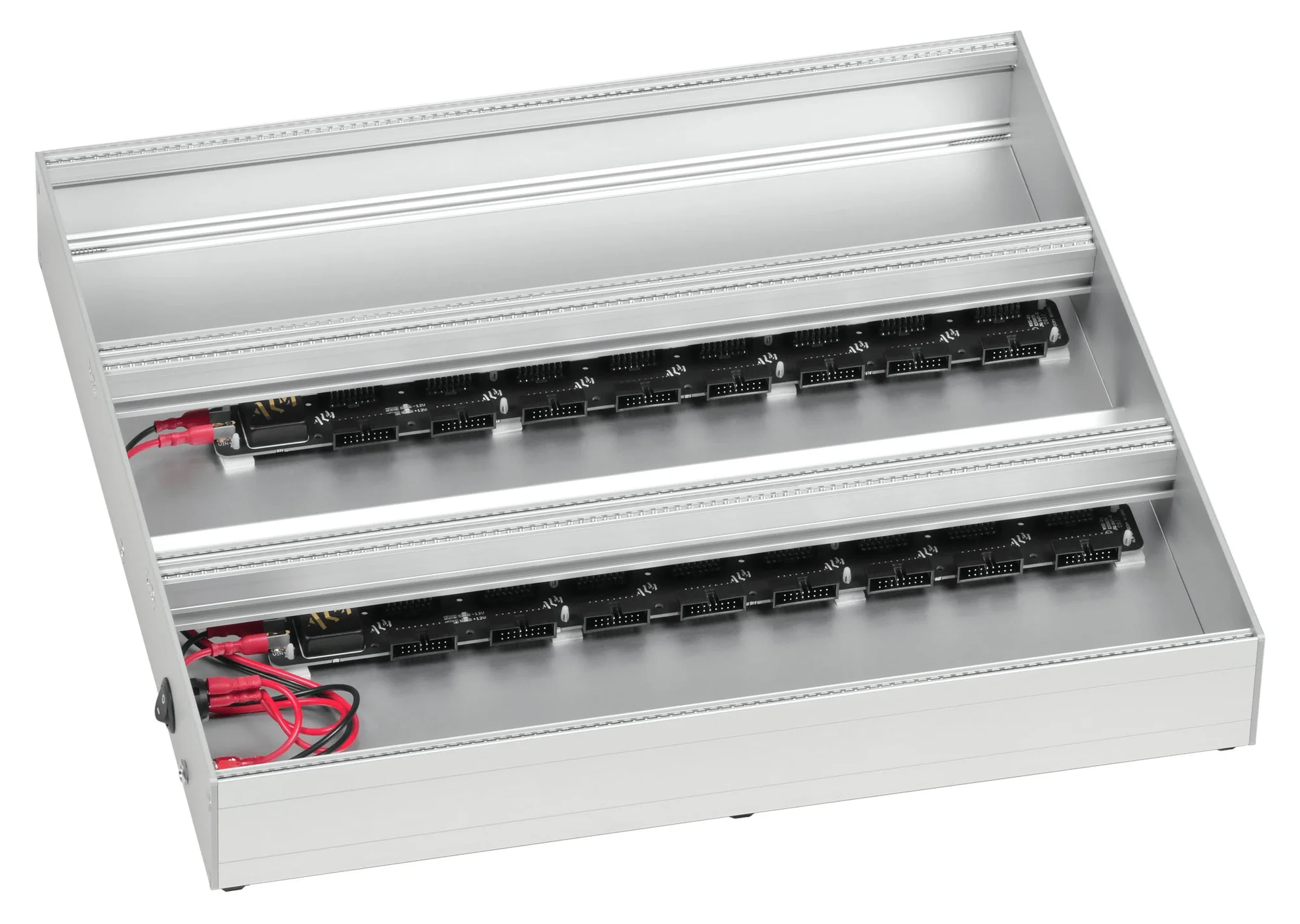
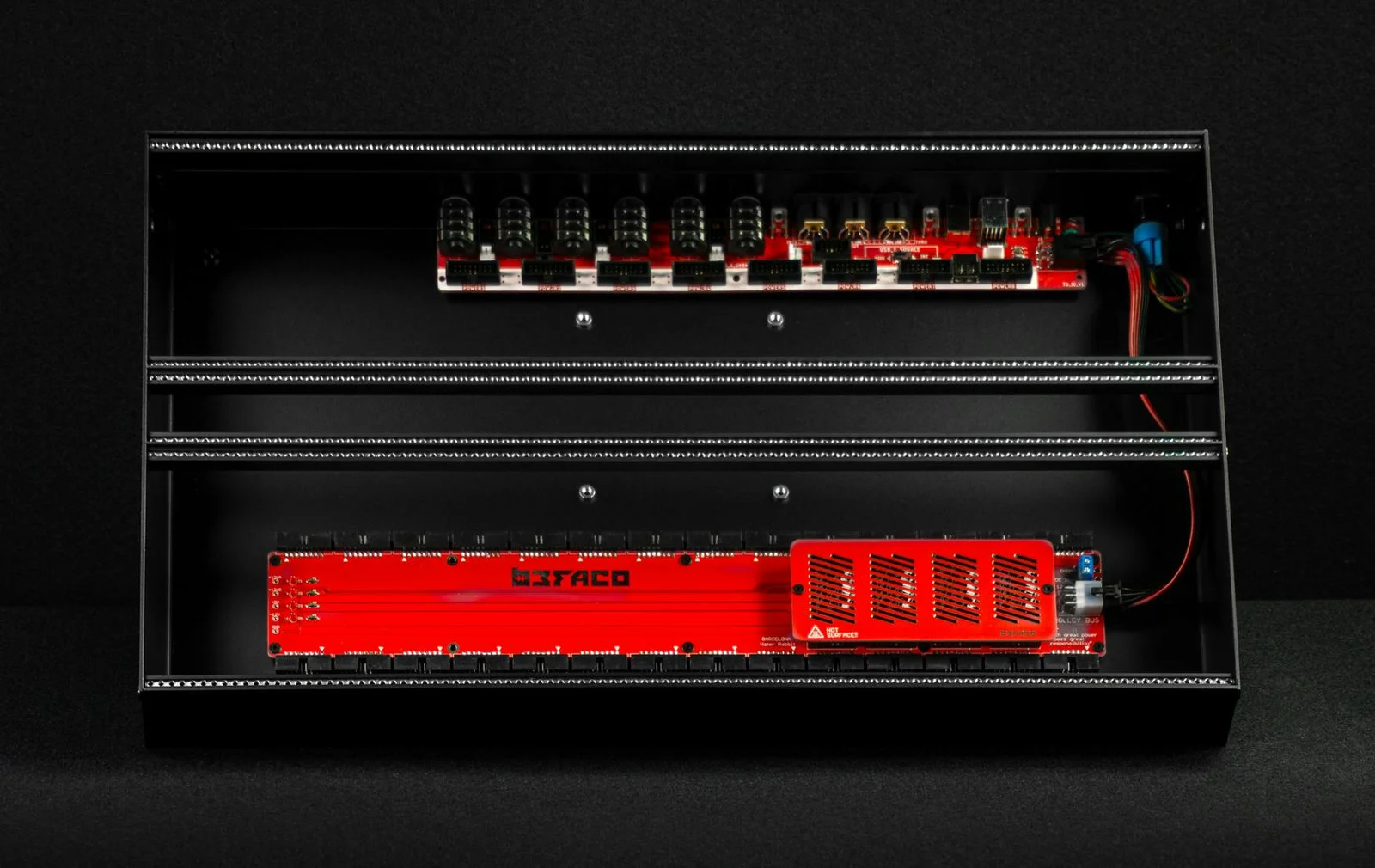
Among these three, the RackBrute 6U, which has appeared several times throughout this series, is actually the smallest. Perhaps “large” is generous — maybe “medium-large” is more accurate.
The defining feature of this category is that a high-capacity PSU comes paired with the case. To cut straight to the conclusion of this power supply guide: if you plan to grow your module collection over time, we recommend choosing this type of case. With a small rated current, you will need to worry about power as your module count increases. A larger rated current means it will be much longer before you hit any limits, giving you peace of mind as you expand your setup.
Looking at the table, the ALM Busy case provides 2500mA, and the Befaco 7U Case provides 5000mA — these cases clearly have generous current headroom. These large cases are also expensive, which is an obvious financial downside. However, part of why these cases cost more is that the PSU requires higher-capacity components, and those components themselves are expensive.
Beyond the high rated current, many of these cases are also well-suited for transportation. Depending on the case, this can be a significant benefit. Many modular synth users perform live at venues, and they need to transport their setups. A large case lets you carry your whole rig intact. Being able to transport with patch cables still connected is incredibly convenient — a must for anyone who preps live sets in advance, some would say. (Though this varies by person.)
If your setup grows large, you could use multiple module-type PSUs or small powered cases. However, this means using multiple AC adapters to supply power. While this may seem like a flexible and reasonable approach, using multiple PSUs introduces a risk of ground loop noise, which can be difficult to eliminate completely. The topic of noise reduction goes quite deep (involving PSU design, module design, etc.), so for now, just keep in mind that splitting your power across multiple PSUs can potentially cause noise.
In short, if you plan to use many modules, investing in a large powered case is a recommended approach.
What Is Ground Loop Noise?
Here is a brief explanation of ground loop noise — just enough to give you a general understanding. In this series, we discussed how current returns to Ground. When you use multiple PSUs, each one has its own Ground reference, resulting in two separate Grounds. Using the diagram from the previous article, the situation looks like this:
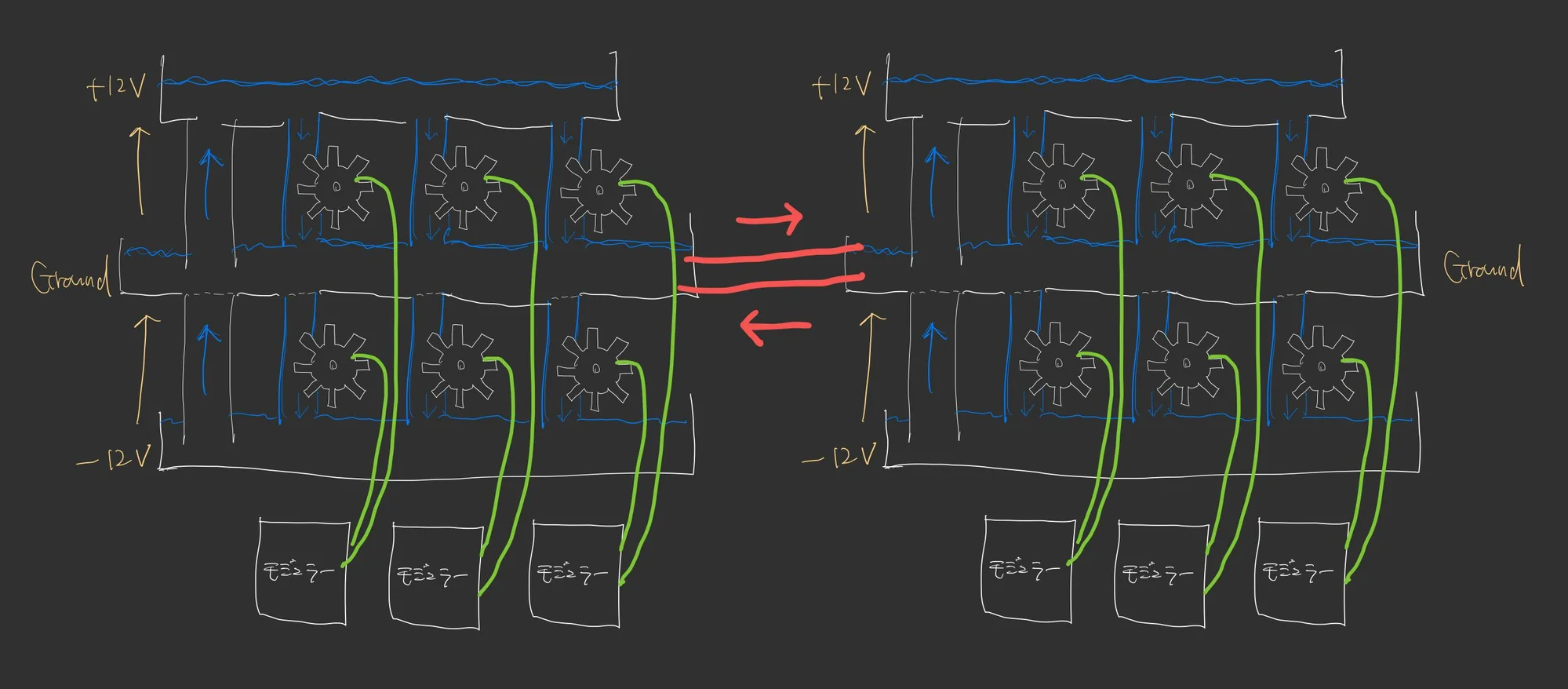
This was the diagram we used previously to illustrate multiple modules connected to a power supply. When using multiple PSUs, imagine the two Ground planes being connected by something like a pipe at the red section in the middle of the diagram.
The diagram alone might not look problematic. But in reality, with current being consumed at various points, Ground is never perfectly stable — it always fluctuates slightly. Very small voltages, perhaps 1/1000th or less of a sine wave from an oscillator, constantly ripple across it. Think of it like the surface of water sloshing around when water flows in and out.
When two of these “water basins” are connected, their tiny fluctuations are transmitted to each other, creating a constant micro-voltage difference on the Ground plane. This phenomenon is called a ground loop, and it results in an audible noise — a constant hiss or hum even when nothing is playing. This is ground loop noise.
The problem of noise in electronic instruments involves many other factors, and eliminating it completely is extremely difficult. But having multiple power supplies is a major contributing factor. The simplest way to avoid ground loop noise is to use a single power supply rather than multiple ones.
4. Standalone PSU
Finally, products sold as standalone PSUs.
| Manufacturer | Product | +12V | -12V | +5V | Size |
|---|---|---|---|---|---|
| Konstant Lab | HammerPWR | 5000mA | 2500mA | 2000mA | - |
| Doepfer | A-100PSU3 | 2000mA | 1200mA | 2000mA | - |
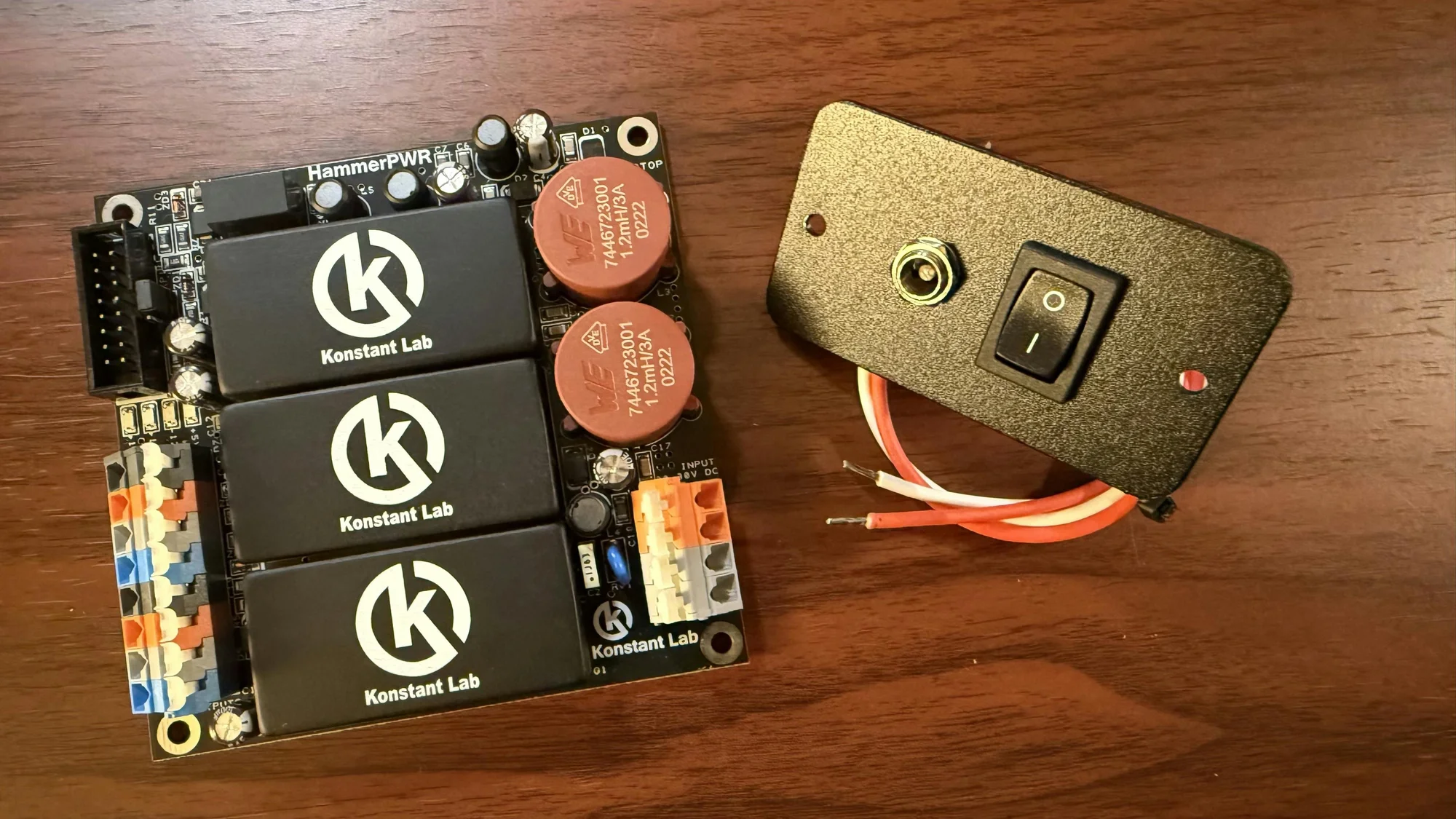
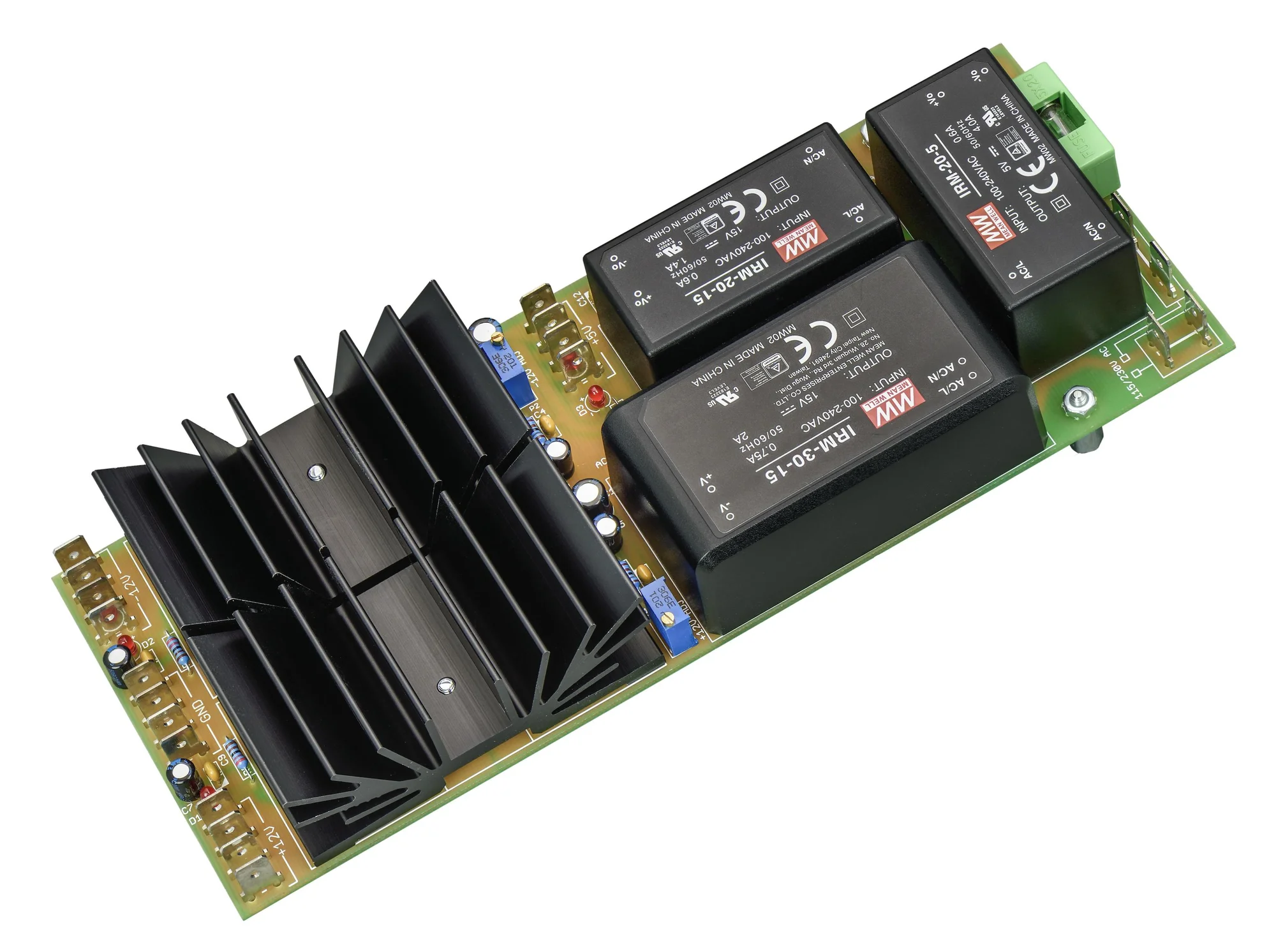
I will be upfront that this is not an area I have deep expertise in, but I want to mention the Konstant Lab HammerPWR and the Doepfer A-100PSU3, both of which were briefly touched on in Part 2. These are products where users are expected to understand what they are doing before using them.
Looking at the HammerPWR’s rated current — 5000mA on +12V and 2500mA on -12V — it is a very high-capacity unit. This is roughly on par with the Befaco 7U Case. The A-100PSU3 offers 2000mA on +12V and 1200mA on -12V, which falls somewhere between the RackBrute 6U and the ALM Busy 9U case. Both can power a substantial number of modules.
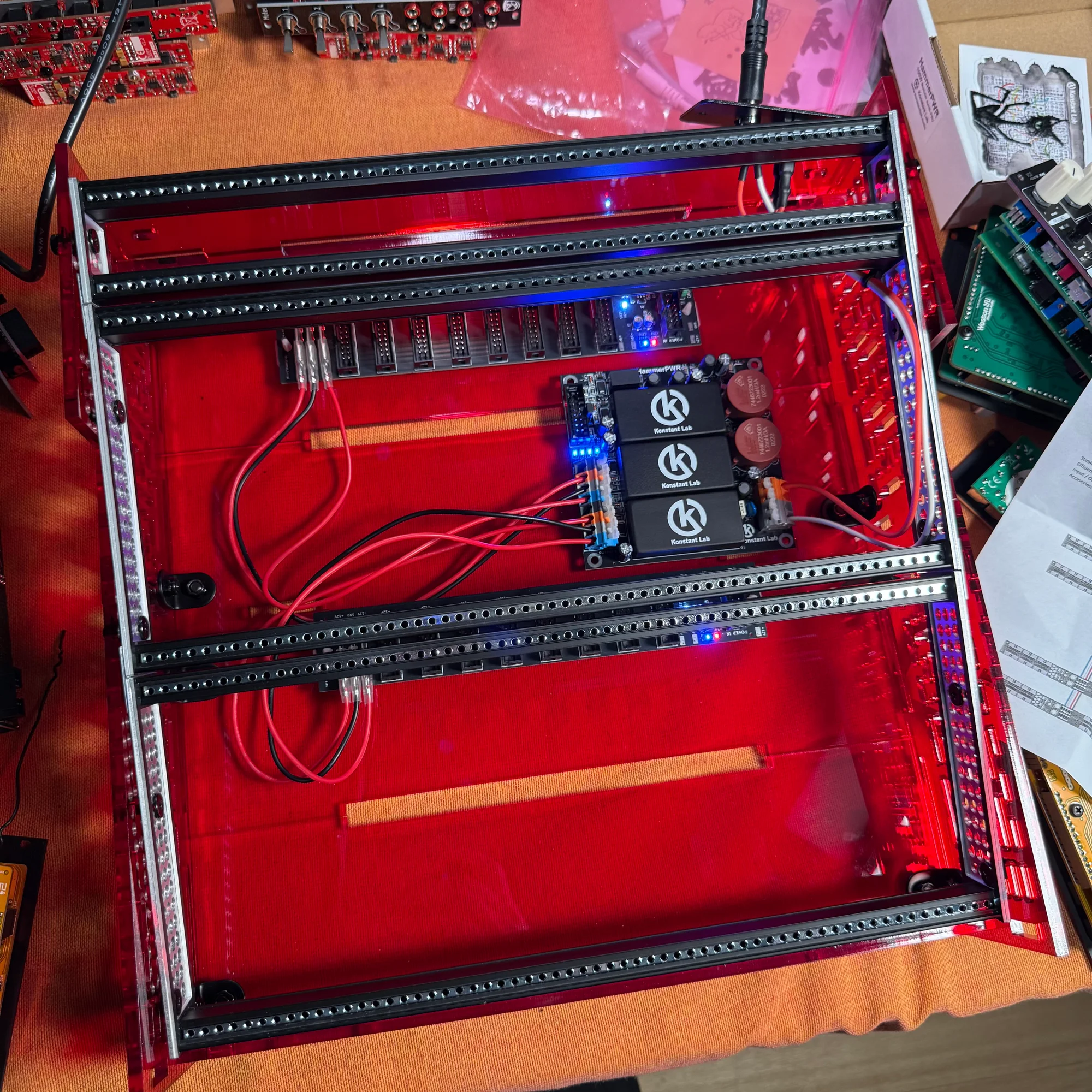
The advantage of this type, unsurprisingly, is that you have complete freedom to design your own case and setup. For example, if you have a favorite trunk case you want to fill with modules, this makes it possible. Or if your setup demands high-draw modules across the board, you can build a custom powered case tailored to your needs.
The photo shows Takazudo’s DIY case using a zudo-block-60, powered by a HammerPWR and zudo-bus.
Additionally, as mentioned earlier, noise issues can originate from the PSU’s own design — component choices, PCB layout, and so on. If you specifically want a PSU engineered with noise reduction in mind, this category may be where you end up looking.
Honestly, anyone buying a standalone PSU like these probably does not need to read this article at all. But even for beginners, it is worth knowing that these options exist in case you ever want to build your own case someday.
Danger: PSUs Without AC Adapters
An important safety note about this category: PSUs that connect directly to mains power without an AC adapter can be genuinely dangerous, potentially life-threatening.
Of these two products, the HammerPWR uses an AC adapter for power input. However, the A-100PSU3 connects directly to a household outlet and uses 100V (in Japan) AC mains power. The product manual includes prominent safety warnings. If you try to use this type of PSU without proper knowledge, you risk electrocution and serious injury. Please keep this in mind when handling power supplies.
What Happens When You Exceed PSU Capacity
Finally, let’s briefly touch on what happens when you exceed a PSU’s rated current. In practical terms, this is likely the most common power-related issue users will encounter. Are you curious about what actually happens?
When modules demand more current than the PSU’s rated capacity, one of the following four outcomes is likely:
- The AC adapter breaks or becomes temporarily unusable
- The PSU breaks or becomes temporarily unusable
- Modules operate with insufficient current
- Something catches fire, causing an accident
I have actually encountered this problem several times, having built my own power supplies. In my experience, I have destroyed two AC adapters and experienced scenario 3 on several occasions.
If you own a modular synth, you might be wondering which of these would happen to you. Unfortunately, it is difficult to predict which outcome you will get, because it depends entirely on the PSU’s design and the components it uses.
But if you have read this far, you likely already understand: the important thing is to use a PSU with sufficient current capacity. If you follow this rule, you should not encounter power-related problems.
AC adapters have electronic circuits inside those bulky brick-shaped housings on the cable. PSUs also contain electronic circuits. Inside these circuits, when the demanded current exceeds what the circuit can handle, a fuse-like component activates and shuts off the current. Which one trips first depends on the design of each. And if that fuse-like component is a one-time-use type, the device (either the AC adapter or the PSU) will be permanently damaged.
Alternatively, the PSU might regulate the current it delivers to modules — for example, supplying only 100mA to a module that requires 200mA. If you encounter this scenario, you will notice it as abnormal module behavior.
For instance, a module with a digital IC might reboot repeatedly or fail to start up entirely. An oscillator might output a sine wave with reduced amplitude or unstable behavior. In my own experience, an Envelope Generator stopped responding to Gate signals, and I eventually realized the power supply was insufficient.
The worst-case scenario is “4. Something catches fire, causing an accident.” In most cases, especially when using an AC adapter, the protection circuit should catch the problem in time. But if there is absolutely no fuse-like protection anywhere in the chain, a component could overheat excessively, melt, or even ignite. The probability is not zero.
So to avoid this problem, as mentioned above, make sure you have sufficient current headroom. You can watch for the following warning signs that you might be approaching the limit:
- The AC adapter or PSU is abnormally hot
- The system occasionally shuts down unexpectedly
- Modules are behaving differently than usual
If you observe these symptoms and they resolve when you remove some modules, that tells you the PSU was not providing enough power. In that case, consider upgrading to a larger case, or adding additional PSUs or cases.
Summary
And with that, the power supply introduction series concludes. The bottom line is: use a power supply and case that match the modules you use! But in my opinion, the real trap with modular synthesis is that you have to think about the power supply yourself…
Think about it: if you buy any ordinary synthesizer or electronic instrument, it always comes with a suitable AC adapter, right? But with modular synths, you have to figure that part out on your own.
In a way, even if you are not doing any soldering, you are sort of building a synthesizer in a DIY fashion. With that mindset, you can appreciate realizations like, “Ah, so this is how power works, and these are the things I need to watch out for!” Without that awareness, it would be natural to think, “Hmm, it’s getting really hot and keeps shutting down,” or “I added this module and now everything else is acting up — must be defective! What a piece of junk!”
So for anyone who has been thinking “I have no idea how modular synth power works,” I hope this series has helped you understand the general picture. And the takeaway: pay attention to your power!
With that said, here is what to keep in mind:
- When you buy a module, check its current draw first
- Know the rated current of your PSU
That about covers it.
That’s all for now.
Here are the previous installments: