This is an introduction to the HV1 Hybrid Oscillator by Weston Precision Audio, available at Takazudo Modular.
The HV1 Hybrid Oscillator is a hybrid VCO built on an analog triangle wave core combined with a digital phase shifter and wavetable functionality. It features thru-zero FM, linear phase modulation, wave morphing, and more, achieving both precise pitch tracking and rich harmonic generation. A next-generation oscillator module with 16-bit/150kHz high-resolution digital processing and flexible timbral changes via CV.
This product is available for purchase below.
Takazudo Modularではマニュアル等の日本語訳付きを作成し、公開しています。以下よりご参照下さい。
- Product Photos
- HV1 Hybrid Oscillator Features
- What Kind of Oscillator is the HV1?
- The Feel of the HV1
- Reference Videos
- Manual
- Technical Specifications
- Included Accessories
Product Photos
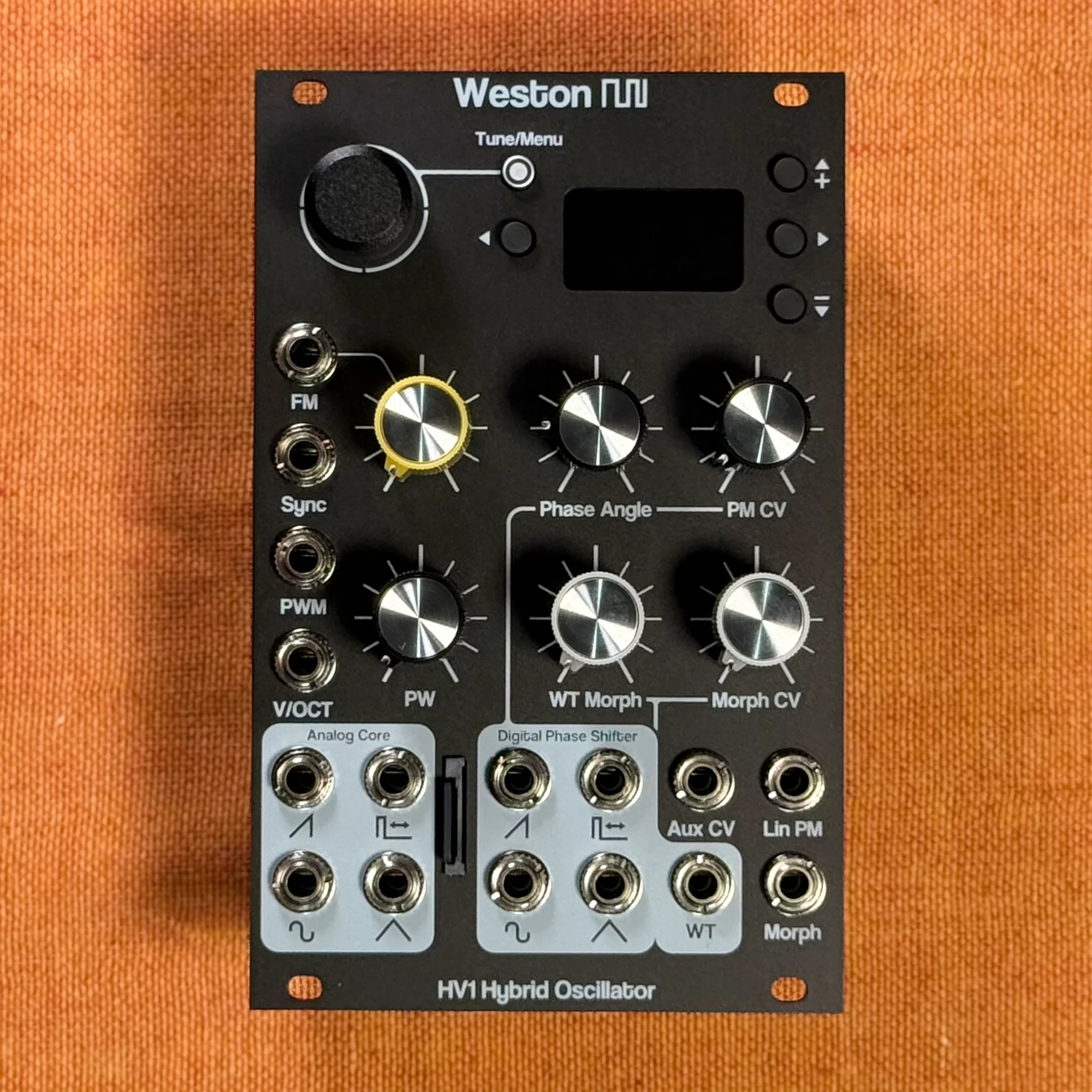
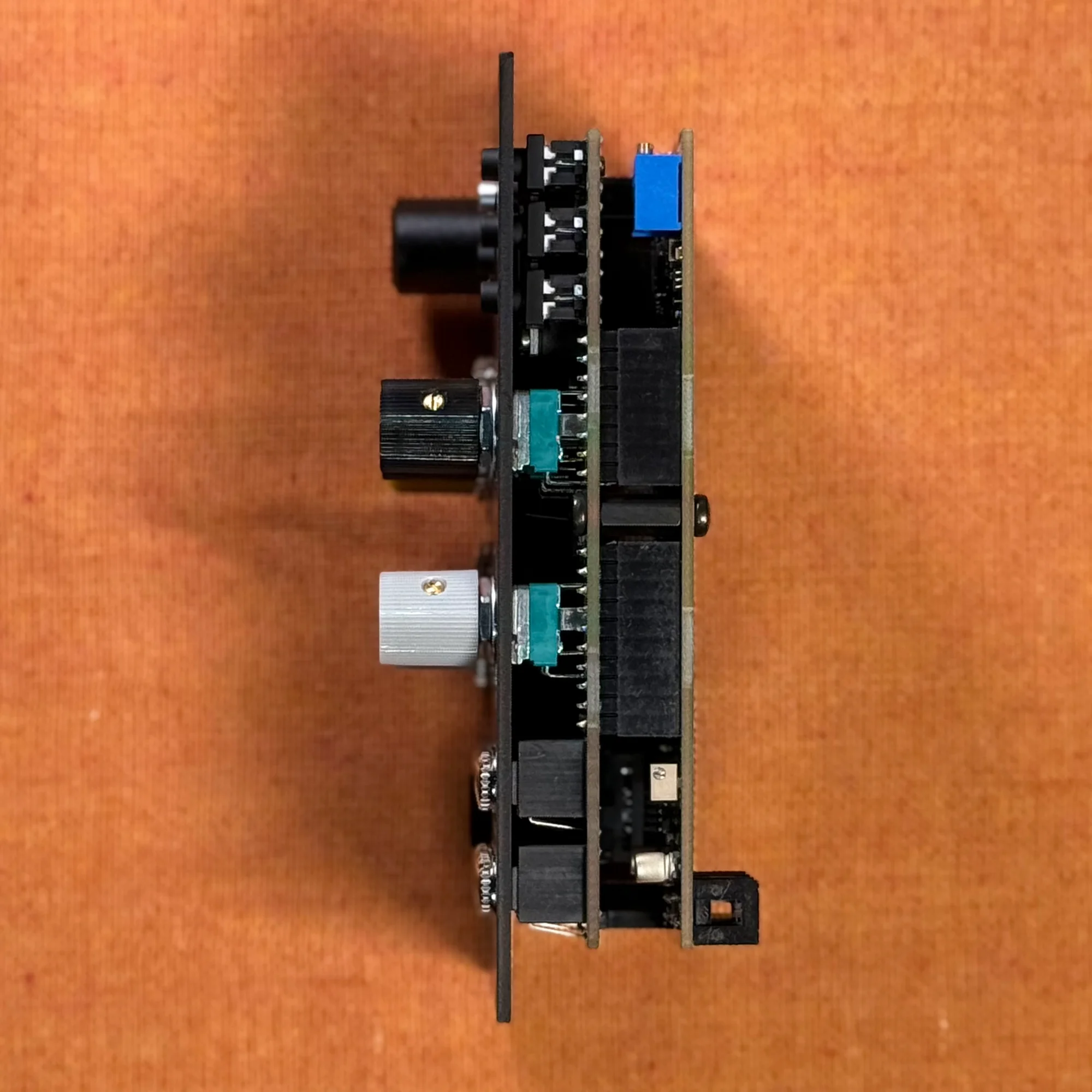
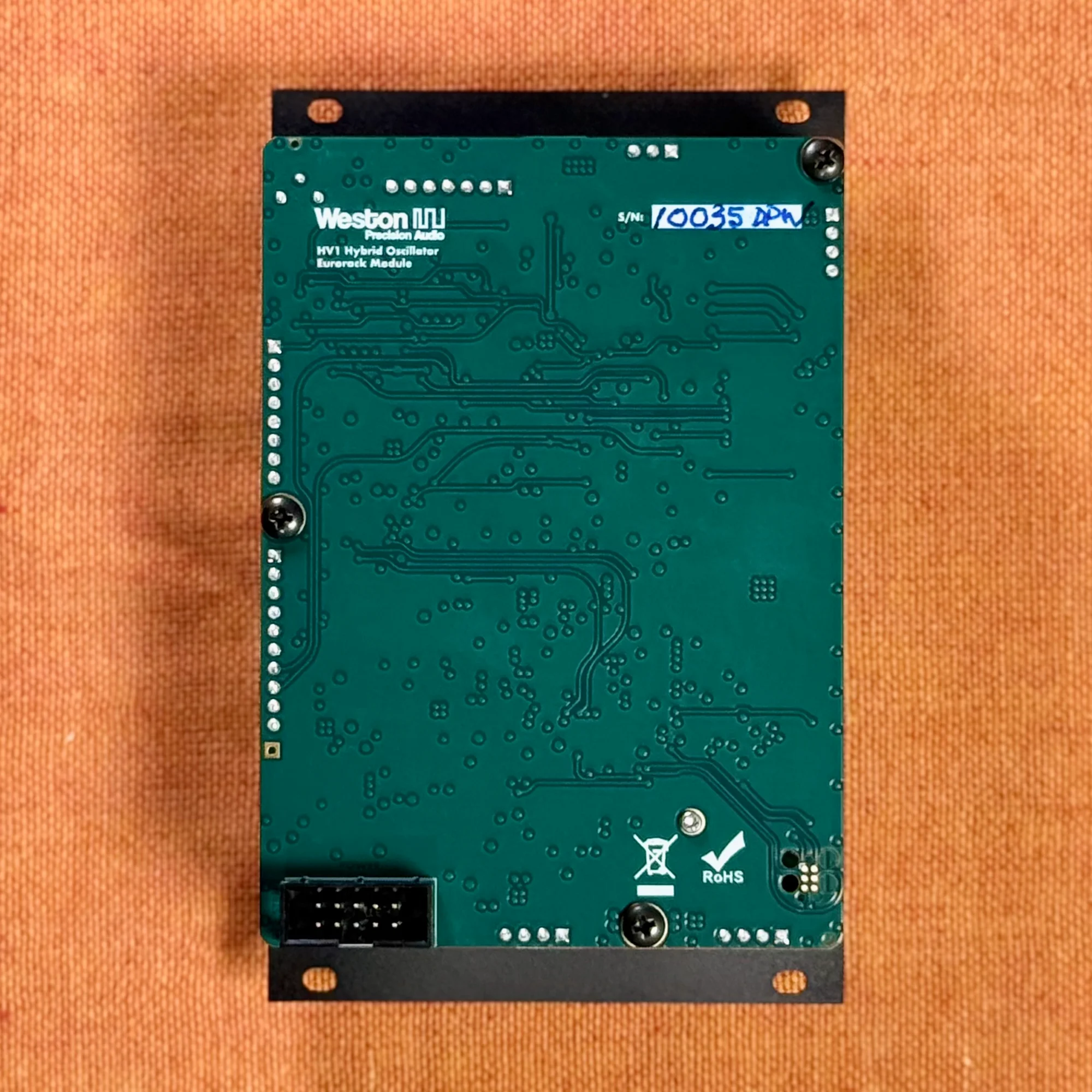
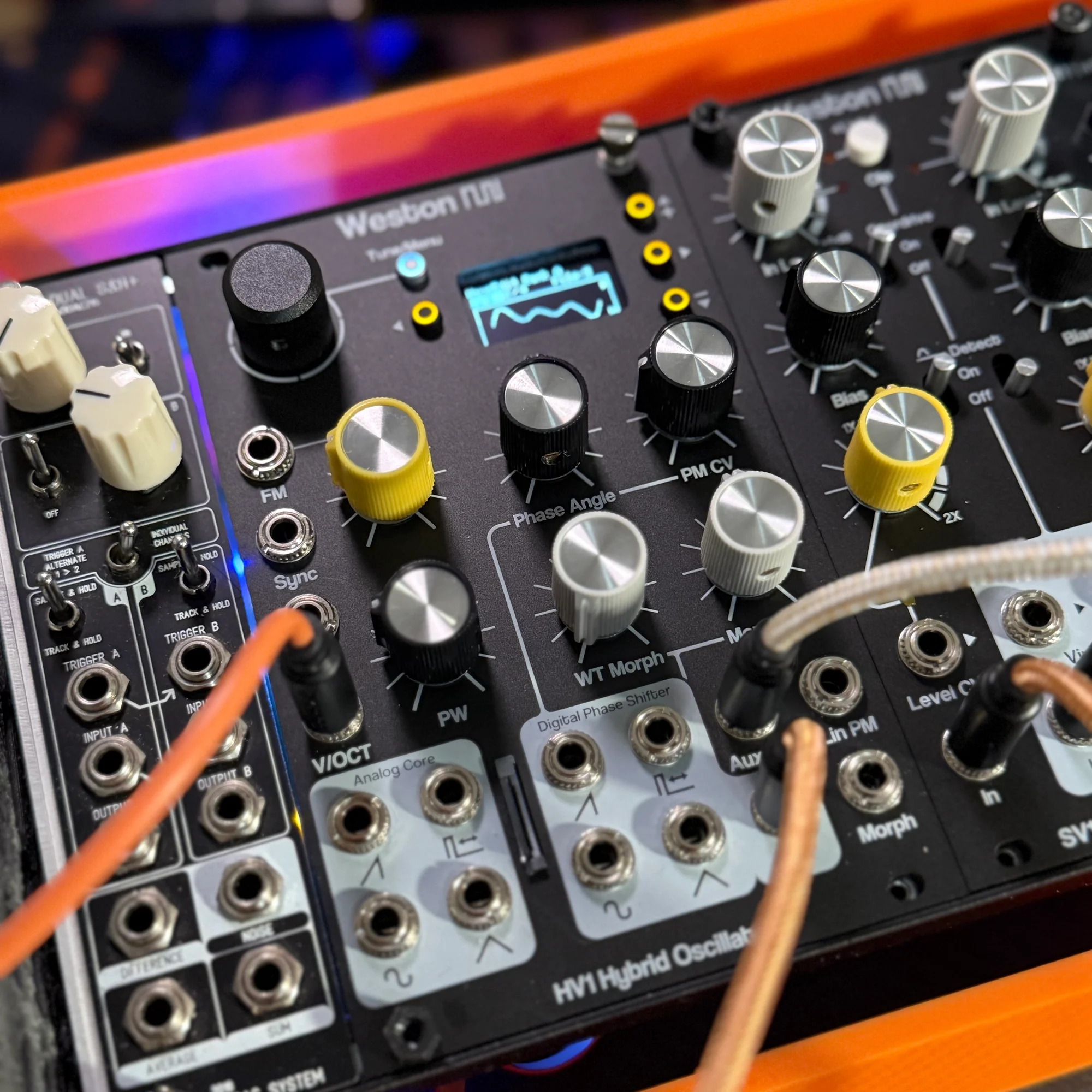
HV1 Hybrid Oscillator Features
The HV1 Hybrid Oscillator combines the best of analog and digital through its hybrid architecture, delivering the smoothness of a classic VCO and the modulation versatility of digital in a single unit. Built on an analog triangle wave core, it sends the output to a digital phase shifter, achieving both stable pitch tracking and complex waveform transformations. Additionally, it features analog outputs for sawtooth, pulse, and sine waveforms, performing well as a conventional VCO.
Phase Shifter and Digital Waveform Processing
The digital section performs modulation through phase shifting based on the triangle wave signal, enabling linear phase modulation and thru-zero FM. This allows for dynamic sonic expressions not possible with conventional analog VCOs. Output waveforms are generated at 16-bit/150kHz high resolution with anti-aliasing applied, resulting in clean, high-quality sound.
Wavetable Functionality and External Data Support
The HV1 has 16 built-in wavetable waveforms that can be morphed between. It also features a microSD card slot, allowing you to load custom waveforms created with WaveEdit or Serum. The flexibility to play externally created waveforms directly on the module is highly attractive for sound design.
Diverse CV Control and Modulation
Multiple CV inputs enable unique sound processing including phase modulation (PM), frequency modulation (FM), wave morphing, and even wavefolding and bit crushing via the AUX input. This allows for an extremely wide range of sound design starting from simple waveforms.
Usability and Interface
The front panel features an octave selector switch (8 steps) and a built-in tuner, making it easy to use in both live and studio environments. The oscillator detune function allows you to create thick sounds reminiscent of two oscillators.
Usage Examples and Applications
- As a lead sound source: Create commanding lead sounds with precise pitch stability and rich harmonics.
- As an FM/PM sound source: Achieve complex FM timbres and metallic tones through the digital section’s linear modulation.
- As a wavetable sound source: Add unique textures through custom waveform loading.
What Kind of Oscillator is the HV1?
The HV1 is essentially an oscillator based on an analog oscillator that outputs the results of various digital processing, with wavetable functionality added on top. If that sounds a bit vague, in rough terms it’s a module that packs in various digital processing capabilities related to oscillation, with the wavetable functionality being the highlight.
Here I’ll briefly explain the wavetable functionality and phase shift features.
Wavetable Synthesis
Most synthesizer oscillators, including modular ones, are designed around the approach of starting with primitive waveforms and shaping or modulating them to create sounds. Primitive waveforms mean things like sine waves, triangle waves, square waves, and sawtooth waves. However, Wavetable Synthesis takes a different approach — creating sounds based on a collection of waveforms (a wavetable) rather than primitive waveforms.
For example, the left side below shows a sine wave, and the right side shows a square wave.
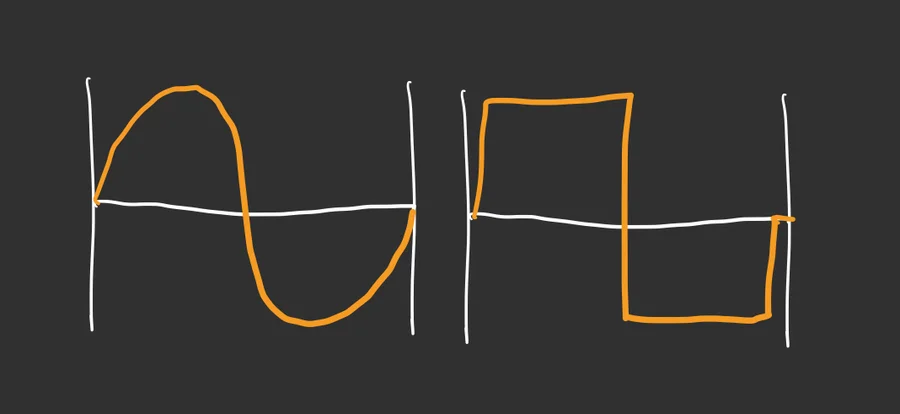
If you think about what the intermediate states between these two would look like, it would be something like the following. You can imagine a shape gradually transitioning from fully rounded to increasingly angular.
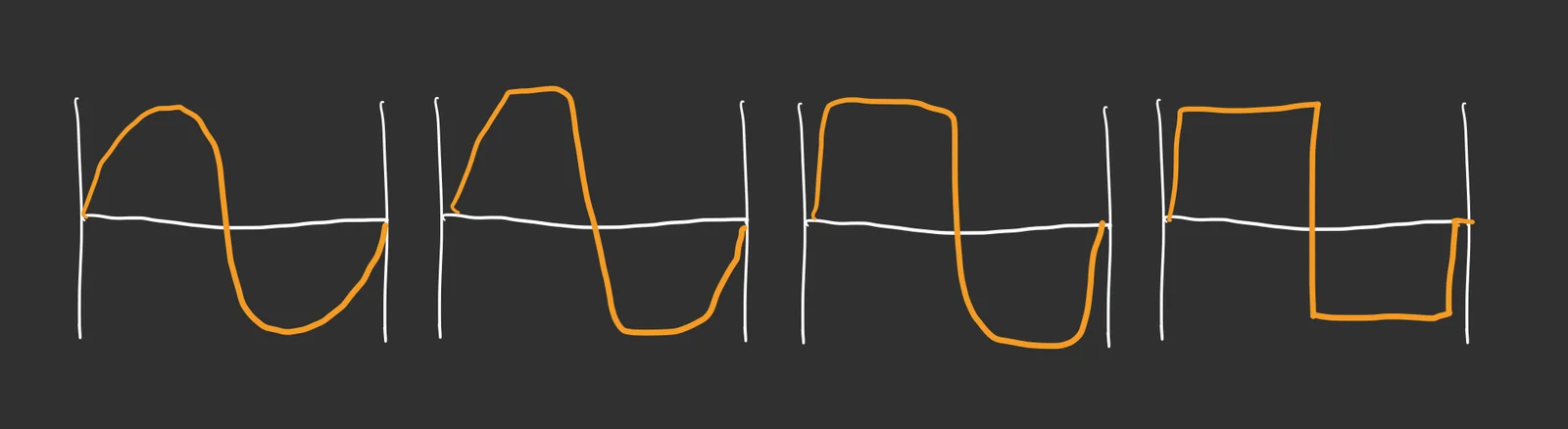
Calculating these intermediate states to generate waveforms is Wavetable Synthesis. In Wavetable Synthesis, this is done not just with two waveforms, but with larger collections of waveforms.
To see this concretely, let’s look at what it sounds like when morphing through the wavetables that come pre-loaded on the HV1. I’ve prepared the following video — please play it.
This was played by loading the data from the HV1’s SD card into WaveEdit, a wavetable editing software. You can see that quite a variety of waveforms are contained within.
The sound played in this video is exactly what you’d hear by slowly turning the HV1’s WT Morph knob. And this can also be controlled via CV input to the Morph jack.
This wavetable can register practically any waveform, and the mapping is also free. So it’s essentially like having sampling within the oscillator.
Notably, one of the most famous Wavetable synths is Serum by Xfer Records. Many wavetable patches are available for Serum, both free and paid, and the HV1 can reportedly load Serum wavetables as well. This significantly expands the timbral variety of oscillators in a modular setup.
Phase Shift Function
Another feature of the HV1 is its phase shift function. This allows the phase of the HV1’s built-in analog oscillator to be shifted through digital processing.
What happens when you shift the phase? As shown in the diagram, if the original is a sine wave, a sine wave slightly shifted forward or backward in time is generated.
What’s the result? Since the shift is a very tiny amount of time, the human ear hears it as the same sine wave playing. However, if you play the original sine wave from L (left) and the phase-shifted sine wave from R (right), something interesting happens — it sounds like reverb has been applied.
It’s not exactly reverb, but it creates a sense of stereo depth. Imagine listening to a synth playing in a room — the sound reaching your right ear and left ear arrives at slightly different times. A similar effect is achieved through this phase shift, creating a reverb-like acoustic effect. (Strictly speaking, reverb involves sound bouncing off walls repeatedly, so it’s not exactly the same.)
This is one effect achieved through phase shifting. You can also get interesting results by applying hard modulation to the phase shift (controllable via CV at the Line PM jack).
The Feel of the HV1
Weston Precision Audio has released various oscillators before, all of which have had an analog-feeling character. When I first heard they were making a digital oscillator, I was surprised. But after actually trying the finished product, I was impressed that it felt like a very analog-feeling oscillator.
This experience made me reflect on what I actually perceive as “analog-ness.” The HV1, like a typical VCO, simply outputs waveforms continuously. Various modulation options are available, and knobs and jacks to control them are provided on the front panel — that might be a big part of what creates this feeling.
For example, in our lineup, the OXI Coral also handles wavetables. OXI Coral is a powerful synth where wavetables are just one of many features, and it can play polyphonically, making it functionally richer. But honestly, I (Takazudo) had forgotten that OXI Coral even had wavetable functionality until I tried the HV1. OXI Coral has many features and flexible parameter control, but that control is primarily done via MIDI, with only a few interface elements on the panel. In contrast, an analog-feeling module has focused functionality with jacks and knobs for its parameters right on the panel — which seems to help you focus on understanding and controlling the features. (Though this also means there’s less you can do.)
In terms of other modules in our shop, this is closer to the feel of ALGO rather than Vector Wave, which can play polyphonically via MIDI.
So the HV1 is recommended for those who want to deeply explore wavetables and phase shifting! It also includes wavefolding, a tuner, and detune functions, giving it more character compared to a primitive analog VCO — while retaining that analog feel.
Reference Videos
Below is an official HV1 introduction video from Weston Precision Audio. It explains each menu item in detail, so it’s a good reference for understanding the features.
Manual
The official manual is available for download below (English only).
Technical Specifications
- Width: 16HP
- Depth: 25mm
- Power consumption: 125mA +12V / 45mA -12V / 0mA +5V
Included Accessories
- Power ribbon cable
- Screws
- Weston Precision Audio sticker
Weston Precision Audioについて
Weston Precision Audioはアメリカのノースカロライナ州で活動するモジュラーシンセメーカーです。
Weston Precision Audioのモジュールを取り扱わせて頂くことになった経緯としては、ファウンダーのDevin氏から代理店としての販売相談のメールを受け取ったのが始まりでした。そして実際のモジュールを見てみると、いずれも素晴らしい品質だと感じたことを覚えています。
氏の作るモジュールは、いずれもアナログの操作感を失わせないこだわりを感じさせ、なおかつ、実際に手に取ってみると、素材や部品へのこだわりを感じるであろうと予言します。
オマケ: 電氣美術研究會モジュラー小物セット付き

モジュラーシンセをもっと多くの方に触って欲しいという願いの元、電氣美術研究會さまにご協力頂き、モジュラー小物セットを本商品にバンドルさせて販売させていただいております。
パッチケーブルや電源ケーブル、ドレスナットのサンプルセット、モノラルスプリッターなど、内容は時期に応じて変化します。商品に同梱しますので是非お試し下さい!
That concludes our introduction of the HV1 Hybrid Oscillator.
Takazudo Modularではマニュアル等の日本語訳付きを作成し、公開しています。以下よりご参照下さい。
We hope you find this helpful.