CH224D - USB Power Delivery Controller (v1.0 Only)
USB Power Delivery protocol negotiation IC for obtaining 15V/3A power from USB-C PD chargers.
CH224D is used in v1.0 only and has been replaced by STUSB4500 in v1.1.
Reason for replacement: CH224D has poor charger compatibility (~33%). Only 2 out of 6 tested USB-PD chargers worked with CH224D. STUSB4500 is USB-IF certified with ~95%+ expected compatibility.
| Charger | CH224D (v1.0) | STUSB4500 (v1.1) |
|---|---|---|
| Anker Nano II 65W | ✅ Works | ✅ Expected |
| Anker Prime 200W | ❌ Fails | ✅ Expected |
| Elecom EC-AC67150BK | ❌ Fails | ✅ Expected |
| Digiforce Square 65W | ❌ Fails | ✅ Expected |
| CIO NovaPort SLIM 45W | ❌ Fails | ✅ Expected |
See GitHub Issue #33 for details.
CH224D does NOT have a separate VOUT pin!
- Pin 2 (VBUS) is BOTH input (initially 5V) AND output (15V after PD negotiation)
- Pin 18 is NC (Not Connected) - no separate output pin exists
- Voltage changes from 5V → 15V on the same VBUS pin after PD negotiation
- Downstream circuits connect directly to VBUS
For 15V configuration:
- Rset = 56 KΩ resistor from DRV/CFG1 junction to GND
- Pin 1 (DRV) and Pin 19 (CFG1) connected together, then through Rset to GND
- CC pull-downs required: 5.1kΩ resistors on CC1 and CC2 to GND (identifies device as USB-PD sink)
See datasheet page 4 (Section 6.1) for reference schematic.

Overview
The CH224D is a USB Power Delivery (PD) protocol controller IC manufactured by WCH (Nanjing Qinheng Microelectronics). In this project, it communicates with USB-C PD chargers to negotiate 15V output, which serves as the input voltage for the modular synthesizer power supply.
Through CFG pin configuration, it can select PD voltage profiles of 5V/9V/12V/15V/20V without requiring an external microcontroller. The compact QFN-20 package minimizes PCB footprint while achieving low cost and high reliability.
Key Specifications
| Parameter | Value | Notes |
|---|---|---|
| JLCPCB Part Number | C3975094 | |
| Manufacturer Part Number | CH224D | |
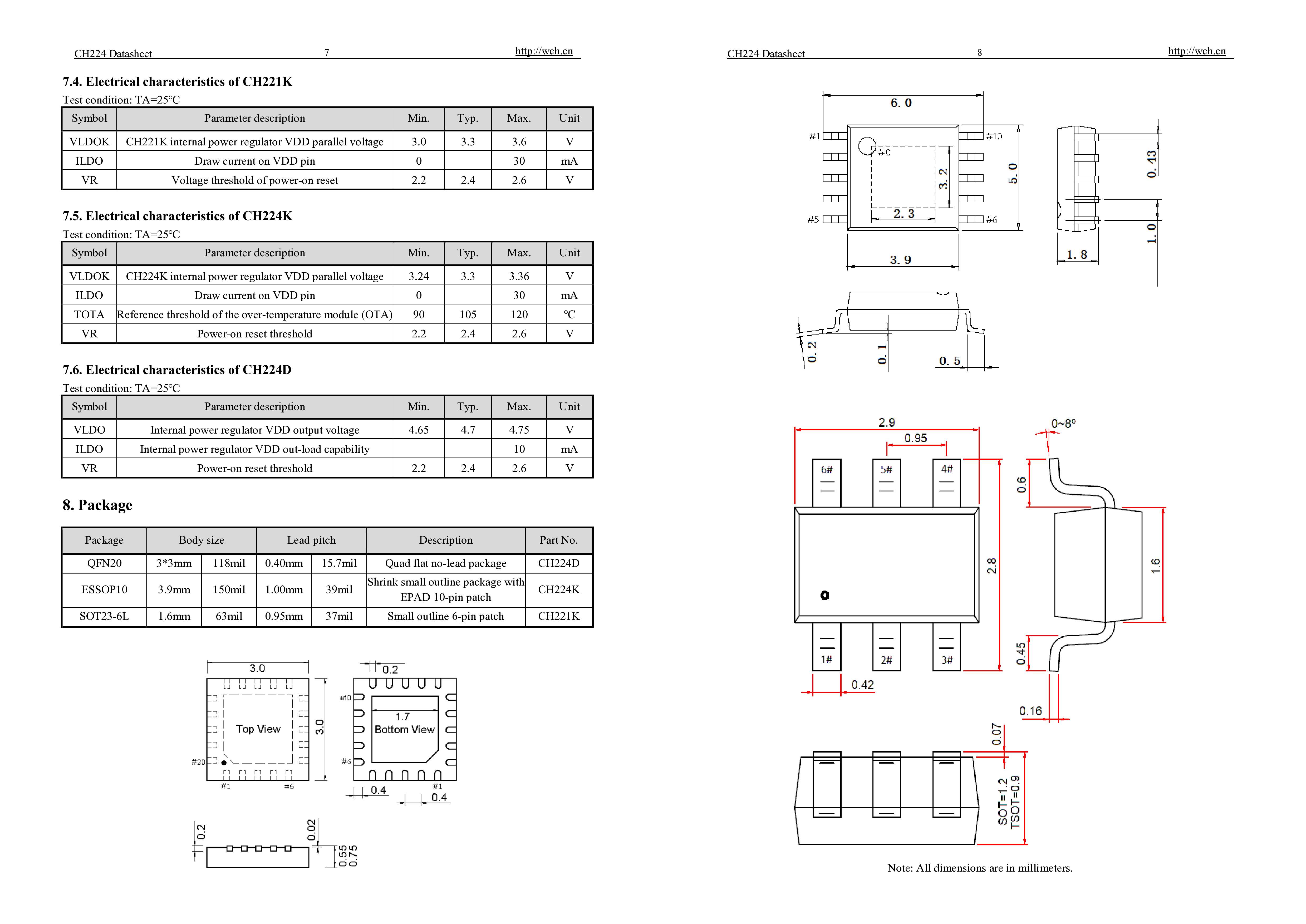
| Package | QFN-20 (3mm × 3mm) | Surface-mount |
| Stock Availability | 2,291 units | Good availability |
| Unit Price | $0.36 | JLCPCB pricing |
| Input Voltage Range | 4V - 22V DC | From USB-C VBUS |
| Output Voltage Options | 5V / 9V / 12V / 15V / 20V | PD negotiated |
| Maximum Current | 3A | Depends on PD source capability |
| PD Protocol Support | USB PD 2.0 / 3.0 | |
| Configuration Method | Resistor-based CFG pins | No MCU required |
| Operating Temperature | -40°C to +100°C |
Pin Configuration
          CH224D (QFN-20)
           Top View
    ┌─────────────────────────┐
    │                         │
DRV │1                    20│ (Reserved)
VBUS│2                    19│ CFG1
    │3                    18│ NC (Not Connected)
    │4                    17│ (Reserved)
GATE│5                    16│ (Reserved)
    │                       │
NMOS#│6                   15│ ISN
VDD │7                    14│ ISP
DP  │8                    13│ CFG2
DM  │9                    12│ CFG3
CC2 │10                   11│ CC1
    │    ┌──────────┐        │
    └────┤ Exposed  ├────────┘
         │ Pad (0)  │
         │   GND    │
         └──────────┘

**CRITICAL**: Pin 11 = CC1, Pin 10 = CC2 (not the other way around!)
Note: QFN-20 numbering goes counter-clockwise from pin 1. Pin 0 refers to the exposed pad (EPAD) which must be connected to GND for thermal dissipation.
Pin Descriptions
| Pin | Name | Function | Connection in Design |
|---|---|---|---|
| 0 (EPAD) | GND | Ground / Thermal pad | System ground plane |
| 1 | DRV | Weak driving output for configuration resistor | Connected to CFG1 (pin 19), then through Rset (56kΩ) to GND |
| 2 | VBUS | Power I/O (input 5V → output 15V after PD) | USB-C connector VBUS (initially 5V, becomes 15V after negotiation) |
| 5 | GATE | Internal NMOS gate driver | Internal connection only (no external connection) |
| 6 | NMOS# | External NMOS control | Tied to GND (enables internal switch mode) |
| 7 | VDD | Internal voltage regulator output (4.7V) | 1µF decoupling capacitor to GND |
| 8 | DP | USB D+ data line (UDP) | Shorted to pin 9 (DM) for PD-only mode |
| 9 | DM | USB D- data line (UDM) | Shorted to pin 8 (DP) for PD-only mode |
| 10 | CC2 | USB Type-C Configuration Channel 2 | USB-C connector CC2 + 5.1kΩ pull-down to GND |
| 11 | CC1 | USB Type-C Configuration Channel 1 | USB-C connector CC1 + 5.1kΩ pull-down to GND |
| 12 | CFG3 | Voltage configuration pin 3 (digital input) | Open (no connection) |
| 13 | CFG2 | Voltage configuration pin 2 (digital input) | Open (no connection) |
| 14 | ISP | Current sense positive | Shorted to pin 15 (ISN), then to GND (not using current sensing) |
| 15 | ISN | Current sense negative | Shorted to pin 14 (ISP), then to GND (not using current sensing) |
| 18 | NC | Not Connected (no separate output pin!) | No connection - VBUS (pin 2) is the output! |
| 19 | CFG1 | Voltage configuration pin 1 (analog input) | Connected to DRV (pin 1), then through Rset (56kΩ) to GND |
Voltage Configuration - Resistance Mode
The CH224D supports two configuration modes. This design uses Resistance Configuration Mode (simpler, no MCU needed).
Resistance Configuration Mode (Recommended)
Circuit Topology:
DRV (Pin 1) ──┬── CFG1 (Pin 19)  ← These pins connected together
              │
            R11 (Rset = 56kΩ, 0603, ±0.1%)
              │
             GND

CFG2 (Pin 13) ─── Open (or GND)
CFG3 (Pin 12) ─── Open (or GND)

How it works:
1. DRV pin provides weak drive output
2. Resistor value determines voltage at CFG1
3. CH224D reads CFG1 voltage to determine requested voltage
Resistor Values (Rset):
| Rset Value | Requested Voltage |
|---|---|
| 6.8 KΩ | 9V |
| 24 KΩ | 12V |
| 56 KΩ | 15V ✅ This design |
| NC (Not Connected) | 20V |
This Design Configuration:
- Rset = 56 KΩ from DRV/CFG1 junction to GND
- DRV (Pin 1) connects to CFG1 (Pin 19)
- CFG1 and DRV junction connects through Rset (56kΩ) to GND
- CFG2 = Open (or GND)
- CFG3 = Open (or GND)
- Result: CH224D negotiates 15V from PD adapter
Application Circuit
USB-C Connector (6-pin):
┌─────────────────────────────┐
│  2, 5  VBUS  ───────────────┼──→ VBUS Rail (5V initially, 15V after PD)
│                             │
│  3     CC1   ───────────────┼──→ To CH224D CC1
│  4     CC2   ───────────────┼──→ To CH224D CC2
│                             │
│  1, 6  GND   ───────────────┼──→ System GND
└─────────────────────────────┘

CH224D IC (QFN-20) - USB PD Sink Controller:
                    ┌──────────────────────────────┐
VBUS (5V→15V) ──────┤ 2. VBUS (Power I/O)          │
                    │                              │
                 ┌──┤11. CC1 (PD Comm)             │──→ To USB-C CC1
                 │  │10. CC2 (PD Comm)             │──→ To USB-C CC2
                 │  │                              │
                 │  │ 1. DRV  ──┬──────────────────│
                 │  │19. CFG1 ──┘                  │
                 │  │13. CFG2 ── Open              │
                 │  │12. CFG3 ── Open              │
                 │  │                              │
                 │  │ 8. DP   ──┬──────────────────│  ← SHORT together
                 │  │ 9. DM   ──┘                  │  ← (PD-only mode)
                 │  │                              │
                 │  │ 7. VDD (4.7V LDO)            │──→ C30 (1µF) ──→ GND
                 │  │                              │
                 │  │ 5. GATE (Internal Switch)    │ ── NC (internal use only)
                 │  │ 6. NMOS# (Ext Switch Ctrl)   │──→ GND (not using ext)
                 │  │                              │
                 │  │14. ISP (Current Sense +) ──┬─│
                 │  │15. ISN (Current Sense -) ──┘ │──→ GND (not using)
                 │  │                              │
                 │  │18. NC (Not Connected)        │──→ No connection
                 │  │                              │
                GND │ 0. GND (EPAD)                │
                    └──────────────────────────────┘

CRITICAL: VBUS is both input AND output!
- Initially: VBUS = 5V (default USB)
- After PD negotiation: VBUS = 15V (requested voltage)
- Pin 18 is NC - NO separate output pin!
- Downstream circuits connect directly to VBUS

Input Filter Capacitors (on VBUS rail):
J1 VBUS ──┬────────────────┬─── CH224D pin 2 (VBUS) ──→ +15VOUT (to DC-DC stages)
          │                │
         C1               C2
       10µF            100nF
   electrolytic       ceramic
    (farther)        (CLOSE!)
          │                │
         GND              GND

VDD Decoupling (Internal 4.7V Regulator):
VDD (pin 7) ─── C30 (1µF) ──→ GND  (Close to IC)

CC Pin Pull-down Resistors (USB-PD Sink Identification):
CC1 (pin 11) ───┬─── R12 (5.1kΩ) ──→ GND
                │
                └──→ To USB-C CC1 (pin 3)

CC2 (pin 10) ───┬─── R13 (5.1kΩ) ──→ GND
                │
                └──→ To USB-C CC2 (pin 4)

Note: 5.1kΩ pull-downs identify device as USB-PD sink (power consumer)

Voltage Configuration (15V Selection via Rset):
DRV (pin 1) ──┬── CFG1 (pin 19)  ← These pins connected together
              │
             R11 (Rset = 56kΩ, 0603, ±0.1%)
              │
             GND
Connection List
Power Rail (VBUS):
USB-C VBUS (pins 2, 5)→CH224D pin 2 (VBUS)→VBUS Rail- Initially: VBUS = 5V (default USB voltage)
- After PD negotiation: VBUS = 15V (requested voltage)
- This SAME pin serves as power output to DC-DC converters
CC Communication Lines (USB-PD Protocol):
USB-C CC1 (pin 3)→CH224D pin 11 (CC1)→R12 (5.1kΩ)→GNDUSB-C CC2 (pin 4)→CH224D pin 10 (CC2)→R13 (5.1kΩ)→GND- Critical: 5.1kΩ pull-downs (Rd) identify device as USB-PD sink
Ground:
USB-C GND (pins 1, 6)→System GND→CH224D pin 0 (EPAD)(thermal pad)
Input Filter Capacitors:
C1 (10µF/25V electrolytic):VBUS⟷GND(bulk filtering)C2 (100nF ceramic):VBUS⟷GND(high-freq decoupling, close to IC)
VDD Decoupling (Internal 4.7V Regulator):
C30 (1µF ceramic):VDD (pin 7)⟷GND(internal regulator output)
Voltage Configuration (15V Selection):
CH224D pin 1 (DRV)→ Connected topin 19 (CFG1)CFG1→R11 (56kΩ, ±0.1%)→GNDCH224D pin 13 (CFG2)→OpenorGNDCH224D pin 12 (CFG3)→OpenorGND
PD-Only Mode Configuration:
CH224D pin 8 (DP)↔pin 9 (DM)- Shorted together (disables BC1.2 and other USB data protocols)- Why short DP to DM? 6-pin USB-C connector has no DP/DM pins. Per datasheet, we must short DP to DM on CH224D to use PD-only mode.
CH224D pin 18- NC (Not Connected in datasheet)
Internal Switch Configuration:
CH224D pin 5 (GATE)- Drives internal NMOS gate (no external connection)CH224D pin 6 (NMOS#)→GND(enables internal switch mode, disables external MOSFET control)
Current Sensing Configuration:
CH224D pin 14 (ISP)↔pin 15 (ISN)- Shorted together →GND- Not using current sensing feature (CH224D provides overcurrent protection internally)
Component Values
Input Capacitors
| Reference | Value | Type | Voltage | Package | Part Number | Purpose |
|---|---|---|---|---|---|---|
| C1 | 10µF | Electrolytic | 25V | - | - | VBUS bulk filtering (farther from IC) |
| C2 | 100nF | Ceramic X7R | 25V | 0603 | - | VBUS high-freq decoupling (CLOSE to IC) |
VDD Decoupling Capacitor
| Reference | Value | Type | Voltage | Package | Part Number | Purpose |
|---|---|---|---|---|---|---|
| C30 | 1µF | Ceramic X5R | 16V | 0603 | C6119849 | VDD internal regulator decoupling (close to pin 7) |
Configuration Resistor
| Reference | Value | Tolerance | Package | Part Number | Purpose |
|---|---|---|---|---|---|
| R11 (Rset) | 56kΩ | ±0.1% | 0603 | C705785 | 15V voltage configuration |
CC Pull-down Resistors (CRITICAL!)
| Reference | Value | Tolerance | Package | Part Number | Purpose |
|---|---|---|---|---|---|
| R12, R13 | 5.1kΩ | ±1% | 0603 | C23186 | USB-PD sink identification (Rd pull-downs on CC1, CC2) |
CRITICAL: R12 and R13 are REQUIRED for USB-PD operation! Without these 5.1kΩ pull-downs on CC1 and CC2, the PD adapter will not recognize the device as a sink and PD negotiation will fail.
Note on Status Indication: CH224D does not have a Power Good (PG) output pin. Power supply status is indicated by the output stage LEDs (LED2, LED3, LED4 on +12V, +5V, -12V rails) which confirm the entire power chain is operational.
Design Considerations
USB-C PD Negotiation Process
The CH224D follows this sequence:
- Initial Connection (0-100ms):
- USB-C connector makes physical contact
- VBUS initially at 5V (default USB power)
- CH224D detects CC1/CC2 orientation via 5.1kΩ pull-down resistors
- Critical: Without R12/R13 pull-downs, PD adapter won't recognize device as sink!
- Capability Discovery (100-200ms):
- CH224D requests available voltages via CC communication
- PD Adapter responds: 5V, 9V, 12V, 15V, 20V profiles
- Voltage Request (200-300ms):
- CH224D requests 15V (based on R11 = 56kΩ configuration)
- Reads CFG1 voltage to determine which voltage to request
- Acceptance & Voltage Transition (300-1000ms):
- PD Adapter accepts request
- VBUS transitions: 5V → 15V on the SAME pin (pin 2)!
- CH224D internal switch passes negotiated voltage through
- Power Ready (>1000ms):
- VBUS stable at 15V
- System can draw up to 45W (15V × 3A)
- Power supply ready for use
Configuration Resistor Selection
Critical: Rset must be a precision resistor (±0.1% or better) to ensure correct voltage selection.
- 56kΩ ±0.1%: Selects 15V reliably
- Other tolerances: May cause incorrect voltage negotiation or selection failure
- Part: RT0603BRD0756KL (JLCPCB C705785)
Layout Recommendations
- VBUS Input Caps: Place C1 and C2 as close as possible to pin 2 (VBUS)
- VDD Decoupling: Place C30 ceramic capacitor very close to pin 7 (VDD)
- Ground Plane: Connect EPAD (pin 0) to ground plane with multiple vias
- Thermal: EPAD provides thermal dissipation - use solid ground connection
- CC Lines: Keep CC1/CC2 traces away from switching noise sources
- Rset Placement: Place R2 (Rset) close to DRV/CFG1 junction for clean analog signal
Troubleshooting
| Symptom | Possible Cause | Solution |
|---|---|---|
| No PD negotiation at all | Missing CC pull-downs R12, R13 | CRITICAL: Add 5.1kΩ resistors on CC1, CC2 to GND! |
| No PD negotiation | NMOS# not tied to GND | Verify pin 6 (NMOS#) connected to GND |
| No PD negotiation | DP-DM not shorted | Short pins 8 (DP) and 9 (DM) together for 6-pin connector |
| No 15V output | Rset value incorrect | Verify R11 = 56kΩ ±0.1% |
| No 15V output | CFG1/DRV/Rset topology wrong | Check: DRV-CFG1 junction, then Rset to GND (NOT from VBUS!) |
| Stuck at 5V | PD adapter doesn't support 15V | Try different PD adapter with 15V capability |
| Intermittent negotiation | Inadequate VBUS capacitance | Check C1 (10µF bulk), C2 (100nF ceramic) placement |
| Overheating | Poor thermal connection | Improve EPAD ground connection with multiple vias |
| Wrong CC orientation detection | Incorrect CC1/CC2 pin assignment | Verify CC1=pin 11, CC2=pin 10 (not reversed!) |